



Conflict is something we all face, but I’m guessing that very few of us enjoy it.
And when it comes to family businesses, conflict usually feels even more uncomfortable and personal. Important relationships, emotions, and the business itself are tightly connected, which makes it hard to address disagreements.
But avoiding conflict can slow you down and hurt everyone involved.
So, let’s talk about why we avoid conflict, what it costs us – and how we can get better at dealing with it in a productive way.
I Learned the Hard Way
Please know that I’m not speaking from a place of perfection – in fact, I’ve been there myself when it comes to avoiding conflict. Early in my career, I managed someone going through some tough personal issues.
Out of empathy, I avoided confronting them about how their distractions were affecting their work. But over time, their behavior started frustrating the whole team – others on the team were being pulled into their personal drama.
By the time I finally addressed it, the conflict had grown – not just with the employee but also with the rest of my team, who felt let down by my lack of action.
They weren’t getting from me what they needed to do their jobs.
I learned the hard way that delaying tough conversations doesn’t help anyone – I could have proactively addressed conflict with one person in the beginning, but by waiting, I ended up managing conflict within the whole team.
Why Do We Avoid Conflict?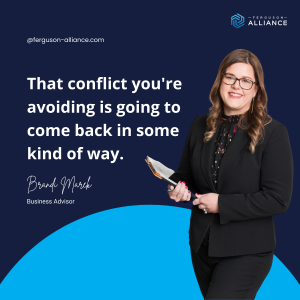
There are a few common reasons we shy away from addressing conflict– see if any of these sound familiar:
- We care too much: We don’t want to risk upsetting a relationship we’ve worked hard to build. It’s easier to hope the issue will just fix itself over time – we don’t want to rock the boat. Given enough time, we feel sure others will come to see the issue the same way we do.
- It’s uncomfortable: Let’s face it, no one likes the tension that comes with difficult conversations.
- We’re scared: What if they get defensive? What if the situation gets worse? Our minds love to create all kinds of worst-case-scenario stories, and that fear keeps us stuck.
But here’s the thing: avoiding conflict doesn’t make it go away.
Whatever you’re ignoring now will probably come back later – and it’ll show up in a bigger and messier way.
The High Cost of Avoiding Conflict
When we avoid conflict, there are real consequences, even if they aren’t obvious right away. Here are just a few you can expect:
- Unresolved conflict slows everything down: Problems don’t just go away – they linger and hold up organizational progress. Whatever you’re pushing off, whatever you’re avoiding, whatever you’re hoping is going to course-correct all by itself, is usually going to come back in a worse kind of way.
- Unresolved conflict damages relationships: If you address an issue with someone early on, they have a chance to change their behavior and for your relationship to grow stronger. But the longer you wait, the more resentment builds up and trust begins to crumble.
- Unresolved conflict creates awkwardness: Even if you’re not talking about it, everyone feels the tension, which makes it difficult to work together. And those who are outside of the relationship, without your emotional attachments, can quickly grow frustrated with your failure to act.
- Unresolved conflict escalates problems: A small misunderstanding can turn into a massive issue if left unchecked.
Conflict Handling Advice from a Conflict-Avoidant Person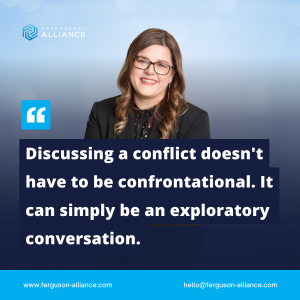
We know conflict is going to happen, but we need to practice ways to manage it without letting it spiral out of control.
I want to share with you some things I tell myself – because I recognize that I’m a conflict-avoidant person. Here they are:
- Face it, even if you’re scared: You’ll feel uncomfortable – that’s normal. Acknowledge your fear. Then have the tough conversation anyway.
- Deal with conflict early: It’s much easier to address an issue when it’s small than to untangle a big, messy, deeply rooted conflict later on.
- Be curious: Don’t go in assuming you know everything. Try to fully understand the situation, not just your own point of view. Start with understanding others’ perspectives. Ask questions like, “Can you walk me through what happened?”
- Recognize that conflict can be healthy: Tackling disagreements can strengthen relationships and make future conversations that much easier.
- Remind yourself that practice makes perfect: Resolving conflict is a skill, and the more you do it, the better you’ll get.
- Listen more than you talk: This one’s very hard for me, but I recognize its wisdom. People need to feel heard. Listening can diffuse tension and create space for others to offer solutions.
Conflict in a family business doesn’t have to be destructive – in fact, it can be healthy and productive.
As a business leader, you can’t avoid the discomfort of conflict, but you can learn to manage it for the sake of your family and your business.
By addressing conflict head-on, you can turn disagreements into opportunities for growth and stronger relationships.
So, the next time you sense an issue, trust your gut and start the conversation. I think you’ll be glad you did.
Would you like some support addressing conflict within your organization? We’d love to help. Reach out today to one of our trusted family business advisors.