



When Your Child Doesn’t Want to Take Over the Family Business
This is one of the most emotionally charged conversations we witness in our work.
You’ve spent years, maybe decades, building something.
And somewhere along the way, a picture formed in your mind of having your son or daughter carry it forward.
Then they sit down with you and say they want to do something else entirely.
That moment lands hard.
And it should.
Because it’s a real loss, and it deserves to be treated like one.
But here’s what we want you to know: this doesn’t have to be a crisis.
With the right mindset and the right plan, it can actually be a turning point that makes your business (and your family) stronger.
Watch the video below, or scroll down to read the highlights.
The Emotions Are Real. All of Them.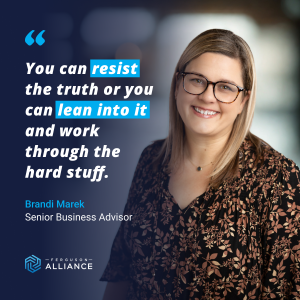
When a child steps away from the business, there are layers to what a parent feels.
There’s the practical concern: who leads this thing now?
And underneath that is something much more personal.
This business was likely a dream you had before your kids were even born.
Watching that particular version of the future not come to fruition is a grief worth acknowledging.
And from your child’s side?
It’s rarely as simple as just wanting to go do something else.
In my experience (and I’m speaking from personal experience here, not just professional) the next generation is often carrying a significant fear of being a disappointment.
Not only to the family, but to the non-family employees who’ve been there for years and who are watching.
I know because I lived it.
I spent fourteen years in my husband’s family business, working my way into leadership and genuinely loving much of it.
But over time, I knew I wanted something different.
I sat with that feeling for a long time before I ever said it out loud. Partly because I wasn’t sure, and partly because I didn’t want to let anyone down.
What I eventually learned is this: if something is genuinely true for you, it stays with you.
I gave it real thought, and the feeling didn’t go away.
So I chose honesty.
I told my family and the people I worked alongside that life is short, and I wanted to pursue a new chapter.
And you know what?
No one was disappointed.
Everyone was genuinely excited for me.
You can resist that kind of truth, or you can lean into it and work through the hard stuff.
The path forward is always clearer on the other side of an honest conversation.
The Strategic Decision That Changes Everything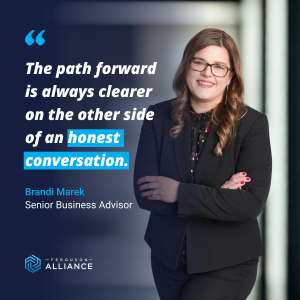
Here’s where we want to shift gears a little, because there’s a business decision that shapes how all of this plays out.
And many families haven’t made it explicitly.
Have you decided whether you’re a business-first family or a family-first business?
In a family-first business, family involvement in leadership tends to be assumed.
It’s tradition, it’s expectation, it’s just how things work.
And when a child steps away from that model, it feels like a crisis.
Because in that framework, it kind of is.
A business-first family operates differently.
It puts the best interests of the business first, including the question of who is the right person to lead it.
Leadership succession is based on qualification, passion, and readiness.
Not on whose last name is on the door.
When a family commits to that philosophy (and I mean really commits, not just agrees to it in principle) it opens up options that weren’t visible before.
It means a strong non-family leader can step in and carry the business forward.
It means your child can pursue their own path without leaving a vacuum behind.
And it means your employees have confidence that the business is in good hands regardless of what happens in the family.
We’ve seen this play out firsthand.
When a non-family leader is already in place and the business-first philosophy is established and communicated to the team, it actually makes it easier for a next-generation family member to make a graceful exit.
There’s no guilt, no scramble, no sense that the whole thing is falling apart.
Everyone already knows the business is built to run on its merits.
Three Conversations You Need to Have
One of the most common mistakes we see families make in this situation is treating succession as one big, tangled conversation when it’s actually three separate ones.
- Who will lead the business?
- Who will own it?
- How will wealth transfer across generations?
These questions are connected, but they’re not the same. Trying to solve them all at once is a recipe for confusion and conflict.
A child who doesn’t want to run the business may still want to retain an ownership stake.
Or they may want a clean break.
Those are very different outcomes that require very different plans.
Working through each conversation on its own, and then looking at how they fit together, is what allows you to build a plan that isn’t just equal, but equitable.
Equal and equitable are not the same thing, and in family business succession, equitable is almost always the right goal.
Nobody Wins When Someone Is Half In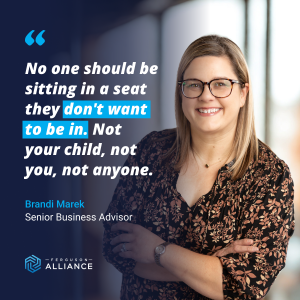
I’ll say this as directly as I can: no one should be sitting in a seat they don’t want to be in.
Not your child, not you, not anyone.
I’ve seen what happens when a family member stays out of obligation rather than genuine passion.
It affects the energy in the room.
It affects morale.
It affects the non-family employees around them, who notice the dynamic even when nothing is said out loud.
And ultimately, it affects the business itself.
The goal is to find a path where everyone is operating in a role that genuinely fits them. One where they feel fulfilled and purposeful, and where the business has the leadership it needs to thrive.
That’s not an impossible combination.
But it takes intentional planning, and it takes honesty about what everyone actually wants.
Please Don’t Wait. Start the Conversations Now.
If you’re reading this and the situation feels familiar, I’d encourage you to start the conversation sooner rather than later.
These things don’t get easier with time and the businesses that navigate succession well are almost always the ones that started planning long before they needed to.
That means having the conversations about leadership, ownership, and wealth.
It means being honest with your family about your vision and genuinely listening to theirs.
It means deciding clearly and explicitly what kind of family you want to be when it comes to your business.
And if those conversations feel too hard to have alone, that’s what we’re here for.
Sometimes it just takes having someone in the room who isn’t part of the family to help you move through the feelings and toward a real path forward.
The goal isn’t just to protect the business.
It’s to protect the family, too.
And with the right approach, you really can do both.
If you’re navigating a succession situation — whether a child is stepping away or you’re just beginning to think about the future — I’d love to talk.
Free Family Business Succession Guide and Checklist
Many owners are surprised that a succession plan touches almost every part of the business and the family.
In this e-book, we outline everything you need to create a succession plan that sets your family up for generations.
- A breakdown of the 3 separate transitions you need to plan for:
- Succession of wealth
- Succession of ownership
- Succession of leadership
- A full checklist of everything you need to do and prepare
- Explanations of the process and definitions of common succession planning terms
- Answers to frequently asked questions about succession planning
If you're struggling to create a succession plan or wondering where to start, we created this guide for you.
Enter your email address below and we'll send you a copy.
~ Rob