


Having spent a significant part of my career in the horticultural industry, I can’t help but notice the parallel between businesses and trees.
Trees can live for hundreds of years.
The oldest tree on record is said to be more than 5,000 years old.
Some trees, like a dogwood, grow quickly and live shorter lives than the mighty oaks.
So even though two trees may be the same age, they can be in very different stages of life.
Family businesses are the same.
They have the potential to live for generations.
Did you know there are roughly 5,500 companies in the world that are more than 100 years old?
And like a tree, every business moves through a natural, predictable lifecycle.
When you know where your company sits on that curve, you can predict the problems you’re going to face and how to deal with them before they catch you off guard.
The Family Business Lifecycle
Every business follows a predictable life cycle shaped by two factors: the rate of growth and the length of time.
Plot time on the horizontal axis and growth on the vertical, and a curve takes shape.
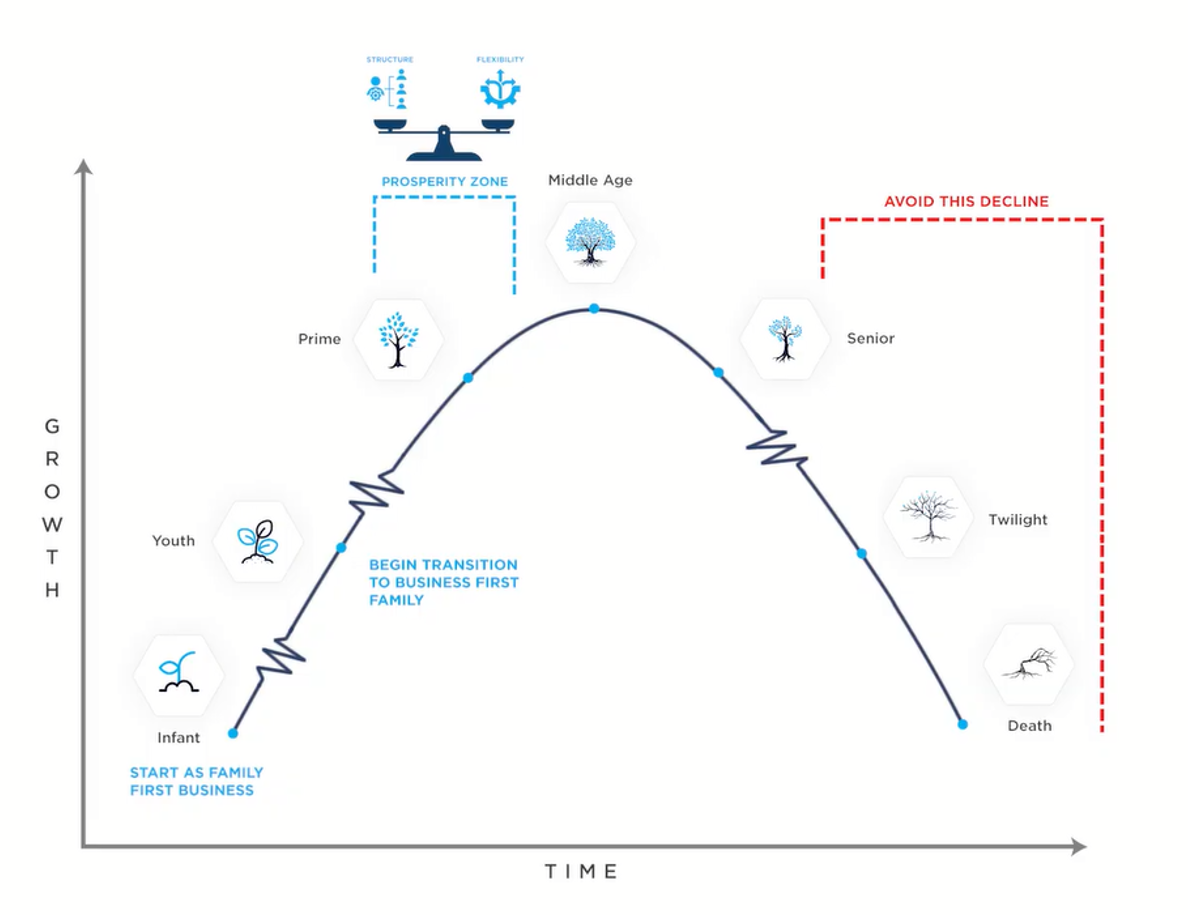
At the very beginning there’s no time and no growth.
That’s the seed.
An entrepreneur with an idea.
That seed becomes a sprout: a proof of concept.
Then a seedling, then a sapling that is young, scrappy, dynamic.
The entrepreneur has gotten some traction, brought in a few investors (often family and friends), hired one or two employees.
The business is flexible because it has to be.
We’re chasing whatever revenue we can get just to pay this month’s credit card bill.
In those early stages, almost every family business operates with what I call a family-first philosophy.
That’s natural.
The family is the engine and the safety net all at once.
The Pivot Point: Becoming a Business-First Family
As the business grows and takes on more girth and structure, the sapling becomes a young tree.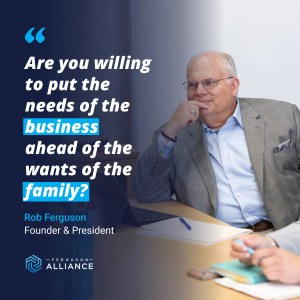
It’s approaching its prime.
And right here is where the most important shift in the entire lifecycle happens.
It’s a shift in philosophy.
The question is whether you can transition from a family-first business to a business-first family.
In other words, are you willing to put the needs of the business ahead of the wants of the family?
This isn’t about your values.
Of course you love your family.
It’s about your priorities when it comes to the business.
A family-first business puts family wants first.
Employment is treated as a birthright, profits flow toward lifestyle rather than reinvestment, and decisions get made through the lens of what’s good for the family rather than what’s good for the enterprise.
A business-first family makes a different choice.
Roles are filled based on skill.
Compensation reflects market rates.
Successors are chosen on merit.
The business is managed in the interest of all its stakeholders (employees, customers, the community) not just the shareholders who happen to share a last name.
When you make that shift, the business takes care of the family, and the family takes care of the business.
That reciprocal relationship is what allows a company to stay in what we call the Prosperity Zone.
The Prosperity Zone: Balancing Structure and Flexibility
The Prosperity Zone centers on Prime.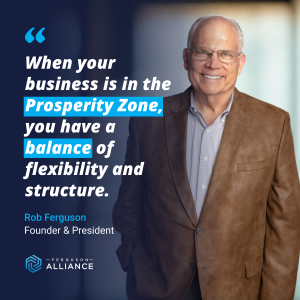
Prime is where flexibility is in balance with structure.
You’ve put just enough structure in place to allow the business to keep growing and innovating, but you don’t let the structure overshadow the innovation, and you don’t let the innovation overshadow the structure.
Scrappy with structure.
Notice that on our curve, Prime sits just before the peak.
Not at it.
That’s deliberate, and we’ll come back to why in a moment.
When you’re in the Prosperity Zone, you can feel it.
The culture, the vibe, the energy.
Employees are engaged.
Customers give you great reviews.
You’re profitable.
And you’re making a contribution that’s bigger than just providing your products and services.
That doesn’t mean it’s smooth sailing.
There are still chaotic stretches because you’re growing and adapting to outside changes.
But your business has the right mix of structure and flexibility to absorb that change without losing its footing.
Companies that decide to stay in Prime can build what we call an Infinite Legacy: a business that keeps living generation after generation, never resting on its laurels, always growing and adapting.
What Happens If You Drift Past Prime
Once a business reaches the very peak of the curve, it looks fantastic from the outside.
Picture a 60- or 100-year-old oak.
Full, healthy, impressive.
But the peak is the beginning of the fall.
Companies at the peak get proud.
They become so satisfied with where they’ve arrived that they stop innovating.
They stop embracing change.
They start to believe that what worked in the past will carry them into the future.
That’s the difference between Prime and Middle-Age.
Middle-Age is steady, profitable, often very self-sufficient.
The company can almost run on autopilot.
But the passion is waning.
The hunger for new opportunities is fading.
You start to hear things like “if it ain’t broke, don’t fix it” and “don’t rock the boat.”
From there, the slope gets slippery.
A Senior business is one that’s clearly in decline, and everyone knows it.
People start blaming each other.
The company becomes more concerned with how it looks from the outside than with how it actually performs.
Family members increasingly rely on distributions.
Internal problems get downplayed.
Past Senior is Twilight.
This is the zone of insolvency.
Cost-cutting takes over.
Silos and petty jealousies emerge.
Leaders look for someone to blame instead of a problem to solve.
Turnaround at this stage is difficult, sometimes impossible.
And eventually, if nothing changes, the tree drops its leaves.
The business runs out of cash and dies.
Assets get sold off.
People take their experience somewhere else.
The Good News: None of this is destiny.
The lifecycle is predictable, but the slide isn’t inevitable.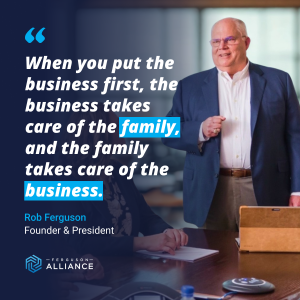
What’s not as widely understood is how to keep your business in the Prosperity Zone.
It starts with the one foundational decision: choosing to be a business-first family.
From there, it’s about building the right structure underneath that decision: governance, the right people, a clear strategy, strong operations, sound finance, and strategic growth.
Those six fundamentals are how a business-first philosophy actually shows up in the way the company runs day to day.
They’re what allow the structure to scale with you as the business scales.
At Ferguson Alliance, we work with youthful companies to get them into Prime.
We work with Middle-Aged companies to bring them back to Prime.
And every now and then, when the leaders have the right mindset and are willing to do the work, we help a Senior or even a Twilight company turn around.
Wherever your business sits on the curve today, the most important question isn’t “how did we get here?” It’s “where do we want to be next, and what decision do we need to make to get there?”
Curious where your business sits on the curve?
Take the Family Business Prosperity Score self-assessment.
It’s a quick way to see how your family business is performing across the one decision and six fundamentals that determine long-term prosperity and where the biggest opportunities for your next move might be.