



One of the most common things we hear from family business owners when we bring up governance is some version of: “You’re going to corporatize us. We don’t need all that.”
We get it. You built something personal. Your culture matters to you. The last thing you want is to feel like you’re running a Fortune 500 company when what you’ve built is a family legacy.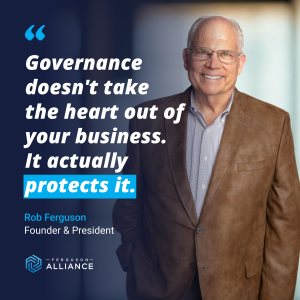
But here’s what we’ve seen over and over again in our work with family businesses: governance doesn’t take the heart out of your business. It actually protects it.
Without a clear structure for how decisions get made and how disagreements get resolved, family members often default to silence. They avoid sensitive topics to protect each other’s feelings. And over time, that silence creates the very dysfunction they were trying to prevent.
In our latest video, Rob Ferguson and Brandi Marek sit down to talk about what governance really looks like in a family business and why it’s one of the most misunderstood tools available to you.
In this conversation, you’ll learn:
- Why the families who handle conflict well aren’t avoiding hard conversations, they’ve just set up the rules ahead of time
- The well-intentioned habit that quietly creates elephants in the room
- How governance actually gives everyone a safer, more equal voice
- What a “barrier escalation process” is and why it keeps businesses from getting paralyzed
- Why the businesses that resist structure are often the ones where relationships are suffering the most
Full transcript is below the video.
What Is Governance in a Family Business?
Rob: Governance, the way we define it, is how the business makes its decisions and how it handles conflict.
What we’ve learned over time is that most successful businesses default to a collaborative approach in their decision-making. There are well-defined homes for each decision. Decision-making is decentralized. Not centralized into one person or entity. The decision maker is responsible for their area, and they seek out input from subject matter experts.
The Elephant in the Room
Rob: What happens is family members think they’re doing the right thing by protecting the other person. They don’t want to hurt somebody’s feelings, or they don’t want to address a difficult issue that could be sensitive for somebody. What that does is create the old elephant in the room. You don’t want to confront what the real issues are.
A Structured Way to Escalate Issues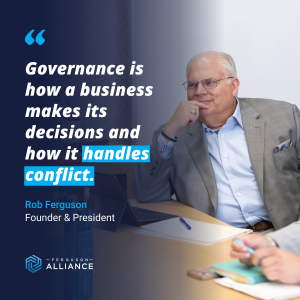
Rob: What we like to do is build what we call a barrier escalation process. We structure it. We help the organization feel comfortable escalating issues or barriers so they can get resolved.
This is a good time to think about having perhaps an advisory board or a governing board. That’s usually a good place to escalate issues where there’s a dispute between shareholders. If they don’t have that in place, then we just need to define how we’re going to do tiebreaking and decide that before there’s conflict, before there’s an issue. That way it becomes a little bit more automatic.
If there is a tiebreaker process in place, you’re going to maintain your relationships with your family members. Your employees are going to feel a lot more comfortable knowing that they can also escalate issues. Non-family members included. It’s going to keep the business moving forward. If you’re not comfortable dealing with conflict in a business, that’s when businesses become paralyzed.
Won’t Governance Make Things Feel Cold and Corporate?
Brandi: This is one of those situations where you don’t know how something’s going to play out, so you make a ton of assumptions: “if this happens, then this happens, and this happens.” Governance allows you to just be like, “Yes, if this happens, then this happens, then this happens.” Recognize the shift there. There’s not the panic. You get real clarity on how you’re going to structure things, how you’re going to make decisions, how you’re going to decide if you need to change how you make decisions. Everyone is clear on that.
Rob: Think about it this way. Governance is all about setting up the rules of how you’re going to handle difficult decisions, how you’re going to handle different opinions and you set those rules up before you ever get to that point. They’re set up unemotionally. And then when you get into the heat of the conversation, you now know the structure. That’s what Brandi was talking about: here’s how we’re going to elevate this issue, how we’re going to discuss it, and how we’re going to make a decision.
Governance Actually Protects Relationships
Rob: We hear that a lot: “I don’t want to be corporatized or too professionalized. I don’t want to take the heart out of our business.” Honestly, governance does the opposite. It actually makes things safer for non-family members to have a voice in the company, as well as family members, siblings, and children, to also have an equal voice at the table. They can bring issues up, and at the same time, they can actually build on relationships, not damage them.
Some families are pretending to be family-driven and relationship-oriented, but underneath the surface, they’re not happy and relationships are being harmed. The reality is quite the opposite of what some family business owners perceive governance to be.
If we can take that myth out of their head and show them that, actually, you’re going to make decisions faster, you’re going to have a higher level of accountability. This increases trust in the organization. You’re also going to get more involvement and input from not only family members but also non-family members in helping the business be successful at achieving what its long-term desires are.
If you’ve been putting off the governance conversation because it feels too formal or too corporate, this is a good place to start. You might be surprised at how different it looks from what you’re imagining.
And if you’d like to talk through what governance could look like for your specific situation, we’re always happy to have that conversation. Book a complimentary and confidential call with one of our experienced advisors