



When I talk with family business owners about governance, their eyes can glaze over pretty quickly.
The word itself sounds like bureaucracy. Layers of rules, committees, and paperwork that get in the way of running the business. I understand the reaction.
But governance isn’t about adding red tape. It’s about clarity. It’s about knowing who makes which decisions, who talks to whom, and what gets discussed where.
Over the years, I’ve found that the easiest way to explain it is in terms of rooms.
When you’re designing a governance structure, think about it like four rooms.
It’s what we call our four-room model. You build a family room, an owner room, a board room, and a management room.
Each room has its own distinct purpose.
The right people are in the right room.
And each room has its own specific decisions that belong there and nowhere else.
- The family room is where the family comes together. Talk about values, to educate the next generation, to make sure everyone understands what it means to be a shareholder and a member of this family. This is the room where the family’s shared vision lives.
- The owner room is where the people who hold equity in the business make ownership-level decisions. Things like who sits on the board and what the long-term direction of the company should be.
- The board room is where the board of directors does its work. Overseeing the business, protecting the interests of shareholders, and making the higher-level decisions that guide strategy.
- The management room is where the people who actually run the day-to-day business make operating decisions. This is where the work of the company gets done.
If you only ever take away one idea from this, take away this: the right people, in the right room, making the right decisions.
The rooms matter, but the real value is in how they’re connected.
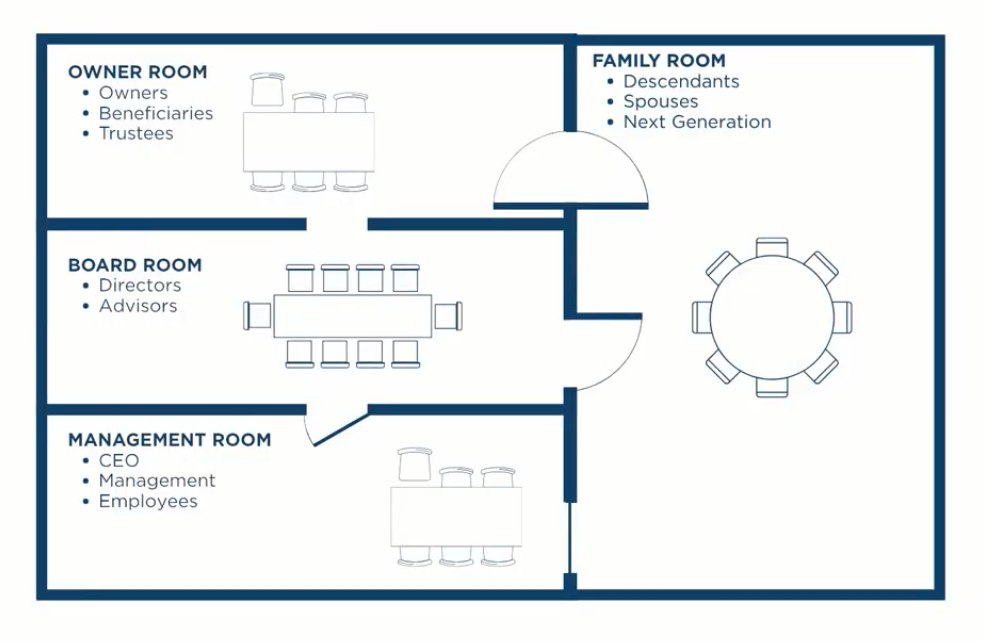
If you look at the rooms, there are doorways between them. And the doorways aren’t all the same.
Some doorways swing both ways. Some swing only one way. And some are intentionally closed.
That is the governance structure.
It’s also the communication process. The doors tell you who talks to whom, what they talk about, and when they talk about it.
Take the relationship between the owners and the board. Owners elect the board and set direction. That’s a door that swings one way at certain moments.
The board reports back and makes recommendations. That’s the door swinging the other way.
And the door between the family room and the management room? That one should be closed. Dinner-table conversations don’t belong in the operating decisions of the company. When you leave that door open, family dynamics walk straight into the business.
Without that kind of structure, everything ends up happening in one room.
I know from my own family what that’s like. It can get chaotic fast.
That’s when emotion takes over from logical, rational thinking. Decisions get made because of who’s upset rather than what’s best for the business. The loudest voice in the room wins, instead of the right voice in the right room.
I’ve seen families joke that they were one PowerPoint deck away from a board meeting at Thanksgiving dinner. It’s funny because it’s true. It’s also exactly the problem. When the family room and the board room are the same room, neither one works the way it should.
The four rooms ensure everyone is clear on which decisions are made by the family, which are made by the owners, which are made by the board, and which rest with management.
When that’s clear, decisions get made efficiently and people stop stepping on each other.
It also takes a lot of the emotional charge out of the room.
When you know what belongs in each room and which doors connect them, you don’t have to figure out “who gets to decide what” every time something hard comes up. The structure already answered that question.
Good governance isn’t bureaucracy. It’s the scaffolding that lets the business grow beyond what any one person can personally oversee. The four rooms are how I’d encourage you to start building it.
You don’t have to construct all four rooms overnight. Start by asking a simple question about the decisions you’re wrestling with right now: which room does this belong in? Is it a family question, an ownership question, a board question, or a management question?
From there, you start to see which doors need to open, which need to swing both ways, and which ones you’ve been leaving open that really ought to be closed.
If you’d like help thinking through what your four rooms should look like, that’s exactly the kind of work we do. Reach out and let’s talk.