



Early in my career, I took my first real job working for a large global conglomerate, inside a business unit that sat inside a much bigger division. I’d just left the Army, so I was used to a disciplined structure. You knew who the boss was. You knew who the boss’s boss was. And you assumed the boss’s boss had a boss too.
As long as you showed up, did your job, and went home without getting hurt, it was all good.
After a few months, I started noticing something else. Political fiefs were forming inside the business unit. People were working around each other instead of with each other. And the unit wasn’t making money.
In this video (scroll down for full transcription), I get into how to spot a people problem in your family business, and what we recommend clients do about it once they find one.
Along with the rest of the story, you’ll hear:
- The four places a people problem shows up before it touches your bottom line, plus the extra one to watch for if you’re a family business
- Seven best practices recommendations we share with our clients
- What it costs to lose the wrong employee, once recruiting fees and training get added on top of salary
- The difference between an identity-based team and a commitment-based one, and why only one of them holds up when things get hard
- Why telling a recruiter you want someone who “doesn’t need developing” backfires
- The one conversation worth having with your people at least once a year, and why most owners skip it
People Isn’t an HR Issue. It’s the Foundation
In a family business, this matters even more.
The people side of a family business is rarely just organizational. It’s emotional. It’s generational. It’s deeply personal. So don’t file it under HR. People is one of the fundamentals we build with every family business client, right alongside governance, strategy, operations, finance, and growth.
How Do You Know If You Have a People Problem?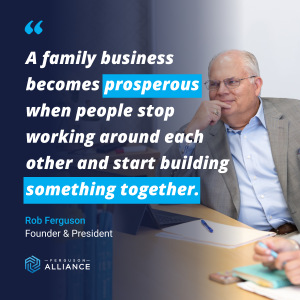
People issues show up from more than one direction at once. Your employees feel it. Your customers feel it. Your leadership team feels it. And in a family business, your family feels it too.
What Your Employees Are Telling You
I’m speaking from my own experience as an employee back in the 1980s. My manager didn’t really know me. There was no such thing as work-life balance. I don’t think company leaders back then cared much about people like me.
If your team is telling you their managers aren’t engaged, that leadership doesn’t seem to care, that they’re being asked to do more than they should, or that there’s no work-life balance, don’t file those under complaints. They’re signals. Pay attention to them.
What Your Customers Are Telling You
Everyone has a story about walking into a great restaurant, excited for a meal they’d read about, and getting lousy service instead. Customers vote with their feet. If the experience falls below what they expected, they walk.
That’s why the people interfacing with your clients matter so much. And it’s not just the client-facing roles. A receptionist or someone in the back office who seems disengaged sends the same signal: this company isn’t attending to quality.
What Your Leadership Team Is Telling You
You can usually spot a people problem in leadership fast. I was recently in a room with a group of executives who couldn’t agree on anything, not even whether it was sunny or rainy outside. When leaders bicker over things that don’t matter, that’s an accountability issue, and it needs leadership to step in directly.
What’s Different About a Family Business
Family businesses carry an extra layer here. If you’re treating family members working in the business differently than non-family employees, that’s a real signal. If you’re promoting a buddy or an old friend over someone more qualified, that’s a people problem too. Watch for it.
What It’s Costing You
If you’re seeing inconsistent revenue or declining profits, more often than not there’s a people problem underneath it.
The Society for Human Resource Management has studied what it actually costs to replace an employee: six to nine months of that person’s salary. For a $100,000 role, that’s $50,000 to $60,000, plus recruiting fees that typically run another 30% of the annual salary. Add training costs on top of that, and losing the wrong person costs you nearly a full additional salary. That’s the price of not having the right people around the right mission, vision, and values.
What We Recommend to Our Clients
Once you’ve identified the signs, the question becomes what to do about them. Here’s what we guide our clients through.
1. Invest in Leadership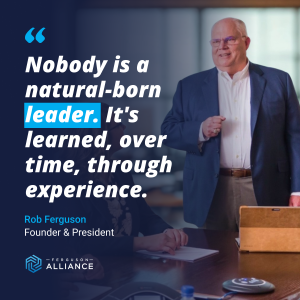
I’m working with a client right now who needs to hire a leader for one of his businesses. The market analysis came back at double what he’d budgeted, and he said, “I’m not spending it.”
He told the recruiter to lower the expectations for the role. The recruiter told him that meant lowering what he was hiring for too, more of an operations manager than a leader. He wasn’t happy with the candidates that produced, and he told me he wanted to hire someone who “doesn’t need developing.”
I told him: then you have to pay for that. If you’re a business that’s growing and scaling, you need to upgrade your leadership team to match. If you’re at $30 million with a five-year goal of $50 million, look for a leader who’s already done that, ideally in your industry or something close to it. A leader who came from a $100 or $200 million company can bring in best practices you don’t have yet.
But hiring is only half of it. Leadership also has to keep developing. Nobody is a natural-born leader. It’s learned, over time, through experience.
We call this “leadershiping” at Ferguson Alliance, turning leadership into an action instead of a title. It has two parts. First, alignment: policies, processes, org structure, compensation and incentives, budgeting and planning, all working together. Second, communication: being able to clearly explain what the future looks like, what someone’s role is in it, and how that role and others can grow from there.
2. Get Clear on Who Owns Which Decisions
Governance is how a company makes decisions, and decision ownership is where that becomes concrete. You need a real philosophy here: autocratic, consensus-based, democratic, or collaborative. For businesses that are scaling, especially family businesses, we believe collaborative decision-making works best.
Then you need to decide who owns what. When I became CEO of a business with more than 4,500 employees, I kept five decisions for myself. I called them my silver bullets. Everything else got pushed down to the appropriate level in the organization.
Over time, especially through acquisitions, I learned to centralize the decisions that gave us a competitive advantage and decentralize the ones where local knowledge mattered more. If we acquired a company with a different product line or in a different region, the decisions about that product or that region belonged at the local level, not back at headquarters where nobody understood it as well. Build clarity around who owns what, and how decisions escalate when they need to.
3. Build Trust by Building Accountability
If you’re decentralizing decisions, you need a high level of trust to support it. Trust and accountability go hand in glove. There’s no trust without accountability, and trust breaks down into three parts: people, process, and purpose.
People: you know you have trust when leaders can stand in front of a team and say, “I made a mistake, here’s what I’m doing about it,” or “I hadn’t thought of that, let’s try it.” That’s vulnerability, and it’s real.
Process: communication needs to run two ways, not one. We were given one mouth and two ears for a reason. Leadership communication that only flows downward isn’t enough.
Purpose: it has to be shared by everyone, not a slogan on a wall. People need room to expand on it and build with it.
And accountability starts at the top. I’ve seen founders insist meetings start on time and then be the last one in the room. I’ve seen leaders demand a 24-hour email response while never doing it themselves. That kind of inconsistency destroys trust. Accountability works like a flywheel: when a leader sets the standard, employees follow it. When a leader doesn’t, that spreads through the organization just as fast.
4. Choose a Commitment-Based Team Over an Identity-Based One
Part of what we do with clients is assess whether their culture is identity-based or commitment-based.
Identity-based organizations run on entitlement. “I’m the VP of sales, I don’t need operations’ input on this.” Silos form. Political structures form. You’ll hear things like “better to ask forgiveness than permission,” which really just means sidestepping the hard conversations.
Commitment-based teams look different. They share a vision that everyone actually owns, the way I owned that vision statement we wrote in California. Trust is non-negotiable. Decisions are decentralized to the right level. People communicate often and honestly, and when someone makes a mistake, the team works the problem together instead of going after the person. Most importantly, everyone honors their commitments.
5. Create a Culture of Excellence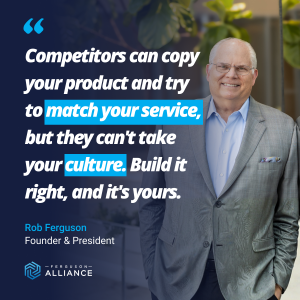
This is where we believe the real advantage lives. Competitors can copy your product and try to match your service, but they can’t take your culture. Build it right, and it’s yours.
Think about it across five angles: Does your team understand and respect the value a customer brings? Do your employees feel purposeful, heard, and understood? Are your standards for good, great, and done actually clear? Does your organization embrace change, or does everyone cringe and run at the word? And do you have consistent, written processes your customers can rely on?
Customer, employee, performance, change, and process. Keep improving on all five, and that’s a culture of excellence.
6. Build a Real Talent Management Plan
A talent management plan has four parts. Recruiting: are you clear on the job profile and behavioral expectations, or are you settling for whoever’s available? Performance management: are you developing people through internal and external training? Learning and development: are you building their leadership and management skills over time? Compensation: does pay actually align with the role, the expectations, and the company’s larger vision?
7. Have an Honest Conversation, At Least Once a Year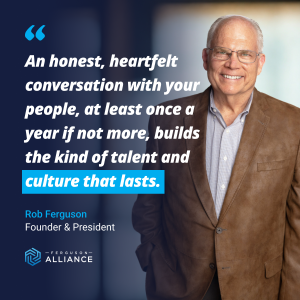
This belongs inside talent management too, but we call it out separately because so many of our clients skip it: the annual review.
Sit down with your employees and ask real questions. How’s it going? What do you like here? What don’t you like? If you were king for a day, what would you change?
It should go both ways. Ask your employees to review you as a leader, the same way you’d review them. Give them honest feedback: here’s what you’re doing well, here’s what to adjust, here’s what to start or stop doing.
An honest, heartfelt conversation with your people, at least once a year if not more, builds the kind of talent and culture that lasts.
Your Business Is Your People
I know I’m passionate about this one. It’s almost cliché to say people are your biggest asset, but a family business doesn’t exist without people. That’s the whole message.
What are you doing to nurture the people already with you? What are you building so they want to stay for their whole career? What are you doing to attract the next ones as you grow? And how is your culture giving you an edge that nobody can copy?
If any of this sounds familiar, that’s worth a conversation. Our team works with family businesses on leadership development, talent strategy, and building the kind of culture that holds up under pressure.
Reach out today to set up a conversation with one of our experienced family business advisors →
Additional Reading
The Art of Leadership-ing: Leading with Clarity and Alignment
More on the concept of “leadershiping”
3 Ps of Building Trust in Your Family Business
Rob goes deeper on People, Process, and Purpose, including a weekly team ritual Ferguson Alliance uses to practice vulnerability on purpose.
How to Create a Culture of Excellence in Your Family Business
Brandi Marek breaks down the same five orientations, customer, employee, performance, change, and process, in more depth.
How to Create a Culture of Accountability
More on why accountability has to start at the top, plus the structures and behaviors that build it into your organization day to day.
4 Approaches to Leadership Decision Making in a Family Business
A closer look at autocratic, democratic, consensual, and collaborative decision-making, and how to tell which one a given situation actually calls for.
Managing Talent in a Family Business: 7 Challenges and 4 Solutions
Goes further into the family-specific talent traps, starting with the same problem of treating family and non-family employees differently.
The One Decision and Six Fundamentals You Need to Build a Prosperous, Long-Lived Family Business
Where People fits among the other five fundamentals, and the one foundational decision that shapes all of them.