


Growth of the family business: this is a topic we regularly discuss with our clients.
In our more than 14 years of working with family businesses on growth strategies, one thing has become abundantly clear: the pursuit of growth is both a necessity and a challenge.
So why are businesses so focused on growing? And why are so many businesses not successful at it?
Reflecting on our collective experiences and research, we’ve distilled some key takeaways that we believe are crucial for navigating the complexities of family business growth.
We share these in the video below – or you can scroll down and read the summary:
Keys to family business growth
Here they are:
- Understand Real Growth
- Grow with Strategic Intent
- Be Aware of Constraints
- Avoid the Growth Trap
- Invest in Resources
- Identify Bottlenecks
- Master Change Leadership

- Focus on Talent
Let’s take a closer look at each of these approaches and how they support growing your business in the right way, with the right timing.
Understand Real Growth
In our experience, many businesses boast about their historical growth figures – but without adjusting for inflation, those numbers can be deceiving.
In fact, often when we adjust for inflation, we find out that growth is probably a lot lower on a compounded annual rate than what leaders thought – and in many cases, we discover that there has actually been no growth at all, or maybe even decline.
It’s essential to understand your business’ true growth trajectory before developing any type of growth strategy.
Harvard Business School research has found that, among 11,000 U.S. companies from 1976 to 2019, those in the top quartile grew an average of 11.8 percent after adjusting for inflation.
But the other three quartiles experienced fractional growth or no growth at all.
Their studies go even further to underscore the point that not only is business growth difficult to achieve, but it’s even more challenging to maintain.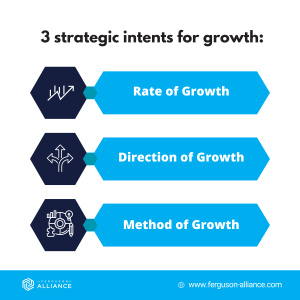
Grow with Strategic Intent
Most CEOs will tell you that businesses don’t grow because of competition, the market or external events, such as new regulations.
But our experience has shown – and this is also backed by research from Harvard Business School – that the difficulty in growing is often self-inflicted. We say it’s self-inflicted because companies aren’t growing strategically.
Instead, they’re growing in reaction to opportunities. And in the process of chasing growth, these companies easily destroy what made them good in the first place. After all, when you’re chasing growth, it’s all too easy to forget about your culture of innovation, or your agility in making decisions – or to ignore your strong process for delivering great customer service, all in the name of growth for growth’s sake.
Reacting impulsively to market opportunities often leads to setbacks. Instead, businesses should approach growth strategically, aligning their expansion efforts with core values and capabilities. We believe the best way to do that is to think about your strategic intents for growth as these three: rate of growth, direction of growth, and method of growth.
- Rate of growth: How fast should your company grow? Choose a target growth rate that matches your capabilities and your ability to scale. It needs to align with your business model, your HR capabilities, and your culture.
- Direction of growth: You want to grow in the direction that will ensure the greatest competitive advantage. So how do you determine that? At Ferguson Alliance, we like to use what we call our growth quad, which helps clients find the right balance of growth between existing and new customers, along with existing and new products.
- Method of growth: Choosing your method of growth is all about choices and strategic tradeoffs. And the first tradeoff that any family business must make is among growth, control, and liquidity. For example, let’s say a family business decides that what’s most important to them is growth and control. That means they’re willing to take on debt and cut back on their distributions in order to maintain control of the business and grow.
Be Aware of Constraints
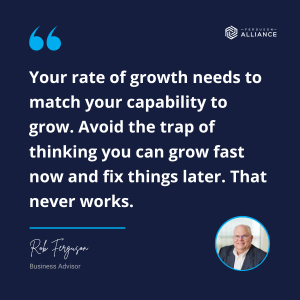
Growth goes beyond financial metrics; it also involves addressing non-financial constraints such as systems, processes, and human capital. Growing now and fixing things later never works – neglecting these constraints can jeopardize long-term sustainability.
Avoid the Growth Trap
Rapid, explosive growth may seem appealing in the moment, but it often comes at a cost. Resist the temptation to prioritize speed over sustainability and opt for measured growth instead. Make decisions logically, not emotionally – understanding that measured growth usually leads to the best results over time.
Invest in Resources
Growth requires resources and capabilities. Proactively seek opportunities to invest in infrastructure, technology, and human capital. Think of these expenditures as investments, not costs.
Identify Bottlenecks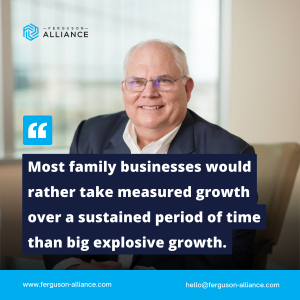
Bottlenecks can hinder any kind of growth progress. Whether they stem from systems, culture or processes, leaders must identify and address them promptly to ensure smooth growth.
Master Change Leadership
Change is inevitable in any growing business. Effective change leadership involves not only driving change but also inspiring and guiding teams through transitions. You can’t force change – you have to lead it.
Focus on Talent
The most valuable asset in any organization is its people. Sustainable growth is impossible without the right talent and skills within the organization, deployed in the right way. Invest in employee development to create a culture of excellence.
Growing your family business requires a strategic approach.
By embracing these takeaways and integrating them into your growth strategy, we’re confident that your family business can chart a path to long-term success.
We’re here to help.
If you’d like a partner to help you plan for growth, our team of trusted family business advisors is here to provide support. Give us a call today – or book an appointment online.