



When a business starts to struggle with profitability, most owners and leaders instinctively turn to the numbers: revenue, margins, pricing, overhead.
But what many overlook is how deeply operations impact those very numbers.
For example, a utility company I worked with was experiencing a troubling trend: project delays, rising costs, and an overall dip in profitability.
Their instinct was to look at staffing levels and billing practices. But the real issue was broader and more fundamental.
They didn’t have an expense problem. They had an execution problem.
If your business is seeing rising costs, missed deadlines, or uneven performance, it may not be a financial problem – it may be an operational one in disguise.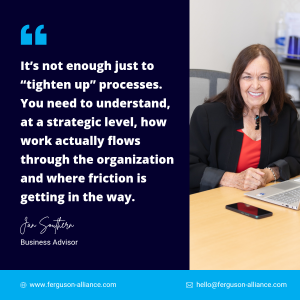
In this case, operational inefficiencies were quietly compounding across the business.
Delays, rework, redundant effort, and a lack of internal accountability were eroding margins and pushing timelines. And while no single issue stood out as catastrophic, the cumulative impact was significant.
For example, highly compensated field engineers were starting each day without the parts they needed. Parts were supposed to be pre-loaded into secure lockers the night before. Instead, the lockers were being used for storage, and engineers were either waiting around for inventory staff to arrive or pulling the parts themselves.
Multiply six engineers, each losing two hours per day, and the organization was losing $150,000 annually in wasted payroll.
One simple change – adding an early morning shift in the inventory department to prep parts on time – recovered that cost and improved project timelines significantly.
This is what we mean by the cumulative impact of small inefficiencies.
What we often see in middle-market companies is that outdated workflows and unclear roles slowly drag performance down over time.
What worked when the team was 30 people no longer works at 100.
What was manageable when one person owned a process becomes a liability when that person leaves and no one knows what “right” looks like anymore.
It’s not enough just to “tighten up” processes.
You need to understand, at a strategic level, how work actually flows through the organization and where friction is getting in the way.
When we work with clients on process improvement, we analyze the data.
Not just financials, but time studies, volume analysis, activity mapping, and benchmarking against peers and industry standards.
We look at every function and department to identify gaps between what’s happening and what should be happening.
And we also spend time with the people.
We talk to frontline employees, managers, and leadership to understand where systems break down, where workarounds are baked in, and where accountability is lacking.
That combination of qualitative and quantitative insight creates a foundation for change that is both strategic and actionable.
The most powerful recommendations are rarely dramatic. Instead, they are clear, targeted improvements that align teams, remove friction, and restore momentum.
Or as Rob Ferguson puts it: “Achieving a 1,000% improvement isn’t about a single dramatic change. It’s about consistently making a thousand small improvements of 1% each.”
This might mean restructuring a workflow to avoid bottlenecks, reassigning responsibilities to eliminate overlap, or finally activating a system that’s been in place but never fully adopted.
In another example from the same project, the finance department had a modern software system in place to track expenditures. However, the department still ran on manual processes.
Simply activating the existing system and re-aligning expectations reduced overtime, lowered stress, and allowed staff to focus on higher-value work.
 Impact comes not from the size of the change, but from how it unlocks performance. Freeing up time, reducing rework, and allowing teams to focus on the work that adds value and drives the business forward towards its goals.
Just as importantly, the way change is introduced matters.
For transformation to stick, your people need to be involved, not just informed.
That’s why we build continuous improvement into the process, helping organizations establish internal systems for identifying, testing, and owning improvements over time.
It’s easy to think of operational reviews as something tactical that happens in the back office. But the truth is, operational discipline – what we call a process orientation – is a profitability strategy.
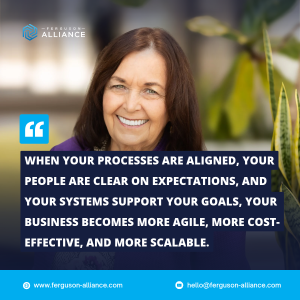
When your processes are aligned, your people are clear on expectations, and your systems support your goals, your business becomes more agile, more cost-effective, and more scalable.
In this case, the company implemented hundreds of targeted recommendations, many of them led by internal teams, resulting in a measurable return to previous levels of profitability – and beyond.
But the deeper impact was cultural: a shift toward ownership, clarity, and accountability across the organization.
If you’re thinking about growth, increasing value, or exit, now is the time to make sure your operations can support your strategy instead of holding it back.
The businesses that win over time aren’t just the ones with the best ideas or biggest budgets. They’re the ones that execute consistently, effectively, and with discipline.
And that starts with process.
If your operations are holding you back from reaching your goals, let’s talk. Book a call with one of our experienced family business advisors to explore how process improvement can unlock your next level of growth.