



Many years ago when I was a CEO, I had a fantastic CFO who wasn’t afraid to challenge my thinking.
We had some heated (but productive) debates. She would act as a speed bump when I wanted to move too fast.
But she also knew when to model different scenarios to help me take calculated risks.
One of our biggest breakthroughs came from a conversation where I said, “What if we could? What would it look like?”
Instead of shutting the idea down, she ran financial models, assigned probabilities, and showed me that even if we were only 70% successful, the upside was worth the risk.
The books told us what we had spent and what was in the bank. Deciding whether the idea was worth pursuing took someone who could use those numbers to look ahead.
That’s the difference between accounting and finance. Accounting keeps the numbers straight. Finance helps you use those numbers to create opportunities.
Many mid-sized family businesses don’t have anyone dedicated to that second job. One person handles both, usually a controller or finance manager.
That can work in the short term. Over time, it creates blind spots.
Accounting and finance serve distinct purposes. Knowing what each one does shows you which job isn’t getting done.
Accounting keeps score of what has already happened
Accounting provides the financial foundation of your business.
Key Responsibilities:
- Recording, classifying, and summarizing financial transactions.
- Preparing financial statements (balance sheets, income statements, etc.).
- Ensuring compliance with tax laws and financial regulations.
- Managing accounts payable, accounts receivable, and reconciliations.
- Conducting audits and internal controls.
Finance uses accounting’s numbers to decide where the business goes next
Finance starts from the same records and uses them to answer questions about the future. Where should you invest? How can you improve profitability? Is the business financially healthy enough for what’s next?
Key Responsibilities:
- Financial planning, budgeting, and forecasting.
- Managing cash flow and liquidity.
- Analyzing profitability and identifying opportunities for growth.
- Evaluating risk and developing mitigation strategies.
- Advising on mergers, acquisitions, and capital investments.
- Designing incentive structures that align leadership with enterprise value creation.
Finance makes sure every dollar in the business has a job, whether that’s growing the company, building its value, or protecting it from risk.
It lets family business leaders make decisions based on data instead of intuition alone.
Treating finance as an extension of accounting leads to missed opportunities and unmanaged risk
When one person is responsible for both, the day-to-day accounting work gets done first. Without a dedicated financial strategy, companies risk:
- Making decisions based on incomplete financial insights.
- Focusing too much on cost-cutting rather than profitable growth.
- Underestimating financial risks that could jeopardize long-term success.
- Overlooking opportunities for expansion, investment, or improved efficiency.
How do you strengthen financial leadership in your business?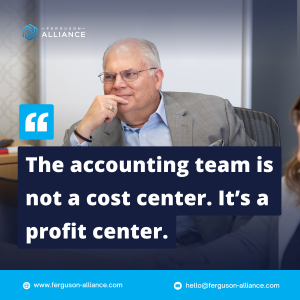
Three steps help, even in a business where one person handles the books today.
Separate the Functions
Keep accounting focused on record-keeping and compliance. Then give someone clear responsibility for the finance work: planning, forecasting, and weighing opportunities like the one my CFO modeled for me.
Engage Expert Financial Leadership
If you’re not ready to hire a full-time financial executive, part-time or outside financial expertise can fill the gap until you are.
Enhance Management Reporting
Finance is only as good as the numbers it works from. Put financial controls and reporting in place that give you the information you need for strategic decisions.
Finance is one of the six fundamentals of a prosperous family business
At Ferguson Alliance, we look at every family business through six fundamentals: governance, people, strategy, operations, finance, and growth.
When finance is part of how the business runs, your accounting team is not a cost center. It’s a profit center.
Financial leaders help make money as well as track it. They challenge waste, question outdated expenses, and find synergies that turn one plus one into three.
Want some outside perspective on how finance works in your business? Book a call with one of our experienced family business advisors.
Family business is hard. We can help.
How we can help
- Align your family and business around a clear strategy
- Set up governance and a board so decisions get made
- Plan a smooth succession and transition to the next generation
- Build a leadership team that can run the business without owner-dependence
- Improve operations and financial performance
Whether you're looking to scale, strengthen leadership, or plan your transition, we'll help you build a business that lasts for generations.

When your family and your business are aligned, everyone wins.
More on turning your numbers into decisions and building financial leadership in your family business
What if Finance and Accounting was a Profit Center? 5 Ways Your CFO Can Make You More Money.
Five specific ways a CFO can turn finance and accounting from overhead into a source of profit, from sharper reporting to better terms with suppliers.
Mastering Cost Control with Effective Management Reports
A walkthrough of what a management report should include, how often to share it, and how it differs from the financial statements your accountant prepares.
How to Use Management Reporting to Drive Greater Profitability & Shareholder Value
The five financial trends every management report should track, including cash flow, liquidity, and borrowing capacity, explained for leaders who don’t come from finance.
The Hidden Reason Financial Decision-Making Feels So Hard in Family Businesses
Rob Ferguson and Jay Rosen follow a hypothetical family business that argues about its numbers, and show how a budget and financial guardrails make decisions easier.
How to Simplify Financial Management for Non-Financial Business Owners
Takeaways from the Cracking the Cash Flow Code podcast on the few KPIs, dashboards, and rolling forecasts that make financials useful to owners without a finance background.
Building a Financial Team
Highlights from a Profit Answer Man podcast conversation on what makes a financial leader effective in a family business, including putting reports in plain language and planning cash for economic cycles.
What Does It Take for Your Family Business to Survive for Generations?
An overview of the one decision and six fundamentals behind a prosperous, long-lived family business, with finance as one of the six.