


We spend a lot of time helping our clients formulate sound business strategy.
And it never fails to surprise me how many of our clients think, when we first meet them, that they have a strategic plan in place when they simply don’t.
Instead, what they have is a documented practice of opportunistic, rather than strategic, growth – and that’s something completely different.
Let’s take a closer look at why you need to have a proactive strategic plan in place for your family business.
What is Strategic Planning?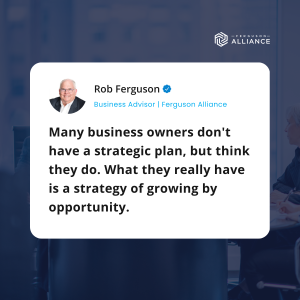
Strategic planning is the ongoing process of using all available knowledge to document a business’s intended direction. This process is used to prioritize efforts, allocate resources, align stakeholders and employees around organizational goals, and ensure those goals are backed by data and sound reasoning.
It’s important to note that the “planning” is more important than the “plan.”
Strategic planning, when done well, is never finished.
It’s a dynamic, iterative process that allows your business to adapt to unanticipated opportunities and threats.
This means that sound strategic planning takes ongoing reassessment and adjustment.
Why Do People Resist Strategic Planning?
We’ve found that business leaders resist the strategic planning process for many reasons, though there are some common threads.
Here are the ones we typically see:
- Fear of losing control: Many business leaders believe that by using a collaborative planning process, they lose control over their organization – but this couldn’t be farther from the truth. What we’ve seen is that when leaders involve their teams in planning, they actually gain more control over the things that matter. When all the details no longer rest on their shoulders, they’re free to work ON their business – instead of simply IN their business.
- Fear of change: It should come as no surprise that many leaders worry about the kinds of changes strategic planning will introduce. Family businesses often are full of nostalgia, and sometimes it’s hard to move away what some view as their family legacy: the way “we’ve always done things.” We often work with clients to help them embrace change, understanding that it’s essential for guaranteeing their organization’s prosperity for future generations.
- Fear of transparency: It’s not uncommon for leaders to want to avoid “opening a can of worms” by divulging too much information to too many stakeholders. And while it’s important to maintain some level of confidentiality, in most cases, it’s also empowering to your team when you share as much with them as you reasonably can. We’ve found that this actually increases financial performance in the long run.
Benefits of Strategic Planning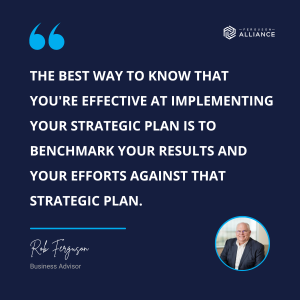
Over the years, we’ve identified many benefits of the strategic planning process – below we’ve listed a few that we think have the biggest impact.
- Unified vision: Strategic planning creates a single, forward-focused vision that aligns the company and all of its stakeholders. By making everyone aware of the company’s goals, the rationale behind those goals, and their role in achieving them, strategic planning creates a sense of responsibility and alignment throughout the organization. This unified vision ensures that all decisions and actions are consistent with the broader strategy, preventing misaligned efforts at any level of the organization.
- Clear direction: When each department and team understands the company’s larger strategy, they also understand how their efforts directly impact its success. This approach ensures alignment and allows for the continuous monitoring and adjustment of KPIs as goals evolve. In addition, both unified vision and clear direction provide your business a competitive advantage when it comes to recruiting, engaging, and retaining the best talent in your industry.
- Conflict resolution: A strong strategic plan provides a clear roadmap that helps your leadership team work through disagreements about whether to take advantage of opportunities as they arise. Opportunities that align with the plan are worth consideration, while those that don’t are likely worth passing on. Coming to clarity on strategic direction lessens the chance that disagreements and reactivity derail your organization’s success.
- Reduction of bias: The strategic planning process forces leaders to critically examine their decisions and back them up with data, projections, or case studies, which helps guard against cognitive biases – like recency or confirmation bias. By involving a diverse team with differing views and opinions in the planning process, organizations can challenge biases and make more robust, well-informed strategic decisions.
The Value of Benchmarking and Reporting
There’s one final point to consider.
While strategic planning is important, if you’re not able to execute against your strategic plan, your efforts will be wasted.
The best way to know that you’re effective at implementing your strategic plan is by benchmarking your results and your efforts against that strategic plan.
By doing this benchmarking, you can stay on track with your goals, making timely adjustments to your strategy in a proactive manner.
This approach increases accountability throughout your organization – and keeps your resources and efforts aligned with your long-term objectives.
If you’d like assistance with strategic planning, benchmarking, or putting appropriate dashboards and processes in place to keep your strategic plan on track, we can certainly help.
Reach out today to set up a consultation with one of our experienced and trusted family business advisors.