


Meetings can be a powerful tool for collaboration, decision-making and innovation, but all too often they become onerous tasks with very little to show for the effort.
If you want to improve your team’s productivity and keep everyone focused, a good way to do that is to develop some guidelines and best practices around how your organization runs meetings.
Here’s how you can get a handle on making meetings work for the benefit of your team:
- Prioritize meeting preparation
- Make a meaningful agenda
- Lead with purpose
- Design a reasonable meeting cadence
Let’s take a closer look at how you can put each one of these strategies into practice.
Prioritize Meeting Preparation
When you’re a meeting facilitator, there aren’t any shortcuts when it comes to preparation.
You have to put in the work of envisioning how you want the meeting to unfold and what you want to accomplish.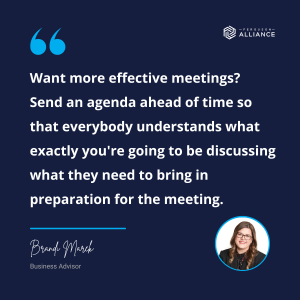
And it’s important that you not only prepare yourself for the meeting, but also that you prepare other participants.
Anyone attending a meeting should understand its purpose and their role in the discussion so that they can prepare.
This means sharing your agenda in advance.
There’s not much worse than walking into a meeting having no idea what you’re there to accomplish or how you can contribute – so don’t put your team in that situation.
When you share an advance agenda, this also presents an opportunity for members of your team to add their own recommendations for discussion items, which gives them a level of ownership in the process.
All in all, taking the time to prepare yourself, and providing your team with the information they need, helps set up your meeting to be its most productive.
Remember, attendees are more likely to engage and contribute effectively if they see a clear purpose and benefit in their participation.
Make a Meaningful Agenda
A well-structured agenda is the backbone of a successful meeting.
- Begin by reiterating the meeting’s purpose, which will guide desired outcomes. Clearly state what participants should know, feel confident about, and be ready to act on by the end of the meeting.
- Don’t overthink everything you’d like to accomplish! Instead, set a small number of expected outcomes. Then, focus on these and clearly articulate them.
- Detail meeting topics and allocate specific times for each. This structure helps manage the flow of discussion and ensures that all important points are addressed.
- List meeting participants and their roles. Knowing who will attend and their expected contributions can help your team better prepare and coordinate in advance.
An effective agenda not only outlines discussion points but also serves as a roadmap to keep the meeting on track and focused on its objectives.
Lead with Purpose
We’ve found that most people believe they attend too many meetings during the workday.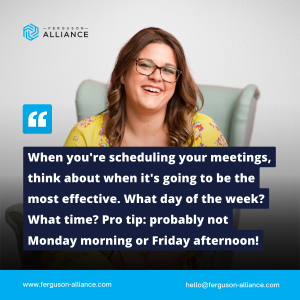
But if a meeting has a clearly defined and articulated purpose, we think you’ll find that your team will be much more enthusiastic about attending – and participating.
If you can’t clearly define a purpose for your meeting, that may mean you don’t need to have a meeting. And sometimes, it may be OK not to have that meeting.
For example, imagine the recurring team meeting where the same one person does most of the talking. Every. Single. Time.
Let’s say there are six other team members who attend the meeting, but they don’t participate, letting this one colleague run the discussion.
Chances are, this isn’t a very good meeting. For anyone.
It may be time to revisit the purpose of it – both with yourself and with your team.
If everyone understands purpose and expectations as they come into a discussion, they are much more likely to actively participate.
Design a Reasonable Meeting Cadence
Cadence is important when it comes to leading productive meetings. And I’m talking about cadence on multiple levels.
Frequency
First, there’s the frequency with which you pull team members together – and you want to get that right.
- Too frequent a cadence, and meetings can lose their meaning, and people start to disregard them.
- But if your meetings are too infrequent, projects can get into trouble because everyone isn’t in the loop in a timely manner.
It’s essential to find a meeting frequency that makes sense for your team and for the types of projects you’re working on.
Time of Day
Time of day is also important. Think about the people on your team and when they’re likely to be most productive.
We’ll go out on a limb and guess that 8 a.m. and 4 p.m. aren’t the best times for meetings. If they can’t be avoided, then so be it, but try to steer clear of them as a rule.
And if you’re asking your team to really participate and be creative, chances are Mondays and Fridays aren’t great days for those types of meetings.
Topics and Timings
In addition, there’s an important cadence when it comes to leading meetings.
- How much time are you prepared to devote to a particular topic?
- How long will you let the team digress before you rein them back in?
These are important questions to ask yourself before any important meeting where discussion has the potential to go off-course.
It may also help your team if you lay out some expectations at the start of the meeting – for example, that some topics may be tabled until a later time in order to make sure the present meeting serves its purpose.
Effective meetings don’t happen by chance – they need deliberate planning, a clear agenda, appropriate timing, and a well-understood purpose.
If you’re a leader within your family business and you’re struggling with meetings that feel lackluster, the power to change things is within your grasp.
With some advance preparation, exploration of purpose – and most importantly – some honest conversation with your team, we feel confident you can design a set of best practices that reflect your team’s needs and your obligations to customers.
Would you like some support in making your meetings more effective? Reach out today to set up a consultation with one of our trusted family business advisors. We’d love to help!