



As we step into a new year, a lot of family business leaders are facing a frustrating reality:
They know they need to motivate their teams… but they don’t feel motivated themselves.
They’re tired.
Drained.
Disconnected.
And when the owner’s energy drops, engagement across the company often drops with it.
In Episode 3 of The Prosperity Playbook, our advisors broke down what’s really happening in these moments, and what leaders can do to regain traction.
You can watch the video here, or scroll down to read the highlights.
Start With the Real Issue: Lost Direction
When owners find themselves in a low-engagement season, it’s often not because they “forgot how to lead.”
It’s because they’ve lost their direction.
As Rob put it:
They’ve “lost their reason for why they’re getting up in the morning.”
When that happens, it becomes hard to inspire anyone else.
Jan reinforced the consequence of that loss of direction:
“It’s hard to really get people behind you when you don’t know where you’re going.”
So the first step isn’t a new incentive program or a motivational speech.
It’s personal clarity.
Rob’s advice was simple:
“Start with your why.”
Ask yourself:
- Why did I get into this business in the first place?
- What was I trying to build?
- How far off-track have I gotten?
- Do I need a complete course correction, or just a small nudge back toward the center of the road?
This is why we talk so often about purpose as a “north star.”
Not because it sounds nice.
Because without it, you don’t have direction, and when you don’t have direction, the business starts to drift.
What Causes Owners to Lose Their “Why”?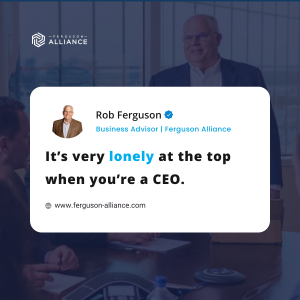
In this episode, several patterns came up.
Some are sudden disruptions:
- Cash flow problems
- Losing a key employee
- Losing a major customer
These curveballs can pull a leader into pure survival mode, and survival mode crowds out purpose.
But other times, the cause is much quieter.
Brandi described it like “a very slow leaking faucet,” where things shift gradually over years.
You can feel the business losing momentum:
- People aren’t as “in the zone”
- The business isn’t where it used to be
- You’re trying things, but nothing seems to work
- You don’t know what the real problem is, so you can’t fix it
That “stuck” feeling is often what leads owners to disengage.
Not because they don’t care.
Because they’re carrying uncertainty alone.
And in family businesses, there can be an additional layer.
When the “North Star” Doesn’t Match Across Generations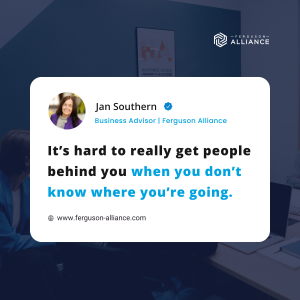
One of the most common disengagement triggers in a family business is misalignment between generations.
Brandi pointed out that when two generations are working in the business, one generation may be holding tightly to the original purpose, while the next generation wants to take the business in a new direction.
When that tension goes unresolved, people get tired.
They stop fighting.
And the business becomes stagnant because it’s unclear who is truly leading.
Rob summarized it plainly:
You can’t have two people trying to lead the company.
Everyone needs to be “on the same train traveling to the same place.”
When there’s disagreement, the work becomes harder, not just operationally, but emotionally.
And eventually, energy drains out of the system.
Rebuild Energy by Rebuilding Communication
So what’s the practical path forward?
Jay shared a real example from his own career.
He joined a multi-generational family business where the family had lost energy, communication was weak, and ownership expectations were unclear.
Some family members felt out of the loop.
Others weren’t sure where they stood.
The breakthrough came when leadership did something very basic:
They got everybody in the same room.
Then they reconfigured management and began communicating in a more structured way.
Jay’s takeaway:
A lot of the solution was “simple communication that wasn’t taking place” because people had gotten too used to doing the same thing.
This is where many family businesses get stuck:
They don’t need more complexity.
They need a better rhythm.
The Cadence That Keeps a Business Engaged
In the episode, we talked about what we call the rhythm (or cadence) of a business.
If engagement is low, the goal is not “more meetings.”
It’s better communication, at the right pace, with clear purpose.
Jay suggested a quarterly rhythm as a starting point, time to review what happened, realign priorities, and revisit the core reasons the business exists.
Rob expanded the cadence idea into a practical structure many healthy businesses follow:
- Annual planning time (often end of year / beginning of year)
- Weekly leadership team meetings focused on priorities and accountability
- Monthly one-on-ones
- Quarterly business review meetings
The key isn’t checking boxes.
It’s keeping your purpose connected to your daily decisions.
That’s the difference between mission statements that hang on a wall, and a mission that actually drives behavior.
As Rob said,
“It’s not so much about the words…
It’s about the discussion…
about what those words mean.”
Brandi added the truth most leaders already know:
“You can get AI to write your words all day long, but if you don’t know how to actionize them… they don’t matter.
You have to live them.”
And Jay offered an important warning:
Too many meetings will backfire, especially if they aren’t meaningful.
Meet because there’s something that matters to talk about.
Not because it’s “the first Tuesday of the month.”
The Owner’s Question: Who Re-Energizes Me?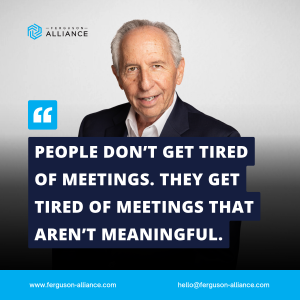
This may have been the most important moment of the episode.
Price asked the question every owner eventually feels:
If the owner is the one pouring into everyone else…
who pours into the owner?
Jan’s answer was direct:
Owners need to seek outside counsel.
That might look like:
- Executive coaching
- A trusted peer in a similar role
- A structured sounding board relationship
Rob added that many leaders find stability and clarity through:
- Advisory boards (including independent board members)
- Peer groups
- Qualified outside counsel
Because the truth is:
“It’s very lonely at the top when you’re a CEO.”
Owners often don’t have a safe place to be vulnerable, talk through fears, or pressure-test decisions.
And the longer they go without that support, the more isolated and drained they feel.
Rob’s candid reminder landed hard (and made us laugh):
“Sometimes your barber is not going to give you the best advice.”
The point is not just to “talk to someone.”
It’s to talk to someone qualified, someone who has been there before, and who can help you get your direction back.
Because time won’t fix it.
As Brandi said:
“It often gets worse with that mentality.”
The reset requires action.
Bringing It All Together: A Simple Reset Plan
If you’re an owner heading into a new year feeling depleted, here’s the practical reset we’d recommend, based directly on the themes from this episode:
- Reconnect to your why – Clarify your purpose and your north star. If you’re not excited about the direction, your team won’t be either.
- Talk about it with your leadership team – Not as a script. As a discussion. Let people wrestle with what purpose actually means in the real world of your business.
- Install a rhythm that keeps purpose alive – Weekly, monthly, quarterly—whatever makes sense for your company. But make it consistent and meaningful.
- Make sure the owner has support – An executive coach. An advisory board. A peer group. Someone qualified who can help you stay sharp and steady.
If you’d like help resetting your focus, rebuilding team engagement, or creating a leadership cadence that strengthens the whole business, our advisors would be glad to help.
Family business is hard. We make it easier.
Reach out today for a consultation with one of our experienced family business advisors.