


Two brothers, one business, and a disagreement that never got resolved.
That’s the situation I want to walk you through in this video, because chances are some part of it will sound familiar.
On the surface, it looked like a strategy problem.
One brother wanted to grow aggressively, take on debt, maybe even bring in a partner. The other wanted to protect what their father built and stay away from risk.
Neither one was wrong. But because they wouldn’t talk it through, decisions started slowing down, the business started to drift, and the tension between them spilled over into their relationship as brothers.
What was really going on had nothing to do with strategy.
It came down to governance. How decisions get made and how conflict gets handled.
In this video, I walk through what weak governance looks like, why business owners resist putting structure in place, and the specific steps we took to help these two brothers get their business (and their relationship) back on track.
Watch the video below, or scroll down for the transcript.
A Story About Two Brothers
Let me start with a situation that’s real. We see this all the time. We’ve got two brothers, second generation, great business. One of the brothers wanted to grow their business pretty aggressively. He was willing to take on debt, maybe even give up some shares to bring in a partner. The other brother was more conservative. He was concerned about protecting his father’s legacy, very adverse to debt, more risk-averse. Neither one of them was actually wrong.
But the problem was they wouldn’t talk about it. Over time, decisions started slowing down. Decisions started getting hard, and they became debates. The business slowed down. The management team recognized they’d lost some opportunities, and over time they lost their enthusiasm as leaders. The business began to drift off course. By the time we were called in, the tension in the business had cascaded into their personal relationships. Trust started eroding, and conversations between the two brothers had almost become non-existent.
What Governance Really Means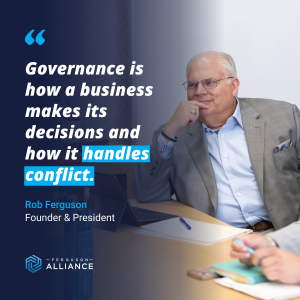
So what’s the real issue? It wasn’t strategy, it wasn’t the market, it wasn’t their operations. It was governance.
When we talk about governance, we try to make it simple. Governance is all about how you make decisions in your business and how you handle conflict. It needs to be defined that way, because if it isn’t, decisions default to personalities. They default to history, to who you were as a kid growing up, to emotions. Whoever can yell the loudest wins.
Signs Your Governance Is Weak
If you feel like you need to tighten up your governance, here are some signs we look for:
- Decisions being slowed or delayed
- Confusion about who owns what decision
- Everybody being inauthentically nice, nobody wants to talk about the elephant in the room
- Business issues starting to affect personal family relationships
- Resistance internally, and resistance to governance coming in from outside
We’ll hear families say things like, “We don’t want to corporatize our business. We’re a family business, we don’t want to lose the heart of it. We don’t need structure, we just need more sales.” What they’re really saying is: we’re afraid of structure. We’re concerned it will ruin our core values or our culture. But the reality is structure protects trust, because you can’t have trust in an organization without accountability. Accountability and trust go hand in glove, and that’s what governance builds.
The Myth About Losing Power
Owners often think they’re going to give up power when they put a governance system in place. One of the things we try to help family business owners realize is that they need a shift in their thinking about where power actually resides.
It’s very common, particularly with third and fourth generation businesses, for owners to want to exit their operating role and move into a governing role. They get concerned about hiring an outside CEO because they don’t know the family and feel like they’re giving up control. Most people think power resides in the hierarchy, the CEO at the top, the senior leadership team below, and that the business is run by management.
Where the Real Power Actually Resides
The real power, and this is eye-opening for a lot of our owners, is ownership. Think about a non-family business: the shareholders vote on the board of directors, and the board hires the CEO. It’s the same in a family business. The owners, the shareholders, are the ones who really hold the power. In a structured governance system, ownership determines risk tolerance, growth expectations, capital allocation, and long-term direction. That’s where the real power resides. If ownership isn’t aligned, your management team will never be able to fix it. That’s exactly what was going on with those two brothers. They weren’t misaligned as operators, they were misaligned as owners.
The Four-Room Model
Here are a few things we did to help these two brothers tighten up their governance.
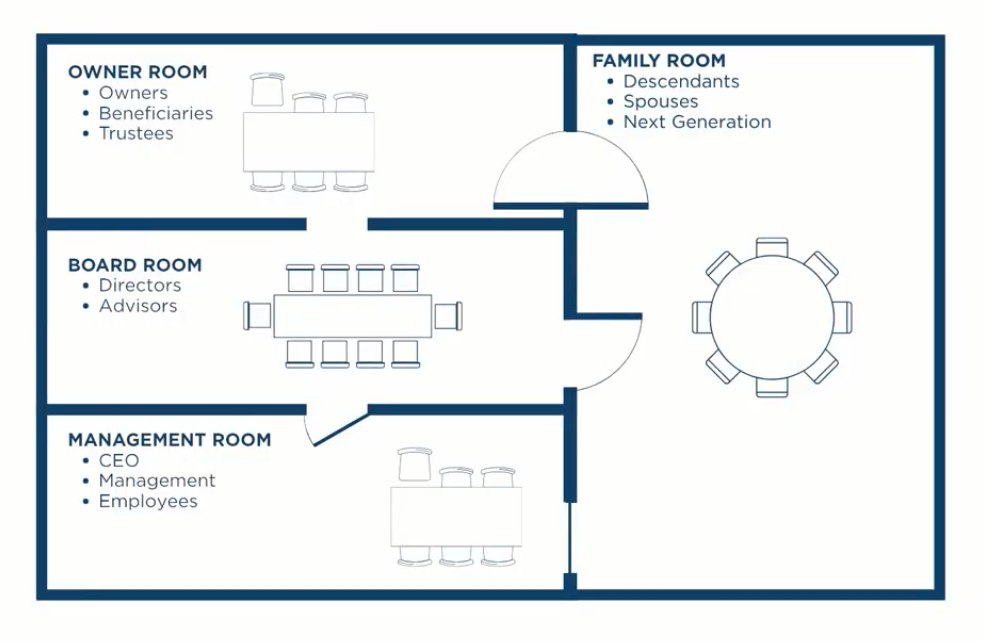
The first thing we did was look at their structure. When we design governance structure, we think of it like four rooms, our four-room model: a family room, an owner room, a boardroom, and a management room. Each room has its own distinct purpose. The right people are in the right room, and each room has its own specific decisions.
What’s really important is how the rooms are connected, the doorways between them. Some doorways swing both ways, some swing only one way, and some are intentionally closed. That’s the governance structure. It’s also the communication process: who talks to whom, about what, and when. Without that structure, everything ends up happening in one room, and that’s when emotion takes over rational thinking.
Four Ways to Make Decisions
The next thing we do is educate owners on decision approaches. There are four:
- Autocratic. One decision-maker makes the call.
- Democratic. Everyone votes; the majority wins.
- Consensual. 100% agreement, 100% of the time.
- Collaborative. A cousin to autocratic, with one twist: the decision-maker actively seeks out subject matter experts, including people who disagree with them, to get a different point of view.
We hear owners say, “We agree to disagree, so we’re consensual.” That’s far off the mark, there’s no agreement in that. Trying to run a business where all parties agree 100% of the time is not realistic.
Why We Recommend the Collaborative Approach
Just because you’re collaborating with a decision-maker doesn’t mean you get a vote or that the decision goes your way, but it’s your opportunity to influence it. That’s why we recommend the collaborative approach as a default. We’re not trying to make sure everyone agrees. We’re going for clarity, making sure everyone understands the decision and their role in executing it. Right decisions, made with the right people. That’s how you move forward without gridlock.
Building Your Meeting Structure
Once you’ve built the rooms and established your decision-making process, you need the real system of governance: meetings. There are typically four types:
Board meetings. Usually quarterly, providing oversight to the company’s health, welfare, and strategic direction. A fiduciary board is accountable for performance and high-level decisions. Management may or may not attend all or part of these meetings.
Shareholder meetings. Typically held once a year, often alongside a board meeting. Larger family businesses don’t have every shareholder on the board, so shareholder meetings are how you stay inclusive of everyone who owns shares. This is where annual decisions like hiring or reaffirming the board occur.
Family council meetings. These are a lot of fun to help put together. They often happen alongside a family vacation or the shareholder meeting, and include the broader family, shareholders and non-shareholders, spouses, and often the next generation (some families set a minimum age, like 15, to attend). This is where operators, shareholders, and board members explain what the business is about, its role in the community, and the responsibilities of one day becoming a shareholder. Families also use this time for things like philanthropic planning, estate planning, or tax planning.
Special meetings. These happen around a life event, a death in the family, a critical emergency.
The point is that the structure of your meetings creates the cadence of your governance system. Each meeting is separate and distinct, with its own purpose and the right participants. Without that structure, important conversations happen at the wrong time, in the wrong room, or sometimes not at all.
Transparency vs. Privacy
Once the board, meetings, and decision-making are in place, the next question is communication. There’s real tension between being transparent and being private.
We often ask family businesses, “Do you share your business financials with your management team?” Frequently the answer is no, “We wouldn’t want our leadership team to know how much money we’re making.” Or, on the flip side, “We definitely don’t want them to know we’re not making money, it could scare them off.” But if they don’t know, how are they going to help improve it? You can’t fix something you don’t know about.
There’s a way to communicate to your stakeholders that protects privacy while still providing transparency. That means identifying what information needs to be shared, who it’s shared with, and when. Without a communication plan, you get rumors. People start making assumptions, and assumptions destroy trust.
How Governance Evolves With Your Business
Governance needs to evolve with the life cycle of the business. If you’re not ready for a fiduciary board with an audit committee, a governance committee, and a compensation committee, you don’t need to build that yet, you’ll overstructure and become slow-moving and bureaucratic. But without any structure, you’ll be flexible and entrepreneurial, and you’ll never get anything done.
Every startup has advisors, usually informal and unpaid, giving thoughts on product, market approach, or financing. As the business matures, you need a different kind of advisor, people who can help you scale, hire key employees, and finance growth. That’s when a more formal advisory board makes sense. An advisory board can function much like a fiduciary board, just without the fiduciary responsibility.
Eventually, generally somewhere north of $50 million in revenue, often closer to $100 million, though it depends on your situation, it’s time to consider a true fiduciary board. As complexity increases, your governance systems need to mature. If they don’t, you’ll have more friction and a harder time handling conflict and making decisions.
Documenting It All: The Family Constitution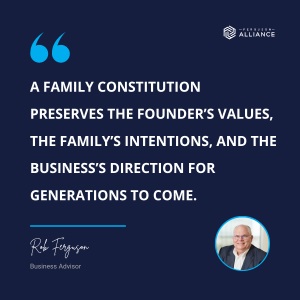
The last step we took with these two brothers was documenting everything in a family constitution. It’s not a legal document, but it’s aligned with the legal documents. It lays out how family members join the business, how they’re compensated, the roles of the board, the decision-making philosophy, the history of the business, and the hopes and aspirations for its future.
The family constitution becomes just as important as your legal documents, and it shouldn’t sit on a desk and get forgotten. It gets reviewed at least once a year, typically at the annual shareholder meeting. That way, future generations don’t have to guess what’s expected of them or where the company is headed.
Back to the Two Brothers
So what happened with those two brothers? They made the changes: they added a board with independent directors, decentralized operating decisions, implemented meeting structures, and built a real decision-making policy with homes for their key decisions.
They didn’t always agree. That part didn’t magically change. But now they had structure and advisors to help them get to a decision faster, based in fact. The personal tension went away. There was still tension between ideas, do we grow, do we not grow, but they were able to look at the best approach, define the critical success factors, and make those decisions together.
It wasn’t really the business that changed. It was the relationship, once governance got put in place. Governance isn’t about taking the heart out of your family business, it’s about protecting it. It protects your relationships, your decision-making, and the legacy you’re building. You don’t need a perfect system. But if you want your business to outlast you, you need a system.
If you’re navigating governance challenges in your own family business, we’d love to help. Reach out today for a consultation with one of our experienced family business advisors.