


I’ll be honest with you: I’m a slow adopter.
I do use AI. I have Claude, and I use it more than I probably expected to.
But I’m also strict with myself about how I use it. And lately I’ve been thinking a lot about why that matters, especially for those of us running businesses where the work is personal.
So, I want to share something that’s been on my mind. Not the technical side of AI (I’m not the person to explain how any of it works.)
What I want to talk about is the human side. Because I think that’s the part we’re at risk of forgetting.
There are some fundamental things in a business that AI is not going to replace.
 You can actually see the first one pretty clearly if you’ve ever gotten an AI-generated summary of a meeting you were in.
Here’s my pet peeve with those: as humans, we weren’t designed to remember ALL the things.
We latch onto what interests us and what we feel passionate about. That’s what we drive with.
If we’re all armed with the exact same information, and we all know ALL of the things, then where’s the anything in that? If the goal is just to spit out facts and figures with no emotional attachment to any of it, then we’ve turned ourselves into robots. And that’s not the goal. That was never the goal.
Here’s what a business actually does: it solves challenges for customers.
That means we have to sit with a problem. We have to put ourselves in the customer’s shoes and ask, what is the challenge this person is facing? What value can we provide that’s going to make it better?
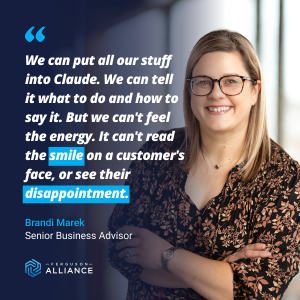
You can program your agents. You can put all your stuff into a tool and tell it, “give it to me like this, don’t give it to me like that.” You can do all of that.
But it can’t feel the energy in a room.
It can’t read the smile on a client’s face or catch the flicker of disappointment when something isn’t landing.
The moment we start leaning on a tool to take over the human part of the work, that’s the moment we’re all just robots out here.
It’s a tool. It’s simply a tool.
And I think we lose something important when we forget that.
The question I make myself ask
 I’ll tell you where this gets hard, because I don’t want to pretend I’m above it.
There are days when I’m tired and I just want the thing to give me the answers.
So, I’ve had to get very clear with myself about what I’m actually using AI for.
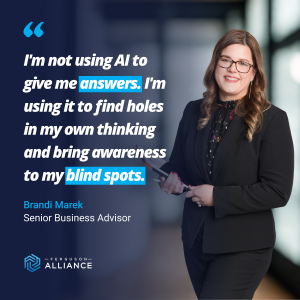
I don’t use it to give me answers. I’ve made that abundantly clear to myself. I use it to find the holes in my own thinking and to bring awareness to my blind spots.
And even then, I’m cautious about it. It honestly feels like a bit of a gamble, because I’m like a lot of my clients: I don’t want to be left behind. I don’t want to be the one who missed something.
But I keep coming back to the same belief that the human element always prevails.
So here’s the question I make myself sit with, and I’d offer it to you too: Am I just being lazy here?
Nobody else has to hear your answer. But don’t lie to yourself about it.
There’s a real difference between using a tool to sharpen your thinking and using it to skip the thinking altogether.
One makes you better. The other hands away the very thing that made you good in the first place.
What Facebook taught me
I see social media as my cautionary tale on all of this.
I was in college when Facebook first came out, so I had a front-row seat. Back then, it was only for college students. Your school had to be enrolled, and then you’d put in your class schedule because the whole point was to connect you with the people in your classes so you could communicate better.
Eventually it opened up to all universities, and then to everybody, and it became “social media” as we know it.
It was going to keep us all connected. We were going to be more connected than ever before.
And you can make a pretty strong argument that it did the opposite. That it left a lot of us more isolated than we’d ever been.
That’s the lesson I carry into every conversation about AI.
When a new tool shows up promising to make life so much easier by doing all the things you don’t want to do, it’s worth pausing to ask: are we missing something here?
There’s value in using AI when you’re intentional about it.
I’m not telling you to avoid AI.
I use it, and I think there’s real value in it when you’re intentional.
What I’m suggesting is that you don’t go all in before you’ve asked yourself the right questions:
- What am I really looking for this to solve?
- Am I asking this tool to write words I can actually stand behind? Or just words that sound good?
- Am I reaching for this because it makes me better, or because I’m tired and I’d rather not think?
Because we still need to think. That’s not optional. The day we stop is the day we become blobs.
Your business isn’t valuable because of the information you have. Everybody has the same information now.
It’s valuable because of the judgment, the care, and the humanity you bring to it. That’s your differentiator. Don’t let a tool talk you out of it.
If you’d like to think through how AI fits into your business without losing what makes it human, I’d love to help. Book a call with me anytime.