


Family business is hard. We make it easier.
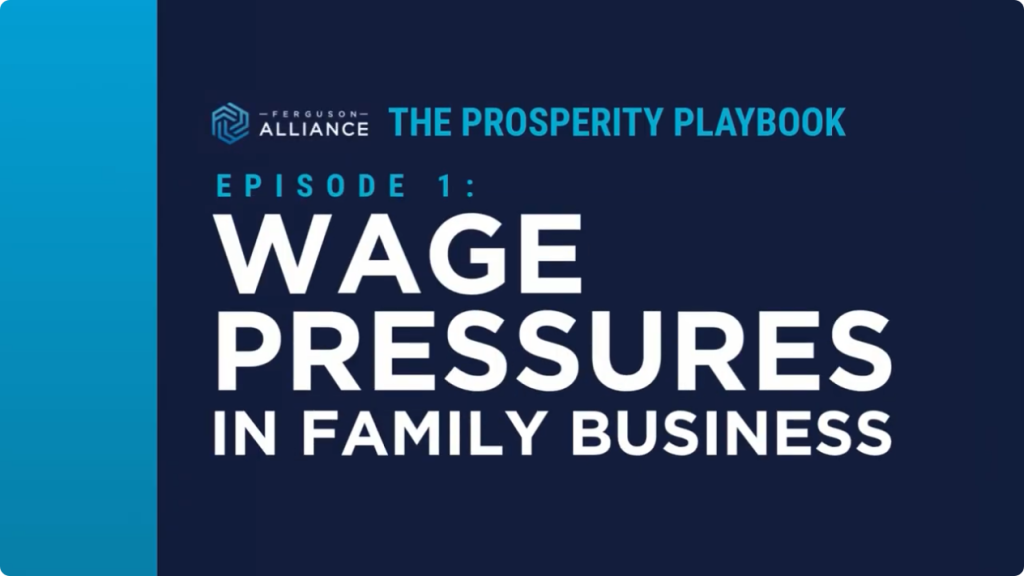
That’s the mission behind The Prosperity Playbook, our new monthly video podcast from Ferguson Alliance. (You can watch/listen to episode one here: The Prosperity Playbook)
Each episode brings together our team of advisors for candid conversations about the realities of leading, growing, and sustaining a family-owned business.
We talk about the tough stuff. The things that most business families deal with but rarely discuss openly.
From leadership transitions to compensation fairness to managing family dynamics, these are the topics that can make or break a business across generations.
In our first episode, the advisory team—Rob Ferguson, Brandi Marek, Jan Southern, and Jay Rosen—sat down with Price Ferguson for a lively roundtable discussion on a question that comes up often in family business:
Should you give a family member a big raise when they ask for one?
Watch/listen to the video discussion – or read the detailed show notes below:
Show Notes: Navigating Wage Pressures in a Family Business
Scenario:
A daughter who works in her family’s business goes to her father, the owner, and asks for a 15% raise. What should he do?
Jan kicked off the discussion with caution:
“It depends on whether she started out at a very low salary just because she was family. If she’s been underpaid and is catching up to market value, then maybe. Otherwise, she should get the same raise as others in a similar role.”
Brandi agreed—with a twist:
“I’d start by taking the family relationship out of it and looking at the position. What’s the fair market rate? That’s where you begin.”
As a former next-generation family business leader herself, she admitted her first instinct was empathetic. “Give it to her!”
But she quickly acknowledged the need for objectivity.
Rob added context:
“It really depends on the business philosophy. Some companies are a family-first business, meaning they do what’s best for the family at any given time. Others are a business-first family, which is our philosophy at Ferguson Alliance. That approach tends to create longer-lasting prosperity.”
For a business-first family, compensation decisions should be consistent with company policy and market standards, not influenced by family relationships.
Business-First Family vs. Family-First Business
This distinction became a central theme of the conversation.
- Family-first businesses prioritize the family’s needs, sometimes placing family members in key roles regardless of qualifications.
- Business-first families make decisions based on what’s best for the business—because a stronger business benefits everyone in the long run.
As Rob put it:
“A business-first philosophy is what creates sustainability. It generates greater prosperity over time.”
Compensation Philosophy
Jay noted that a raise request might point to a deeper issue:
“If an employee (family or not) has to ask for a raise, it’s probably too late.
That means they’re feeling underappreciated or overlooked. Ideally, there’s a structured annual review process where everyone’s compensation is proactively assessed.”
Brandi and Rob both emphasized the importance of having a clear compensation philosophy that outlines how family and non-family employees are paid and rewarded.
“Once that philosophy is set,” said Rob, “it becomes the cornerstone for all future decisions. It removes emotion and creates fairness.”
Are Family Members Overpaid or Underpaid?
The group debated whether family members are typically overpaid or underpaid.
Rob has seen both:
“In some cases, family members are overcompensated for minimal contribution. In others, they’re paid less because they’re ‘still learning.’ It’s a mixed bag.”
Brandi, speaking from experience, said she’s seen more cases of underpayment:
“There’s often a psychological layer. Parents still see their adult children as the kid who spilled milk at the dinner table. That dynamic can make it hard to see their true professional value.”
Ownership, Tenure, and Succession
The conversation turned to ownership stakes and next-generation involvement.
Rob explained that ownership and compensation are distinct issues:
“A family member can be an owner, an employee, both, or neither. But those are different roles with different rewards.
- Employment is compensation for work performed. It should align with the job’s market value.
- Ownership is compensation for risk, the return on investment and the responsibility that comes with holding equity.
An owner gets their return through distributions and value creation, not through an inflated paycheck.
We’ve seen businesses where family members who aren’t contributing meaningfully still draw large salaries. That creates frustration among non-family employees and even among productive family members.
The way to prevent that is by unifying around a clear compensation philosophy and separating pay from equity.”
He added that ownership is part of succession planning. The shareholders must decide when and how to transition leadership, ownership, and wealth. Especially when not all children will work in the business.
A Personal Perspective: Proving Yourself
Brandi shared a candid reflection from her own experience as a daughter-in-law working in her husband’s family business:
“I wanted my actions to speak louder than my last name. I worked hard to earn my seat at the table, and I took pride when people didn’t even realize I was part of the family.”
She added that transparency and self-awareness are key: knowing your value, understanding market rates, and keeping emotions in check when comparing salaries.
Jan agreed:
“It’s often harder for a family member because coworkers question why you were hired. You have to prove yourself even more.”
Lessons from Experience
Rob shared a story from his time as a non-family CEO in a fifth-generation business:
“In that company, only the men were allowed to work in the business, even though some of the women were highly educated and accomplished. When we restructured governance, we brought them onto the board and their contributions were remarkable. It was a reminder of how family traditions can sometimes hold businesses back.
The point is to replace guesswork with governance.
When you combine fairness, structure, and communication, you protect relationships. And you protect the business.”
Jan concluded with a simple truth:
“We see it all the time. When families put the business first, they make better decisions for everyone.”
Key Takeaways
- Define your philosophy. Decide if you’re a family-first or business-first family and make sure everyone understands what that means.
- Create a clear compensation policy. Base pay decisions on market value, not family ties.
- Review regularly and proactively. Don’t wait for requests. Address compensation systematically.
- Separate ownership from employment. Fair pay doesn’t automatically equal ownership rights.
- Encourage self-awareness and humility. Every family member should earn their seat at the table.
If today’s discussion hit close to home, you’re not alone.
Whether you’re navigating pay and performance, ownership transition, or family dynamics, our advisors can help you bring clarity to complex situations.
If you’d like to talk through your own situation, we’d love to hear from you.
Book a complimentary call with one of our family business advisors to talk through what’s happening in your business and explore practical next steps.