


Leaving a Legacy, Not a Mess

Rob Ferguson speaking to the Conroe Noon Lions Club
When you’ve spent a lifetime building a business, the last thing you want is to leave behind confusion, conflict, or chaos.
Yet, that’s exactly what happens when owners don’t plan for what comes next.
At Ferguson Alliance, we call this the difference between leaving a legacy and leaving a mess.
For many entrepreneurs, succession and exit planning sit at the bottom of a long list of “someday” projects.
It’s easy to understand why.
The process can feel personal, even uncomfortable.
You’re not just talking about money or control. You’re talking about your family’s future, your employees’ livelihoods, and your own identity.
But here’s the truth: every business owner will exit someday.
The only question is whether you’ll leave it on your terms or let circumstances make the decision for you.
Why the Clock Is Ticking for Family Businesses
A century ago, the average family business lasted more than 60 years. Today, that number has dropped to just 24.
That’s a staggering decline. And it tells me two things:
- Competition and change are moving faster than ever.
- Families need stronger systems and better planning if they want to survive transitions.
The hard reality is that only about 30% of family businesses make it through the second generation. Fewer than 12% reach past the third, and less than 3% survive through the fourth.
It’s not because the families don’t care.
It’s because too many avoid the planning conversations that matter most until it’s too late.
I’ve seen it firsthand: decades of work undone by poor communication, unspoken expectations, or the assumption that “the kids will figure it out.”
They rarely do. At least not without a roadmap.
Family-First or Business-First? You Have to Choose
Every family business must decide what it values most: family dynamics or business performance.
There’s no right or wrong answer, but there is a consequence to pretending you don’t have to choose.
A family-first business places its highest commitment on relationships, identity, and the well-being of family members — even when that means slowing growth or adapting business goals to protect those bonds. That can work for a while.
But over time, it can limit growth, frustrate non-family employees, and strain the business’s sustainability.
A business-first family takes the opposite approach. They prioritize the company’s performance, structure, and long-term success — expecting family members to align with the business’s needs, roles, and professional standards above personal considerations.
The irony is that putting the business first often ends up protecting the family more in the long run.
A healthy, valuable business supports everyone: family, employees, and community alike.
Succession Planning Is Three Conversations
One of the biggest mistakes I see is treating “succession” as a single event that happens when the founder retires or passes away.
In reality, it’s three separate, but connected plans:
1. Wealth succession – How will assets and income be distributed fairly?
2. Ownership succession – Who will legally own the company?
3. Leadership succession – Who will lead the business day to day?
Each of these involves a different mix of emotions, logistics, and timing.
Trying to solve all three at once is like untangling a knot by pulling on every string at the same time. You end up with more tension, not less.
When families address each area separately—guided by clarity, not emotion—they make better decisions and preserve both wealth and relationships.
Understanding the True Value of Your Business
Here’s a surprise for many owners: only about 25% of your company’s value comes from tangible assets like cash, inventory, and equipment.
The other 75% comes from intangibles. Your brand, your leadership team, your customer relationships, your systems, and your culture.
In other words, the “soft stuff” is often what determines whether a buyer (or the next generation) sees your business as a thriving enterprise or a risky investment.
Building strong processes, a capable leadership bench, a compelling value proposition and a strong culture that doesn’t depend on the owner personally isn’t just good management. It’s value creation.
I’ve seen owners spend $200,000 to bring in a strong COO, and in doing so, add millions to the company’s valuation.
Why? Because buyers pay more for a business that runs smoothly without the founder being the hub of every decision.
If everything depends on you, your business is worth less the day you step out of it.
Your Business Is Probably Your Biggest Asset
For many entrepreneurs, 85% to 90% of their wealth is tied up in the business.
That means your company isn’t just your livelihood. It’s your retirement plan.
Without a succession or exit strategy, that wealth is at risk.
A health issue, a market shift, or even family conflict can wipe out decades of work and jeopardize your financial security.
Planning early doesn’t mean you’re stepping away tomorrow.
It means you’re protecting the future you’ve built and giving yourself options.
You Can’t Time the Market. (But You Can Control Readiness.)
One of the most common questions I hear is: “When’s the right time to sell or hand off my business?”
My answer: you can’t time the market. But you can time your readiness.
Readiness has three dimensions:
- Personal readiness: Are you mentally and emotionally prepared for your next chapter?
- Financial readiness: Do you have enough to live the life you want without the business?
- Business readiness: Is the company attractive to buyers or next-generation leaders?
These are moving targets.
That’s why succession and exit planning aren’t one-time events. They’re living processes that should evolve as you, your family, and your business change.
Start Sooner Than You Think
Whether your goal is to transition the business to next-generation family members or prepare it for sale to an outside party, the steps are remarkably similar:
- Build a strong leadership team.
- Strengthen culture and systems.
- Have a competitive value proposition.
- Have the tough conversations early.
- Put your plan in writing.
- Revisit it often.
The most successful transitions I’ve seen are the ones that started years in advance.
The least successful are the ones that started after a crisis.
Don’t wait for a health scare, a family conflict, or an unsolicited offer to force your hand.
Leaving a Legacy That Lasts
When I talk about legacy, I’m not just talking about a name on a building or a plaque on the wall.
Legacy is the peace of mind that comes from knowing you’ve set your family, your employees, and your business up for success long after you’re gone.
If you’d like some help thinking through your next chapter, we’d be glad to talk.
Whether your goal is to transition to the next generation or sell at top value, our team at Ferguson Alliance can help you design a plan that lets you leave a legacy, not a mess. Reach out to set up a consultation with one of our trusted family advisors.
Free Family Business Succession Guide and Checklist
Many owners are surprised that a succession plan touches almost every part of the business and the family.
In this e-book, we outline everything you need to create a succession plan that sets your family up for generations.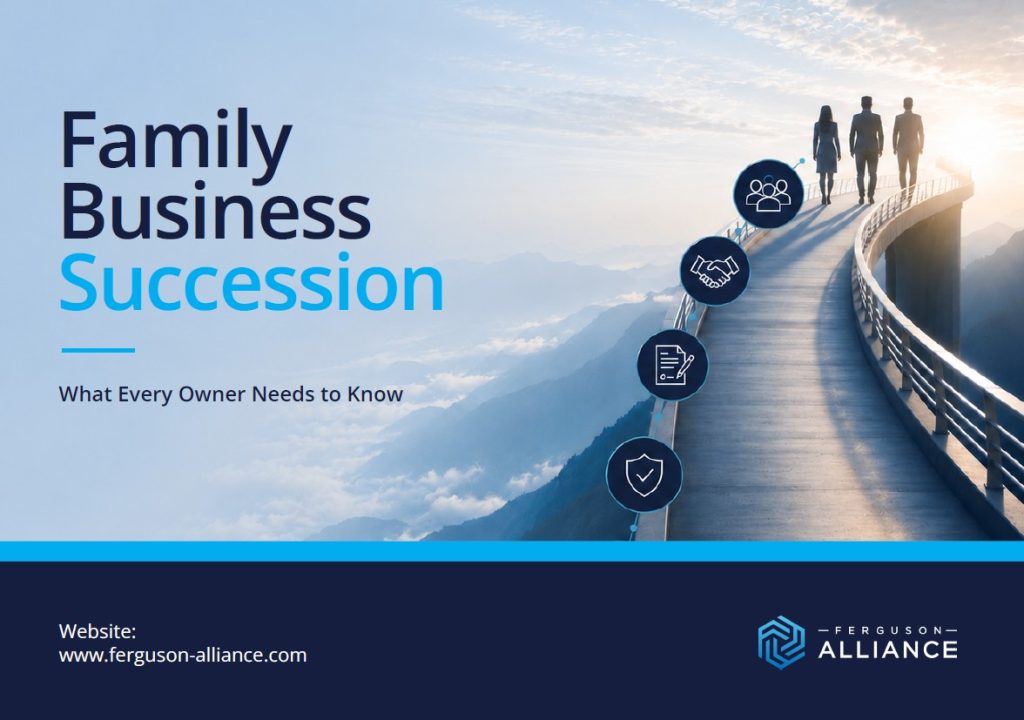
- A breakdown of the 3 separate transitions you need to plan for:
- Succession of wealth
- Succession of ownership
- Succession of leadership
- A full checklist of everything you need to do and prepare
- Explanations of the process and definitions of common succession planning terms
- Answers to frequently asked questions about succession planning
If you're struggling to create a succession plan or wondering where to start, we created this guide for you.
Enter your email address below and we'll send you a copy.
~ Rob