


Everybody’s talking about AI right now. Business leaders, your professional network, your doctor, maybe even your kids.
And if you’re a family business owner, you’re probably hearing the same questions over and over: How far behind am I? Should we be using it? Where do we even start?
In this episode of The Prosperity Playbook, our advisory team (Rob Ferguson, Brandi Marek, and Scott Wheelock) sat down with Price Ferguson for a wide-ranging conversation about what AI really means for family-owned businesses.
Here’s some of what we covered:
- How to think about AI when you’re focused on building long-term business value
- The governance questions worth addressing sooner rather than later
- The difference between AI as a tool and AI as a distraction (and how to tell which one you’re dealing with)
- How to experiment without losing focus on what’s really driving value in your company
- Why discipline matters more than speed right now
- Where AI is already saving time in businesses like yours (and where it can actually set you back)
- The one thing our team would say to any owner who feels overwhelmed by all of this
None of us are AI experts, and that’s the point.
This isn’t a technical deep dive. This is a practical conversation about how business leaders should be thinking about AI as it relates to their operations, their culture, and their long-term value.
Detailed show notes below the video.
Show Notes: What Should We Do About AI?
The Number One Question We’re Hearing: How Far Behind Am I?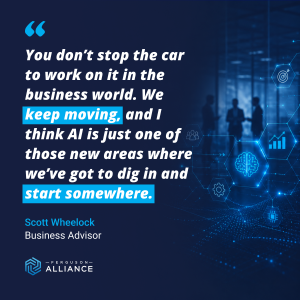
Rob opened the conversation with the question he hears most from clients:
“How far behind am I?” The second question is usually, “How do we use it?”
His typical response? Start with the business, not the tool.
“The first thing I do is ask them, ‘What are you really trying to work on? What are you trying to improve, and how does it relate to the business?’ If you’re trying to work on your key drivers of value, AI is just a tool. It may not be what you need.”
Scott added that many leaders get stuck feeling like they need to figure all of AI out before they can do anything.
“In reality, that’s where you lose a lot of time and opportunity. You don’t stop the car to work on it in the business world. We keep moving, and I think this is just one of those new areas where we’ve got to dig in and start somewhere.”
The Real Risk: Solving the Wrong Problem
Rob raised a risk that doesn’t get talked about enough:
“If we don’t know what we’re really working on, AI can get you working on the wrong problem. But it’ll help you solve it really, really well. You just go down this rabbit trail. That, to me, is the really big risk.”
He’s seen it happen with clients who start making decisions based on what AI has told them, without having enough knowledge of their own business to evaluate whether the information is even accurate.
“If you’re really using it for some of the critical thinking aspects of trying to figure out what you truly don’t know, then you truly don’t know if it’s giving you the right information either.”
So what are the guardrails? Rob suggests using a simple framework: Is this directly going to improve the core value drivers in my business? Is it going to help with margins, scalability, or revenue? If the answer is yes, lean in. If not, it might just be noise and novelty.
AI and Your Company Culture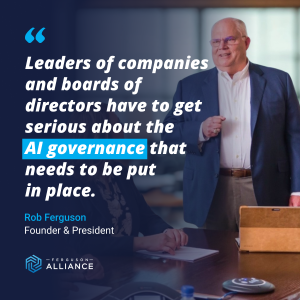
Brandi brought the conversation to culture, which she sees as the largest intangible asset in any organization.
“You have to think about this just like you do with anything in your culture. What is the company culture around AI, and how can it be used and how should it be used? I believe that if you rely too much on AI, you could potentially lose your company’s culture and authenticity.”
Rob agreed, connecting it back to what drives real competitive advantage: “The soul of the organization, the culture. That’s what gives you a competitive advantage in hiring employees, retaining clients, attracting strong vendors, developing great relationships. If leaders get sucked into this AI noise of ‘we’re behind, we’re behind, we’re behind,’ you’re going to lose focus on the real issue at hand.”
Setting Guardrails: Governance Matters
Scott made the case for getting ahead of AI governance before the organization defines it on its own.
“It doesn’t have to be heavy-handed, but if you don’t add some clarity around what’s okay, what needs review, and where the data is going, the organization will define it for you. You will have a path. The question is whether or not you predetermine what you expect and where you’re comfortable around some of those risks.”
Rob pointed out a key difference between AI and previous waves of technology change: the speed. “The change and innovation is real. You need to embrace this technology change. The difference with this particular technology versus the others is the speed of change. Leaders of companies and boards of directors have to get serious about the governance that needs to be put in place, and you have to probably look at it not annually, almost monthly.”
Discipline Over Urgency
The team spent time on a theme that might sound counterintuitive: in a landscape that’s moving this fast, discipline is actually more important than speed.
Rob shared what he’s seen from leaders who jumped in without a plan: “We have a couple of leaders that have just said, ‘All right, leadership team, I’ve got an account for you. I want everybody to go out and just start using AI for everything.’ That’s the wrong approach. You’ve got to test using AI in small, controlled ways so it doesn’t impact your authenticity or your culture, but at the same time, it improves your decision-making.”
Scott suggested a practical way to get started: “Pick two or three use cases that we can attack today. Jump in with both feet, sprint really hard for 30 days, and then huddle up and evaluate. Is it going to move the needle? Are we heading down the right path?”
Where AI Can Help Right Now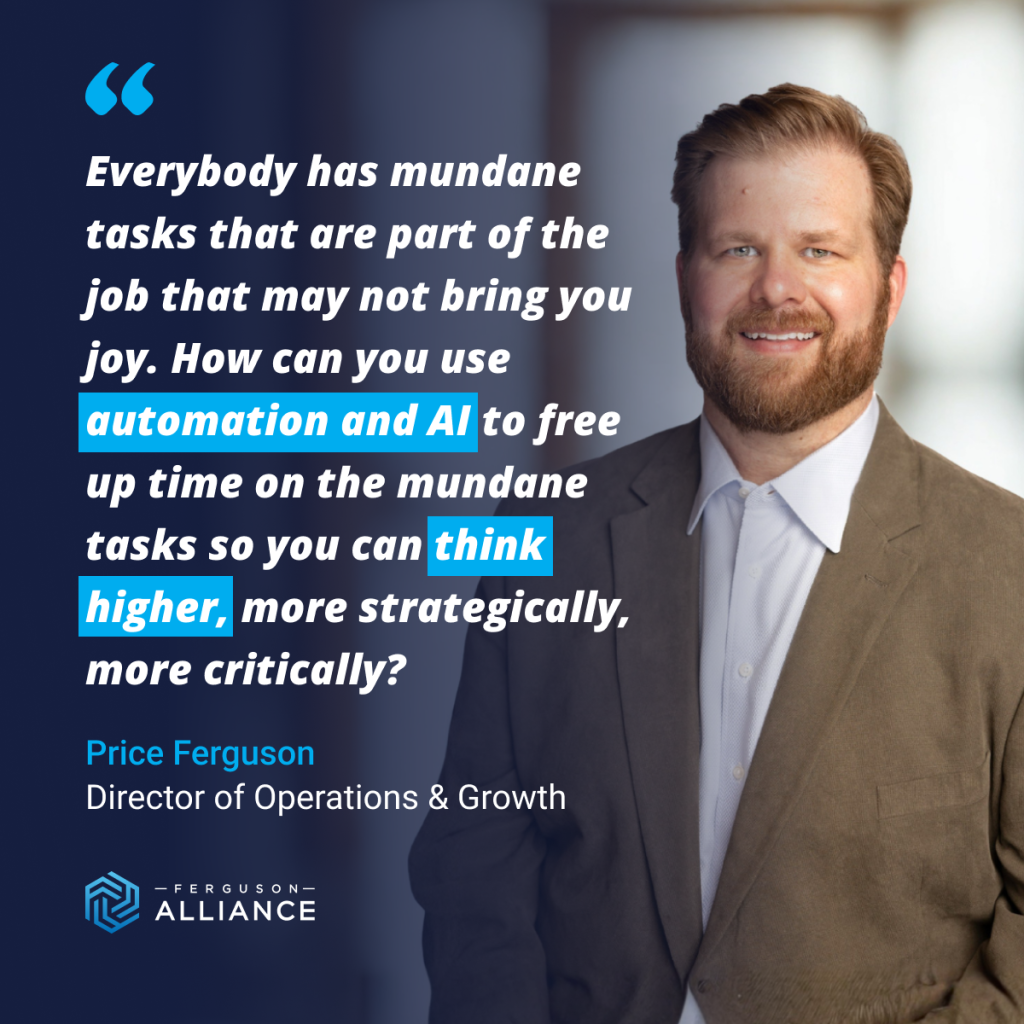
Scott offered a simple starting point: “Ask yourself some simple questions. Where am I losing time, and how could AI speed the business up? In decision-making, collaboration, or removing burdensome work?”
He shared a story about a large accounting firm where AI is already making a difference. The firm’s owner told them that AI wasn’t replacing people. Instead, it was removing the burdensome, manual tasks so that people could actually move the business forward. During tax season, there’s a huge volume of manual work like moving numbers from one cell to another. AI created a real opportunity to free people up for higher-value work.
Price built on this: “Everybody has those mundane tasks that are part of the job that may not bring you joy. How can I use automation and AI to advance my job, to free up time on the mundane tasks so I can think higher, more strategically, more critically?”
Rob connected it to something he’s hearing from leaders directly: “I was on a coaching call a couple of hours ago, and the leader was talking about how lonely he is. He’s working on big strategic projects and initiatives. ‘I’m not with my clients like I’d like to be. I’m not with my people like I’d like to be.’ If there are ways to leverage automation and AI to take care of some of the tasks that drain your energy, you can actually have more time and higher levels of energy to interface with your stakeholders and build that culture. That’s your real differentiator.”
Don’t Let AI Build the Core of Your Business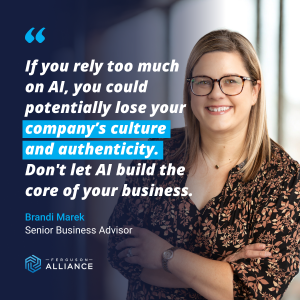
Brandi shared a watch-out from her work with clients on vision and mission development:
“More and more as we’re doing that work, everyone’s going, ‘I’m just going to use ChatGPT, I’ll put it in Claude, it will write it for me.’ One, we hear a lot of noise. A lot of extra words. And there’s no connection to those words. And two, it takes them out of the process. That process allows them to really get attached and ingrained to the meaning of those words. When they’re just jumping to AI to write the statement to check the box, there is zero attachment to what those words mean.”
She added: “Those people are the leaders of the organization and are tasked with bringing that to life through their team. It makes it impossible because they don’t have attachment to those words. One of my big watch-outs is don’t let it build the core of your business, because the business needs the passion to drive it.”
Rob agreed, drawing on his own experience: “Sometimes the work of doing it in and of itself is what helps you identify opportunities. It helps you see the business more clearly. It triggers something in you that otherwise you would’ve completely missed.”
That said, the team agreed that AI can be valuable for analysis and processing data quickly. Just make sure you have enough knowledge about what’s going on in your business to prompt it well and evaluate what comes back.
How to Make Yourself Irreplaceable
Brandi addressed the fear many employees have about AI replacing their jobs:
“The more that you can understand the business from beginning to end and the value that it delivers and how your role delivers value, that’s the key. You want to make yourself as valuable as possible. Understanding how the organization creates value, how you add to that value makes it much more challenging to think about replacing that person.”
If you’re feeling fulfilled and purposeful in your role, and you understand how your work connects to the bigger picture, you’re in a strong position. Regardless of what technology comes along.
If You’re Feeling Overwhelmed or Behind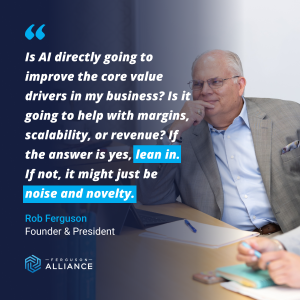
We asked each panelist to share one thing they’d want a listener to hear if they’re feeling overwhelmed by AI right now.
Rob: “You don’t have an AI problem. You maybe have a focus problem. Focus on what is most important about your business. What are the drivers? What’s your strategy? What’s your long-term vision? That’s where the focus needs to be. If you’re very clear on it, you will then know and understand what is the right tool. AI might be the right tool, and it may not be.”
Scott: “Where could this hurt us if we ignore it? Where can it make us better quickly? If whatever that direction is really plays out in the future, how will we adjust? Treat it like you would any other kind of disruption in your business.”
Brandi: “What are your core drivers? Allow that to continue to be the beacon in your company.”
Price: “Treat it as anything else that could be good or harmful to you. You’ve got to have discipline, you’ve got to have flexibility, and you have to be balanced with it. You can’t lean too heavily into it, and you can’t ignore it.”
If you’re feeling pressure to “do something about AI”, you’re not alone.
Whether you’re trying to figure out where AI fits into your operations, worried about losing focus on what really matters, or just looking for a sounding board, our advisors can help you think it through.
If any of this resonated with you or if you’re working through questions like these in your own business, we’d be happy to have a conversation.
Book a complimentary call with one of our family business advisors to talk through what’s happening in your business and explore practical next steps.