



What Is a Succession Plan? What goes into a Succession Plan?
I’ve had hundreds of conversations about succession planning.
And I often hear the same set of misconceptions about what it actually is.
They think it means giving something up. Control. Wealth. Their identity.
Or they think it’s a meeting you schedule, a document you sign, and then it’s done.
It’s none of those things.
Succession planning is a process, not an event.
And clearing up that confusion is usually where we start.
Watch the video below, or scroll down to read the highlights.
Succession Planning Is Three Conversations, Not One
Here’s one of the most important things I can tell you: succession planning is not one conversation.
It’s three, and they need to happen separately before they can be brought together.
The first conversation is about leadership:
Who will run the business?
The second is about ownership:
Who holds equity, and how does that transition?
The third is about wealth:
How do assets transfer across generations in a way that’s tax-smart and fair?
Most owners come in having tangled all three of these together, which is precisely why the whole subject feels so overwhelming.
When you separate them, something interesting happens.
People settle in.
They become more open to different paths and possibilities.
They stop feeling like they’re being asked to give up everything all at once — because they’re not.
Each conversation has its own logic, its own timeline, and its own set of decisions to work through.
Your wealth advisor is probably talking to you about the third conversation.
Your attorney and CPA are likely focused on governance, shareholder agreements, and the legal structure of the second.
What we do at Ferguson Alliance is help you work through all three — first independently, and then together — to make sure everything is aligned and working in the same direction.
Succession Planning is a Process, Not an Event
One of the biggest surprises for clients is learning how much goes into a succession plan — and how long it takes.
I’ve heard it more times than I can count:
“We’ll get together, have a meeting, and have our plan.”
It just doesn’t work that way.
A well-built succession plan includes a governance document called a Family Constitution.
It includes your mission and vision statements.
It addresses who your potential successors are, how ownership will be distributed, what your advisory and board structures look like, and how decisions will get made across generations.
That’s a significant body of work, and it takes real thought, real conversation, and real time.
When we work with clients on succession planning, we do it in a workshop environment over the course of three to four months — sometimes longer depending on the complexity of the business and family dynamics.
Here’s why we do it that way: the plan has to be yours.
We can’t walk in and hand you a document and call it a succession plan.
You have to build it, understand it, and own it.
Otherwise, it sits in a drawer and nothing changes.
We take clients through three phases.
The first is about alignment — making sure everyone understands the current structure, who’s in what role, and where there are gaps in readiness.
If people aren’t aligned at the start, it’s very difficult to move forward.
The second phase is about vision and planning — defining what you want the future to look like, identifying potential successors, and working through the ownership and wealth distribution questions.
The third phase is about governance — putting the accountability structures in place, whether that’s a family council, an advisory board, a formal board of directors, or some combination.
These are the tools that allow the business to function well through a transition and well beyond it.
A Succession Plan is Never Finished — and That’s By Design
When we finish the process with a client, their plan isn’t 100% complete.
It might be 50 to 80 percent complete.
And that’s not a failure.
That’s by design.
What they leave with is a living document with a clear task list: things to work on with their tax advisor, their estate planner, their operational team.
We ask them to review it at least once a year, ideally at a shareholder or board meeting.
A good succession plan needs to become part of the rhythm of the business.
Because here’s the reality — for families who intend to carry their business from one generation to the next, succession planning never truly ends.
It evolves.
It gets updated as the family grows, as leadership changes, as the business changes.
The families who do this well are the ones who have institutionalized it.
It’s not a task they check off a list.
It’s an ongoing conversation with a set of decisions that get revisited as circumstances change.
The businesses that navigate succession most successfully are the ones that started planning long before they needed to.
Succession planning can feel like something far off in the future.
This makes it easy to deprioritize when you’re managing cash flow, customers, and operations today.
But the earlier you start, the more options you have.
You have time to identify and develop leaders.
You have time to work through ownership and wealth transfer in a way that’s strategic and tax efficient.
You have time to put governance structures in place before they’re urgently needed.
You have the luxury of making thoughtful decisions rather than reactive ones.
If you’ve been putting this off, I’d gently encourage you to stop waiting for the right moment.
There isn’t a perfect moment.
There’s just today.
And today is a good day to start.
If you’d like to talk through where your business stands and what a succession planning process might look like for your family, we’d love to connect. Book a free consultation call with one of our experienced advisors.
Free Family Business Succession Guide and Checklist
Many owners are surprised that a succession plan touches almost every part of the business and the family.
In this e-book, we outline everything you need to create a succession plan that sets your family up for generations.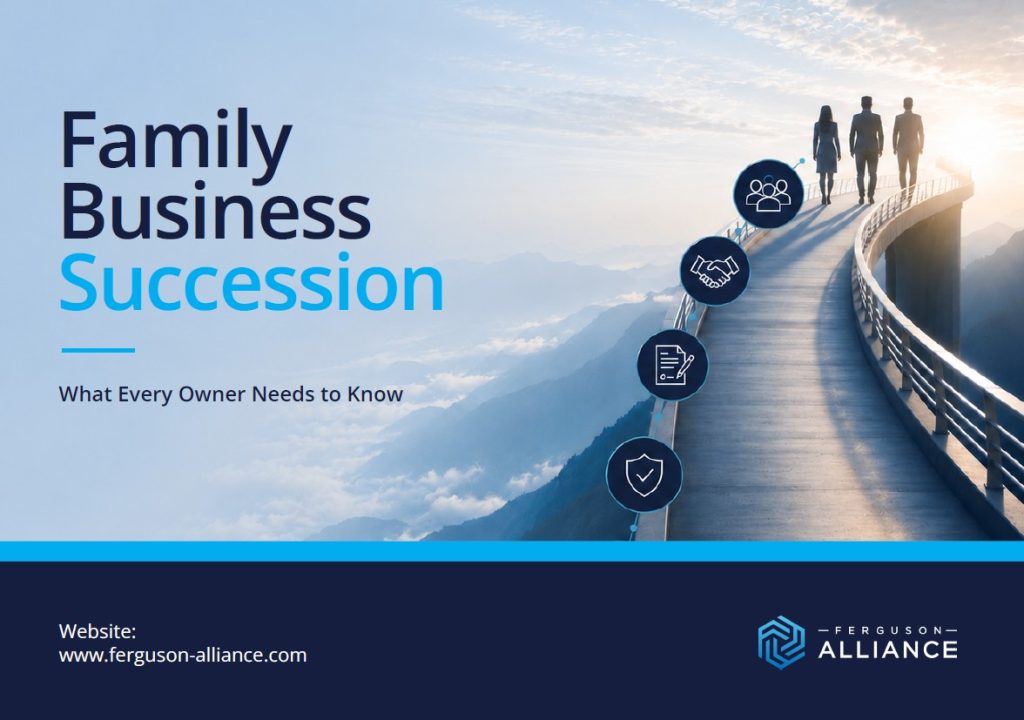
- A breakdown of the 3 separate transitions you need to plan for:
- Succession of wealth
- Succession of ownership
- Succession of leadership
- A full checklist of everything you need to do and prepare
- Explanations of the process and definitions of common succession planning terms
- Answers to frequently asked questions about succession planning
If you're struggling to create a succession plan or wondering where to start, we created this guide for you.
Enter your email address below and we'll send you a copy.
~ Rob