



You’ve done the hard work.
You’ve gathered your team, analyzed your market position, and distilled everything into a clear one-page strategic plan that articulates your purpose, vision, mission, and strategic intents.
You’ve aligned on where you’re going and how you’ll get there.
Now comes the real work: execution.
Because here’s the truth—the best strategy in the world is worthless if it lives in a binder on a shelf, gathering dust.
In this short video, we share the key steps leaders need to take to move from strategy to execution — starting today.
You can watch the video here, or scroll down to read the highlights.
Bring the Future to the Present
At Ferguson Alliance, we call the process of executing strategy “leadershipping”—and it’s all about bringing the future to the present.
The future is coming whether you like it or not.
Tomorrow is coming.
Next quarter is coming.
And that means the future is coming for your business, too.
Yes, we all get bogged down in our day-to-day operations.
We feel like everything is mission-critical.
We’ve got fires to put out, problems to solve, decisions to make—all today.
It’s equally important to be thinking about what the future is bringing for your business and what you’re doing today to create alignment and clarity for your team about that future.
That’s the big key to kicking off execution and keeping your strategy alive every day.
Whether you have your one-page plan on your desk, posted in the conference room, or reviewed in every leadership meeting, you need to make sure that especially as a leader, you are bringing your team back every day to higher-picture thinking.
You can’t let everyone (including yourself) get completely bogged down in the day-to-day.
Make Your Strategy Visible and Accessible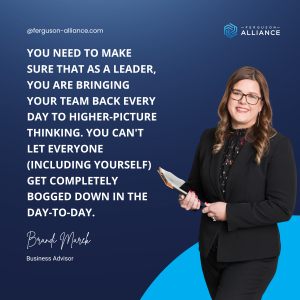
One of the most important things you can do is make your strategic plan accessible to the people who can actually impact the strategic direction of your company.
This is especially important in a family business, which is usually a pretty tight-knit group.
Everyone needs to know exactly where the boat’s rowing and what direction they need to row.
And they need to know when that direction changes—before they find out by accident or after the fact.
It’s critical to include your strategic plan in your onboarding process.
New team members should understand from day one what you’re building toward, what success looks like, and how their role contributes to the bigger picture.
When people understand the strategy, they can make better decisions in their own areas of responsibility.
They can identify opportunities that align with your direction.
They can spot risks before they become problems.
Without that clarity, you’re asking people to row hard without showing them where you’re headed.
Develop a Strategic Mindset in Leadership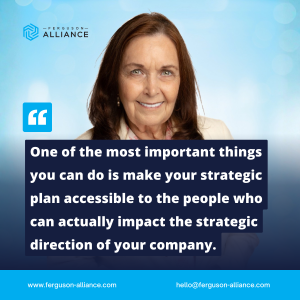
In order to bring your strategy to life today, leadership has to develop what we call a strategic mindset.
What does that mean?
It means that when you’re making any decision, you’re thinking about how this decision is going to affect your strategy, your strategic intents, or how it’s consistent or inconsistent with your core values or mission.
Let me give you some examples:
- When you make a hire, ask yourself: is this person going to be accretive to our approach to achieve our mission?
- When you add a new product line, ask: does this align with our strategic intents for growth?
- When you make an acquisition, consider: how does this move us closer to our vision?
- When you discipline an employee, think: does this uphold our core values?
All of that has to line up with your strategy.
This can be a difficult transition for operating leaders to make.
Most leaders got to where they are by being excellent operators, by solving today’s problems effectively.
Stepping back to consider the strategic implications of every decision requires exercising a different muscle.
The only way we know to exercise that muscle is by prompting leadership to pause for a moment and ask that one question before making decisions or announcements:
How is this going to help or hurt our strategy?
This strategic mindset should show up everywhere.
Even in the smallest communications.
When you’re writing a memo or making an announcement, think about how you can demonstrate that this decision or action is making progress on your strategic intents.
When you’re in a budget meeting, connect spending decisions back to your strategic priorities.
When you’re reviewing performance, evaluate not just what got done, but how it moved you closer to where you want to be.
This consistent connection between daily operations and strategic direction does two things:
- First, it ensures you’re actually making progress toward your goals instead of just staying busy.
- Second, it reinforces for everyone on your team that the strategy is real, it’s active, and it matters every single day.
Operational Execution is One of the Six Fundamentals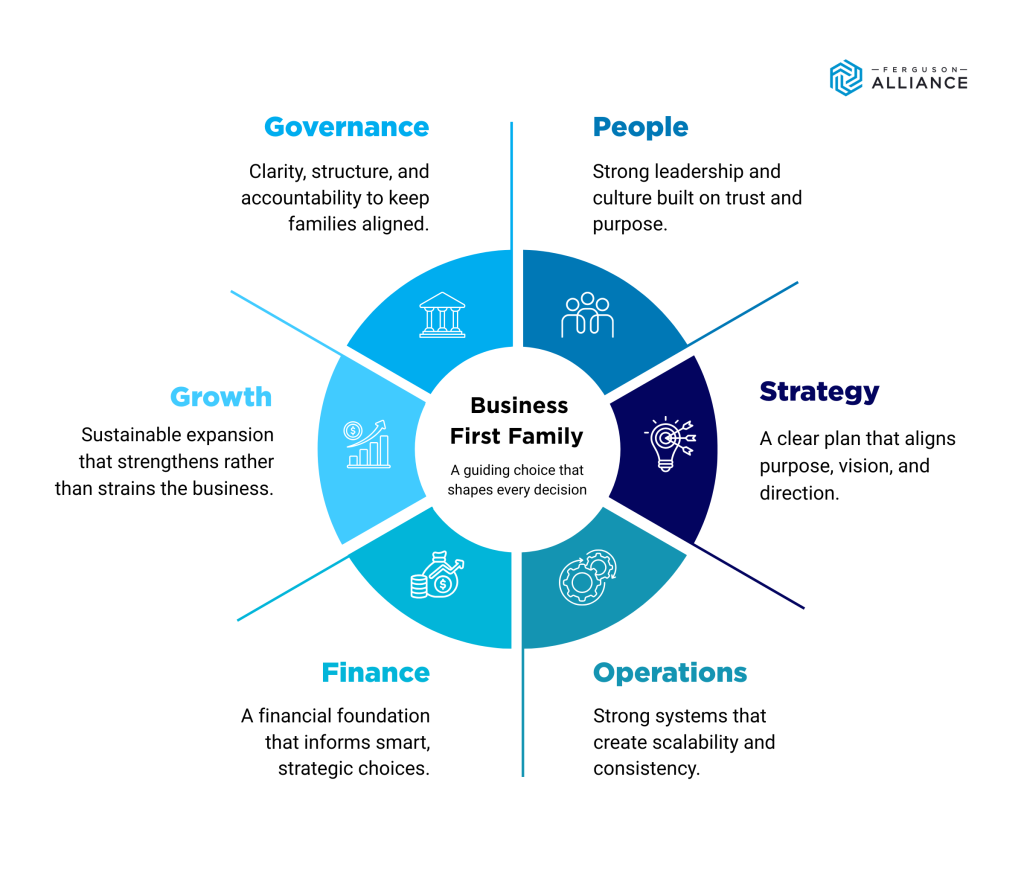
At Ferguson Alliance, we work with family businesses using a framework of one foundational decision and six fundamentals that build prosperity and longevity.
Strategy is Fundamental #3 in that framework.
And execution lives in Fundamental #4: Operations.
Operations determines how work flows, where value gets created, and whether you can scale successfully.
It’s about establishing clear processes and implementing a system for managing that includes planning, execution, reporting, evaluation, and forecasting.
When you have strong operational discipline, everyone knows what “right” looks like.
Your team stays aligned on expectations, work flows smoothly, and you can predict and measure results.
Your strategic plan informs your operational priorities, which shapes how your people work, which determines whether you achieve the growth you’ve envisioned.
It’s all interconnected.
You can’t execute a strategy without operational excellence.
And operational excellence without strategic direction is just busy work.
The difference between companies that execute their strategy and those that don’t often comes down to this: consistency.
- Are you consistently bringing your team back to the plan?
- Are you consistently making decisions through a strategic lens?
- Are you consistently measuring progress against your stated goals?
The real work of strategy execution isn’t about the big planning retreat or the polished one-page plan.
It’s about the daily discipline of keeping that future vision alive in the present.
In your decisions, your priorities, your communications, and your culture.
That’s where strategy comes to life.
That’s where plans become results.
If you’d like support developing or executing your strategic plan, we’d love to help. Reach out today to schedule a consultation with one of our trusted family business advisors.