


At Ferguson Alliance, we talk a lot about prosperity.
Not just profit, though profit is essential, but prosperity in the fullest sense of the word: a healthy, thriving business that supports a healthy, thriving family and community.
When we sit down with family business owners, we often ask:
“What does prosperity really mean to you?”
For some, the answer comes quickly: more profit, more wealth, a higher valuation.
For others, it’s freedom, time with family, the ability to take a real vacation, or the satisfaction of building something that will outlast them.
The truth is, prosperity is bigger than a P&L statement.
And for most family businesses, philanthropy and community impact are an important part of that picture.
This episode of The Prosperity Playbook brings together insights from several of our advisors on how family business owners can think about prosperity, giving, and long-term legacy.
Watch the video or read the article below.
Prosperity Is More Than Profit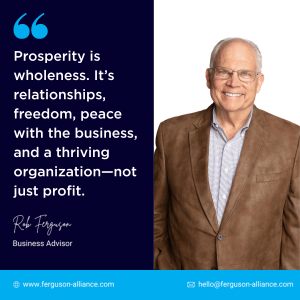
When many owners hear the word “prosperity,” their mind immediately goes to money: revenue, profit, enterprise value.
Those are important. But they’re not the whole story.
From our perspective, a truly prosperous family business includes:
- Strong relationships – within the family, within the leadership team, and across the organization.
- Peace with the business – you’re proud of what you’ve built, not resentful or exhausted by it.
- Freedom and flexibility – the business runs because of you, not only through you. You can step away without everything falling apart.
- A thriving organization – systems, leadership, and culture that don’t place a constant burden on the owner.
- Positive impact – employees, customers, and the local community are better off because your business exists.
Prosperity, in other words, is wholeness. It’s the combination of financial health, personal wellbeing, strong relationships, and meaningful impact.
Prosperity Is Personal: Define It for Yourself
One of the first things we do with new clients is get very clear on their personal definition of prosperity.
For some owners, the number one driver really is financial:
- Paying off debt
- Reaching a specific net worth
- Positioning the company for a future sale
For others, prosperity looks more like:
- Being able to take several real vacations a year
- Leaving work by 5 pm most nights
- Knowing the business can function smoothly without them in every decision
- Mentoring the next generation into roles they are excited—and prepared—for
We recently worked with a client who had been in business for over 40 years and had never taken a vacation.
As part of his succession planning process, we gave him an unusual homework assignment:
- Take a one-week vacation.
- Later, take a three-week vacation.
He was nervous. He worried things would fall apart. But he had a capable leadership team and solid operating practices.
Here’s what happened:
- The business continued to run smoothly.
- Sales actually increased while he was away.
- His team began encouraging him to go on vacation more often.
That experience changed his definition of prosperity.
It was no longer just about the size of the business, it was about the freedom to enjoy what he had built and the confidence that his succession plan was working.
Your version of prosperity might be different. The key is to:
- Name it honestly – wealth, freedom, legacy, impact, or some mix of all four.
- Align your business strategy with that definition, instead of assuming that “more revenue” automatically equals “more prosperity.”
Philanthropy as Part of a Long-Term Legacy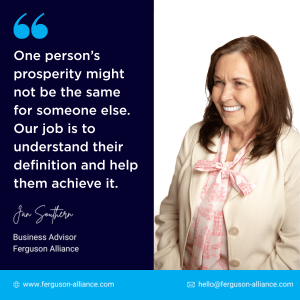
For many family businesses, prosperity and philanthropy are deeply connected.
Research and our own experience show that family businesses are major drivers of philanthropy in their communities.
Not just because they “should give back,” but because giving is often woven into their purpose and values.
We encourage family businesses to think about philanthropy not as a side activity, but as part of their long-term strategy and legacy.
When you do that, a few guiding principles emerge.
1. Align Giving with Your Values
Start by asking:
- What do we, as a family and as a business, care most about?
- What values do we want to see reflected in our community?
- Where do our employees feel a strong connection?
Then choose causes, organizations, or projects that reinforce those values.
That alignment might show up as:
- Supporting education because your own story includes scholarships and mentors
- Investing in youth sports or arts because your employees’ families are heavily involved
- Contributing to local healthcare initiatives because your community depends on them
When philanthropy is tied to your purpose, it stops feeling like an obligation and starts feeling like a natural extension of who you are as a company.
2. Involve Your Employees
Prosperity is not just something the owners experience.
Your employees feel it too, through job security, growth opportunities, and the pride of working for a company that gives back.
One practical way to involve them:
- Each year, shortlist several charitable organizations aligned with your values.
- Ask employees to vote on which ones the company will support that year.
We’ve seen clients adopt parks, support local food banks, participate in community cleanup days, and volunteer at shelters, often based on ideas that came directly from their teams.
The result?
- Greater employee engagement
- Stronger connection between profitability and impact
- A shared sense of purpose: “When we succeed, our community benefits too.”
3. Remember: It’s Not Just About Writing Checks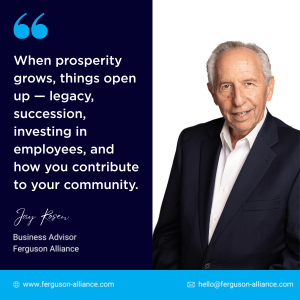
Not every business has a large budget for charitable giving, and even those that do shouldn’t overlook the value of time and expertise.
Some of the most meaningful contributions we’ve seen include:
- Teams volunteering together at food banks or community events
- Employees serving as mentors, coaches, or board members for local organizations
- Companies donating professional skills—finance, marketing, operations—to nonprofits that need them
- Leadership teams “tithing” a portion of their board fees to charities of their choice
In one long-standing family enterprise, every operating company was required to include a charitable giving line item in its P&L statement, equaling up to 10% of profit (once certain thresholds were met).
Board members were also expected to donate 10% of their board fees.
Giving wasn’t an afterthought, it was part of the business model.
Time, talent, and relationships can be just as powerful as money, and often more personal.
A Case Study: Redefining Success for a Second-Generation Business
Let’s bring this into a hypothetical scenario.
Imagine a second-generation family business that:
- Has had a strong financial year
- Wants to strengthen culture
- Hopes to deepen community impact
- Is preparing for a leadership transition in 2026
They’re asking, “We’re making good money. But what does success look like beyond the numbers?”
Here’s how we’d guide that conversation.
1. Start with Purpose: “Why Do We Exist?”
Before we talk strategy, metrics, or structures, we start where Brandi often starts in our strategic workshops: define the “why.”
Questions we ask:
- Why does this business exist—beyond generating profit?
- What impact do you want it to have on customers, employees, and the community?
- What kind of future are you trying to create—for the family and for the organization?
Companies with a clear purpose consistently outperform those without one over the long term.
Purpose becomes the north star: it shapes decisions, priorities, and the way you weather challenges.
2. Reframe Success Metrics
We don’t throw out financial metrics, but we broaden them.
Alongside profit and growth, we encourage leaders to consider measures such as:
- Employee engagement and retention
- Customer loyalty or community reputation
- Investment in leadership development
- Hours or dollars contributed to community and philanthropic efforts
- Progress toward succession and governance milestones
Success becomes a portfolio, not a single number.
3. Do the Personal Work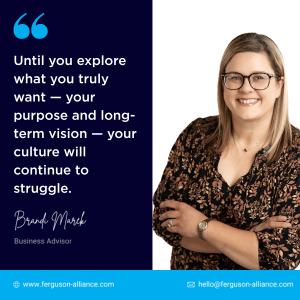
This is often the hardest part.
We ask owners and next-generation leaders to get honest about:
- Their personal goals and dreams
- How they actually feel about the business
- What they want their role to be in 5–10 years
- What they are afraid to say out loud
Until those conversations happen, culture suffers.
Leaders feel stuck.
The business may appear successful on paper, but it struggles to build a sustainable, aligned path forward.
It takes courage to do this kind of “soul searching,” but it’s essential.
Family business is personal.
Ignoring that doesn’t make it go away, it just makes it harder.
4. Address Generational Friction Head-On
In second-generation businesses, it’s common for the definition of prosperity or success to shift.
- The founder may have focused primarily on survival and growth.
- The next generation may prioritize culture, balance, and impact alongside profit.
That doesn’t mean one is right and the other is wrong, it means they need a shared language and framework.
We help families:
- Move leaders from being “bricklayers” to “architects”, from doers of tasks to builders of systems and stewards of the business.
- Develop a common purpose and vision that both generations can own.
- Use that shared purpose as the standard for decisions, governance, and culture.
It doesn’t eliminate conflict. But it gives everyone a place to stand when disagreements arise:
“I may not agree with your approach to this decision, but I can see that you’re trying to move us toward our shared long-term purpose.”
That shift, from defending positions to stewarding a shared mission, is where real prosperity begins to take root.
From Leader to Steward: The Maturity Journey
In family businesses, we often see three stages of leadership maturity:
- Bricklayer (Doer) – Focused on tasks, operations, and day-to-day firefighting.
- Leader (Builder) – Focused on teams, strategy, and performance.
- Steward – Focused on legacy, purpose, and the long-term health of the business and family.
Prosperity and philanthropy really come into focus at the stewardship level.
Stewards ask questions like:
- What kind of company are we building for the next generation?
- How will this business continue to serve our employees and community long after we’re gone?
- How do our profits fuel our purpose and our ability to give?
When owners and successors embrace stewardship, prosperity becomes about being good as well as doing well.
Bringing It All Together
Prosperity in a family business isn’t just:
- A bigger bottom line
- A higher valuation
- A successful exit
It’s:
- A business that can thrive without burning out its leaders
- A family that can sit together at both the boardroom table and the holiday table
- A culture where employees feel valued, aligned, and part of something meaningful
- A community that feels your presence, and would miss you if you were gone
Philanthropy isn’t an add-on to that picture.
It’s a powerful expression of it.
When your purpose, prosperity, and philanthropy are aligned, you create something far more durable than quarterly results: you build a legacy.
Ready to Redefine Prosperity for Your Family Business?
If you’re:
- Profitable, but not sure what “success” should look like next
- Thinking about succession in the next 3–5 years
- Wanting to strengthen culture and community impact
- Wrestling with different definitions of success across generations
…you don’t have to figure it out alone.
At Ferguson Alliance, we help family businesses clarify their purpose, align around a shared vision, and design practical strategies for prosperity and philanthropy that fit their reality.
Family business is hard. We make it easier.
If you’d like to explore what prosperity could look like for your business and your family, we’d be happy to talk.
Reach out today for a consultation with one of our experienced family business advisors.