



Most family business owners assume that when conflict shows up, it’s a people problem.
A personality clash, a long-standing rivalry, or just the complicated history that comes with being family.
In our experience, that’s rarely where the real problem lives.
In this week’s video, Rob Ferguson and Brandi Marek walk through a hypothetical, real-world scenario to show how unclear decision-making and the absence of good governance quietly erode a business from the inside out.
Here’s what you’ll hear in the video:
- Why conflict in family businesses is usually a governance problem in disguise (and why addressing the people without addressing the structure rarely works.)
- The four ways a business can make decisions including the one that masquerades as fairness but often leads nowhere, and the approach that most successful businesses default to.
- What’s happening beneath the surface when two owners are avoiding direct conflict while frustration builds, and why that pattern bleeds into the broader organization whether you intend it to or not.
- Why strategy and governance are more connected than most owners realize and how the absence of a shared direction makes even routine decisions harder than they need to be.
- What it looks like when two very different leadership styles become an asset rather than a source of ongoing friction.
If decision-making in your business feels harder than it should, or if important conversations keep getting pushed down the road, this video is worth your time.
You can watch it below or scroll to read the transcript.
Governance, Decision Making, and Conflict in Family Business
Price: When family business owners talk about conflict, they often focus on the people involved.
But in our experience, most conflict in family businesses isn’t caused by bad intentions or difficult personalities.
It’s caused by unclear roles, blurred decision-making, and a lack of governance.
So let’s look at a hypothetical case study — the Carter family.
They own a second-generation manufacturing business in the southeast, founded by their father Bill.
His two sons, Mark and David, have equal ownership and are both actively involved in leadership.
On paper, it looks fair.
Here’s how the business actually operates.
Mark is focused on growth — new equipment, adjacent markets, professionalizing the organization.
David is focused on stability.
He takes pride in the quality of the work, the long-tenured employees, and the way things have always been done.
Years ago, the brothers agreed to make all major decisions by consensus, believing that would preserve harmony and fairness.
On the surface they’re respectful — no raised voices, no direct confrontation.
But behind the scenes, frustration is building.
Meetings drag on without resolution.
Important decisions get delayed or revisited weeks later.
Senior leaders don’t know whose direction to follow.
If you were advising the Carter family, what’s the first governance change you’d recommend?
Rob: Governance, the way we define it, is how a business makes its decisions and how it handles conflict.
So that’s exactly where I’d start.
The fact that they’re making decisions consensually — I know it sounds like it would create harmony, and it sounds fair, but trying to make all decisions by consensus is very challenging.
What we’d do is help them understand that there are more ways to make decisions than just consensus.
There’s the autocratic approach — one person makes the call.
There’s the consensual approach — everyone has to agree before you move forward.
There’s the democratic approach — you vote, and the majority wins.
And then there’s the collaborative approach, which is like the autocratic approach with an important addition.
There’s one decision owner, but they actively reach out to subject matter experts to gather input and perspective before making the call.
The people they’re consulting know they’re there to influence, not to decide.
Sometimes that process leads to consensus — but often it doesn’t, and the decision owner still makes the final call.
What we’ve learned over time is that most successful businesses default to the collaborative approach.
Decision-making is decentralized, there are well-defined homes for each decision, and the person who owns a decision is responsible for it.
That approach alone alleviates a lot of problems.
Price: What do you think is happening beneath the surface emotionally for both Mark and David?
Brandi: They’re both feeling genuinely conflicted.
Mark feels passionately that growth is the right direction.
David feels just as passionately about stability.
And at the same time, both of them care deeply about the relationship with their brother and what that means for the family.
So there’s this constant push and pull — “I believe this is the right direction for the business, but pushing hard on it puts the relationship at risk.”
What we’re seeing in this scenario is serious conflict avoidance combined with very unclear decision-making, and those two things together create a real problem.
And that drive for consensus can lead to what we sometimes call the fifth way to make a decision — which is no decision at all.
When you keep hitting a wall trying to get everyone to agree, the easiest path is to keep pushing the decision off.
One of the best places to start with Mark and David would be helping each of them understand what actually drives their thinking and behavior.
A behavioral assessment can be really valuable here — it gives them a clearer picture of why Mark is so growth-oriented and why David is so invested in stability.
Once they have that clarity, they can start to leverage their individual strengths and get much more specific about who owns which decisions.
That moves them toward a collaborative approach and helps them feel more grounded in their governance structure.
Right now, the internal friction between them is showing up throughout the organization — either directly in how they interact, or indirectly in the fact that nothing seems to be moving forward.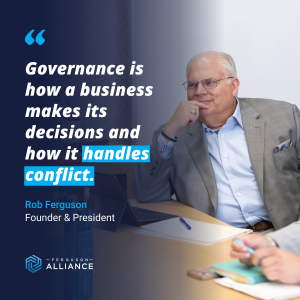
Rob: You know, Brandi, what you’re describing also points to something that goes beyond governance.
Mark is future-oriented — he wants to grow and scale.
David is holding back, trying to protect his father’s legacy.
At the core of that is the absence of a unified commitment to where this business is going.
That’s not purely a governance issue — it’s a strategy issue.
And it directly impacts decision-making.
If they can get clear on why the company exists, where it’s going, and how they plan to get there, that declaration becomes an anchor for all the difficult conversations that follow.
When things get hard, you can always come back to what you agreed the business is trying to become — and ask whether a decision moves you toward that or away from it.
That settles a lot of conflict.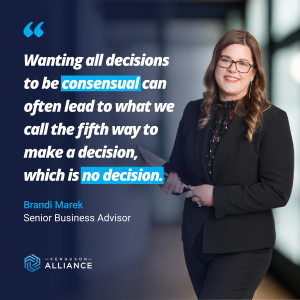
Brandi: And if they can get into a healthy mindset around this and get clear on who owns which decisions, those two different orientations — stability and growth — actually become a real asset.
You want both.
Stability without growth stalls a business, and growth without stability creates chaos.
If Mark and David can figure out how to leverage what each of them brings to the table, and make it less about their individual perspectives and more about what’s best for the company, they have something genuinely powerful.
They’ll still face challenges — every business does — but the more they can recognize and use each other’s strengths, the further they can take the business.
If decision-making in your family business feels harder than it should, we can help. Reach out to start a conversation about governance, strategy, and getting everyone moving in the same direction. Book a free consultation call with one of our experienced advisors.