


Imagine a successful second-generation family business. It’s very profitable, doing $50 million in annual revenue, with a good leadership team and a good reputation in the market.
They’ve done their strategic work, and the leadership team has agreed on what they want over the next five years:
- Grow, while staying family controlled
- Expand into two adjacent geographic markets
- Reduce their dependency on a couple of large customers
- Build a professional leadership team that can take over from the current generation
- Keep the business financially strong enough to fund that growth, without taking on excessive risk
Then a competitor calls.
The owner wants to retire, and he’s offering to sell them his company. It would immediately increase their revenue by 30%, perhaps more, and it’s priced reasonably.
The leadership team and the family get excited very quickly. Somebody says, “This is a once-in-a-lifetime opportunity. We have got to do this.”
And pretty soon the whole conversation becomes, “Can we do the deal?”
But “Can we do the deal?” is the wrong question.
The strategic question is, “Should we do the deal?”
In this video (scroll down for the full transcript), I explain the difference between having a strategic plan and having a strategic mindset. I also walk through the framework we use with our clients to build that mindset into a leadership team, so it shapes the decisions they make every day.
Along with the rest of the story, you’ll hear:
- How to build a strategic thinking muscle across your whole leadership team
- How to connect your 10-year vision to what your team needs to get done this year
- What the family’s role should be in setting the strategy for the business
- The three things every family would love to get from their business at the same time, and why you probably can’t maximize all three
- Why the hardest part of strategy for most business leaders is deciding what to say no to
- What Blockbuster’s downfall shows about which parts of your strategy should stay fixed and which have to keep changing
A Strategic Mindset Asks Whether an Opportunity Moves You Toward Who You Want to Become
Let’s apply what I call a strategic mindset to that same situation.
Instead of immediately running to the bank to see if you can finance this deal, building financial models, and talking about integration strategies, let’s start thinking strategically.
Does this acquisition move us toward who we have decided we want to be?
Maybe it does.
Does it give us something we’ve determined we must have in order to be what we want to be longer term?
Perhaps it gives them more geographic presence.
But with a strategic mindset, you dig deeper. And what you find out is that the competitor has more customer concentration than you have.
You interview the management team, and you find some holes. Missing positions haven’t been filled.
The integration effort would consume all of your leadership team’s bandwidth.
And the debt you’d have to take on would dramatically change the family’s risk profile.
So with a strategic mindset, all of a sudden the deal changes. Yes, it gives you the revenue you wanted. But it actually takes the company further away from what it’s trying to become.
The family and the leadership team decided to take a pass on this opportunity.
And you know what happened?
Six months later, a new opportunity came forward. Another acquisition.
It was much smaller, about half the size, but it was in their target market. It had a very strong brand, with a product line they didn’t have and really wanted. And it had no customer concentration, so it diversified their customer base.
They made that acquisition, and it got them further down the path to what they want to become.
Your Strategy Gives You a Filter for Every Shiny Object
That’s the difference between having a strategic plan and having a strategic mindset.
A strategic plan didn’t make the decision for them. It was the mindset that made the decision. It was the conversation.
Their strategy gave them a filter.
Without strategy, you get shiny object syndrome. Every opportunity creates excitement. We start analyzing it, and then we go off and start doing things.
With a strategic mindset, you’re still looking at the shiny object. But you put it up against your strategy and ask, does this fit?
And then you make a choice.
Sometimes the answer is no, it doesn’t fit. Just like in that story.
The Goal of Strategic Planning Is to Develop a Strategic Mindset that Enables Your Leaders to Make Better Decisions Every Day
That’s why I don’t think the goal of strategic planning is the plan. I think the goal is the conversation. It’s the process.
It’s developing that strategic thinking muscle with and throughout your leadership team.
We want leaders who understand where we’re going, why we’re going there, and what we need to have to get there.
Then they can make better decisions every day without having to go look at a three-ring binder sitting on a dusty bookshelf somewhere.
That’s a strategic mindset.
When a new opportunity comes along, we’re not just asking what we can do. We’re asking whether it helps us have what we’ve determined we must have in order to be the company we’re trying to become.
Strategy Is a Set of Choices About Where You’re Going and How You’ll Get There
Strategy is the next fundamental of our model.
Strategy gives us the direction. People give us the capabilities. Governance gives us the structure.
Strategy is how we win.
But before you decide what you want to do, you have to set some context. Who do we want to become? And what must we have to become that?
Strategy is not a budget. It’s not a binder. It’s not a list of goals. It’s a set of choices about where you’re going and how you’re going to get there.
A good strategic plan tells you where you’re going. A strategic mindset changes how you make decisions along the way.
It’s a dynamic, living document. That’s why I like to refer to it as a mindset more than a written plan.
Shifting Priorities, Silos, and Constant Debates Are Signs You Need a Strategy
Look at your company and see if you have any of these symptoms:
- No unified, common direction
- Priorities that are always shifting
- An organization working in silos
- A leadership team that reacts to the market
- Relying on your past success model
- A great vision with no execution around it
The other one I’ve really noticed is leadership meetings that always turn into confrontations or debates.
Instead of talking about choices, we’re arguing about who’s right and who’s wrong.
All of those are symptoms that you need a strategy. Underneath all of them, you haven’t established the context for your people to make good decisions and become aligned with your long-term goal.
When the context isn’t clear, organizations wander around.
Your leadership team is going to want to take action. They want to do stuff. They want to make sure they’re being productive.
And that’s okay. But I think it’s incomplete without knowing who we want to be.
That’s where strategic thinking really comes in.
Strategy Starts With Who You Want to Become
We call it our Be-Have-Do model.
The “Be” sets the context for what the company wants to be. Without it, you’ll be busy having things and doing things, and doing things to have things, but you’ll never get anywhere.
Once you’ve established your long-term vision of what you’re striving to become, you can prioritize your activities. And you don’t get stuck in that “Have-Do” loop.
You’ve seen it.
“We need to have more revenue.”
“All right, what do we need to do?”
“We need to hire more salespeople.”
“All right, let’s go hire more salespeople.”
Now they have more revenue. But it’s in the wrong market, or it’s at the wrong margin.
There was no context. What kind of revenue don’t we want? Where do we want the revenue to be?
Activity isn’t strategy. Strategy is all about context, and where we’re headed.
A Strategic Framework Connects Your 10-Year Vision to This Year’s Priorities
We’ve translated Be-Have-Do into a strategic framework we use with our clients, so they can turn it into something that can actually be operationalized.
It provides direction. It connects the long-term aspiration of the company to today’s tasks.
It’s a series of three horizons.
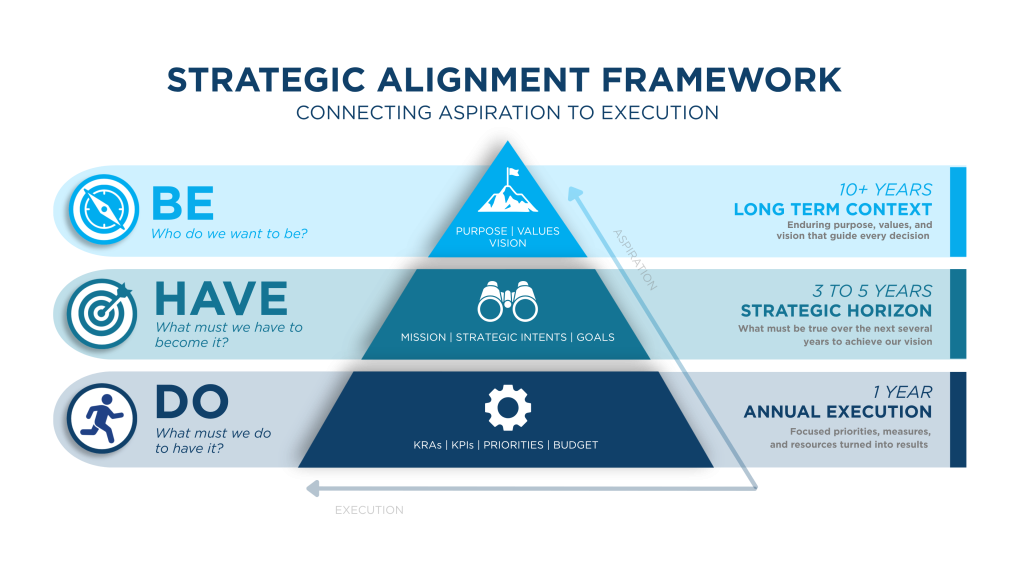
Horizon 1: Your purpose and vision
The first horizon is your purpose. It’s your vision of what you aspire to become in the next 10 years or more.
It’s as far out as you can see.
Horizon 2: Your mission and strategic intents
The second horizon is what you have to have in order to become that. That’s your mission and your strategic intents.
This one usually has a time horizon of three to five years.
Horizon 3: What you have to do this year
The third horizon is the now. What do you have to do this year?
That’s where your budget sits, along with your priorities, your key result areas, and the KPIs you’ll use to measure your performance. Those will change year to year.
The framework moves you from an aspirational idea of where you’re going to be in 10 or 15 years to what you have to do this year.
Family Strategy and Business Strategy Have to Be Developed Together
In a family business, there’s another dimension we can’t ignore.
The business has a vision, but so does the family.
The business has needs: capital, leadership, talent, growth. The family has expectations around ownership, family careers, distributions, and risk.
So when we’re thinking about strategy in a family business, we have to have a parallel system.
Family strategy and business strategy can’t be developed independently. Family values, commitment, and vision all must align with the business side.
The objective isn’t for the family to dictate the strategy of the business. It’s to create alignment, so the family can support what the business needs to prosper.
Family Business Strategy Means Choosing Tradeoffs Between Growth, Control, and Liquidity
Once expectations are clear between the family and the business, and you have clear thinking on the vision, mission, and strategic intents, you have to realize there are going to be tradeoffs.
They come in threes: growth, control, and liquidity.
Every family we work with would love to have all three at once. It’s a real challenge.
Growing costs money. So the family and the leadership team have to decide.
Are we going to fund our growth by giving up liquidity? Or are we going to fund it by giving up some control?
Maybe you don’t want to grow as much as the leadership team does, because you want to keep control and liquidity. The tradeoff is less growth.
Maybe it’s very important to you to keep control and grow. So you give up liquidity, and you don’t make as many distributions that year.
Once you understand that you probably can’t maximize all three, you can make an informed decision.
A Good Strategy Starts With a Clear View of Where You Are Today
Once that decision’s been made, it’s time to assess where you currently are.
You’ve established where you want to be and what you must have to get there. Now you need a clear view of your current situation.
We use a lot of tools to do that: SWOT analysis, Five Forces, the Ansoff Matrix, PESTEL.
They help us understand:
- Your position in the market
- Your competitive advantage
- The economics of your business
- The strength of your customer relationships
- The strength and capabilities of your leadership team
- How operationally sound you are
If you don’t know where you are, you’re going to have a very challenging time getting to where you want to be.
Strategy Means Saying No to a Lot of Things
Then it’s all about strategic choices.
Where do we want to compete? How do we want to win? And how are we going to do that with our products, our customers, our geographies, and our channels?
I think this is the most difficult thing for business leaders to wrap their minds around.
Strategy requires saying no to a lot of things. It’s how you compete today, and at the same time, how you prepare for tomorrow.
Today’s success can’t become tomorrow’s trap.
Every Strategic Intent and Key Result Area Needs an Owner
So how do you turn strategy into execution?
Your strategic intents and goals cascade down into your annual priorities. Those drive your decisions for budgeting and planning.
Then you follow up on a regular cadence:
- Weekly, from an operations perspective
- Monthly, from a sales, marketing, and financial perspective
- Quarterly, from a strategic perspective
Every strategic intent and every key result area must have an owner, so it gets executed in a timely manner.
Strategy Gives You an Enduring Purpose and the Flexibility to Adapt
A lot of organizations have failed because they didn’t change with the times. The one I want to highlight is Blockbuster.
The year is 2004, and Blockbuster is at its peak. They’d survived the transition from VHS to DVD. Remember those days?
Their downfall started when Netflix began sending DVDs to your mailbox in a little red envelope. That blew up Blockbuster’s brick-and-mortar model.
Then cable started streaming movies. You didn’t need a device to play a movie anymore. You could stream it right to your TV. The phone companies got involved too.
And a little company called Redbox came along. You no longer needed a big store like Blockbuster. There was a kiosk outside your neighborhood pharmacy where you could rent a movie for a dollar.
Blockbuster didn’t change. They didn’t react. They weren’t a leader in that technology change, and they ended up very reactive.
They even turned down the chance to buy Netflix.
And the rest is history. Blockbuster is no longer around or relevant.
That’s a hard lesson, no doubt.
Blockbuster could have kept an enduring purpose. Its values about how it treated employees and customers could have stayed in place. Purpose and values should be long-lasting.
But they weren’t looking at what they had to have to keep that purpose alive, and they certainly didn’t change what they were doing. The technology evolved, and customer habits changed.
That’s why I come back to our strategic alignment framework. It gives you something stable enough to maintain at the top, and deeper down, the flexibility to adapt as you go.
When your leadership team shifts its mindset to strategic thinking, not just planning, you can move your company forward successfully.
Strategy Creates Alignment Between the Family and the Business
Strategy is all about alignment.
It creates alignment between the family and the business.
It creates alignment between your long-term vision and today’s priorities.
And it creates alignment between leadership decisions and direction.
A strategic plan tells you where you’re going. A strategic mindset changes how you make decisions along the way.
When that way of thinking becomes ingrained in your leadership, you’ll have a successful, long-term, prosperous business.
Want help building that mindset across your leadership team?
Talk with one of our experienced family business advisors →
Family business is hard. We can help.
How we can help
- Align your family and business around a clear strategy
- Set up governance and a board so decisions get made
- Plan a smooth succession and transition to the next generation
- Build a leadership team that can run the business without owner-dependence
- Improve operations and financial performance
Whether you're looking to scale, strengthen leadership, or plan your transition, we'll help you build a business that lasts for generations.
When your family and your business are aligned, everyone wins.
More on Building a Strategic Mindset, Making Strategic Choices, and Aligning the Family With the Business
A Framework for Family Business Strategy
A two-minute video from the same presentation, focused on the three horizons and why family strategy and business strategy have to be built together.
Why Strategic Planning is Crucial for Your Family Business
The difference between strategic growth and opportunistic growth, why the planning matters more than the plan, and the reasons business leaders resist the process.
The Family Business Priority Triad: a Strategy for Growth
A closer look at the tradeoff between growth, control, and liquidity, with examples of what owners give up when they prioritize each pair.
Strategic Planning for Family Businesses: Using SWOT, PESTLE, and Ansoff
How three of the assessment tools mentioned in this video work, and what each one tells you about where your business stands before you set direction.
Acquisition Success Factors
Eight things to weigh before buying another business, starting with whether the acquisition fits your strategy and long-term goals.
Famous Strategic Failures (and What We Can Learn From Them)
More on Blockbuster’s decline, alongside Nokia and Kodak, and the warning signs that a once-successful strategy has stopped working.
Is Your Strategic Plan Gathering Dust? (Here’s What to Do About It)
Episode 4 of the Prosperity Playbook follows three siblings who each want something different for the business, and what happens when their strategic plan sits on a shelf.
What Does It Take for Your Family Business to Survive for Generations?
Where Strategy fits among the six fundamentals of our Family Business Prosperity Model, and the one decision that shapes all of them.