


Most family business owners have a strategic plan.
The challenge?
Many of those plans are sitting on a shelf somewhere, outdated and unused.
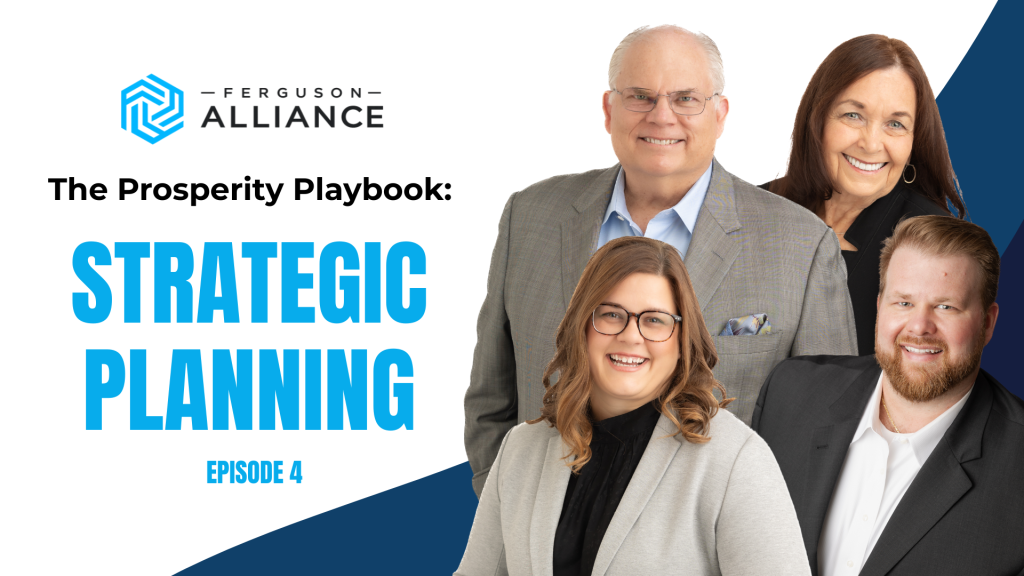
In Episode 4 of The Prosperity Playbook, we explored why strategic planning remains one of the most powerful tools a family business has, and what happens when it stops working.
We walked through a real-world scenario that reflects what we see regularly in family businesses: the Miller family.
(This isn’t a real client — we take confidentiality seriously. But this example captures the kinds of challenges our clients bring to us.)
You can watch the video here, or scroll down to read the highlights.
The Miller Family’s Situation
The Miller Family Manufacturing Company is a second-generation business with about 120 employees and strong revenue.
The company has been profitable for years, but recently growth has stalled, margins are tightening, and competitors are getting more aggressive.
On the surface, things look stable.
But underneath, alignment is breaking down.
The company is owned and led by three siblings:
Mark wants to stabilize operations, protect cash flow, and minimize risk.
Susan wants controlled growth — new products, better systems, and reinvestment in leadership.
David is pushing for aggressive expansion and acquisitions.
Each believes they’re acting in the best interest of the business.
They do have a strategic plan, a comprehensive document created during an offsite two years ago.
But it hasn’t been revisited since.
No one can clearly articulate the current priorities, and managers don’t reference it when making decisions.
The result?
- Leadership meetings become debates rather than decisions.
- Managers are unclear on what matters most.
- Projects start but don’t finish.
- Frustration grows across the organization.
If this sounds familiar, you’re not alone.
What’s Really Going On?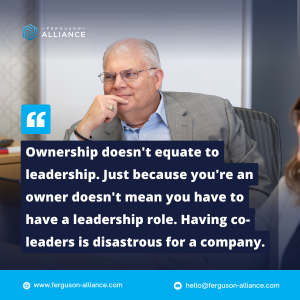
When strategic plans sit unused, there’s usually a deeper issue..
In the Miller family’s case, the core problem isn’t the plan, it’s the lack of shared direction.
The document exists, but there’s no real agreement on where the business is headed.
Without that clarity, each sibling naturally pursues their own vision, and the organization fragments.
This is where motivation matters.
When progress stalls, it’s worth asking:
- What do the owners actually want?
- Are they energized by the work, or feeling stuck?
Understanding individual motivations, both professional and personal, becomes essential before any strategic plan can gain traction.
The Leadership Challenge
One critical distinction often gets overlooked, as Rob pointed out: ownership and leadership are not the same thing.
Equal ownership stakes don’t translate to equal leadership roles.
Just because you’re an owner doesn’t mean you have to have a leadership role.
Trying to operate with co-leaders creates confusion about who makes final decisions and who’s accountable for results.
When leadership roles aren’t clearly defined, people often fall into a pattern of trying to prove they’re right, which means proving others wrong.
This turns conversations into debates about who has the better idea rather than discussions about what’s best for the business.
The more productive question to ask:
What is the right direction for the company as a whole?
The Impact of Leadership Energy
There’s another important factor to consider: the energy level of leadership itself.
As Rob noted, when leaders feel burned out or complacent, that affects everyone in the organization.
Strategic planning works best when viewed as an ongoing leadership practice, not just an annual event.
Thinking strategically about the future can actually be energizing.
It creates space to envision what’s possible and to inspire others with that vision.
But when leadership stays focused only on daily tactics and immediate constraints, that forward-looking energy fades.
Looking for Deeper Root Causes
The symptoms we see in situations like the Miller family’s often point to deeper issues.
As Brandi explained, a strategic plan that isn’t being executed might not be a planning problem at all.
There may be barriers to execution that have nothing to do with the document itself.
It’s similar to treating an infection, you need to diagnose what’s actually causing the problem before choosing the right solution.
Otherwise, you invest time and effort addressing the wrong issue.
When a family business finds itself stuck, it helps to look at the history:
- Where has the organization been?
- What has motivated leaders to stay engaged?
- What are the underlying goals?
Sometimes the real challenge is that family members hold fundamentally different visions for the future.
Before they can move forward with any plan, they need to have honest conversations about those differences and find common ground.
The strategic plan isn’t the problem, the unresolved differences in vision are.
Why Strategic Plans Stop Working
Strategic plans often fail to produce results when they’re not regularly revisited and adjusted.
- Markets change.
- Technology evolves.
- Competition increases.
As Jan pointed out, a plan created two years ago may no longer fit today’s reality, and hoping a strategic plan will last you 3 to 5 years just isn’t realistic anymore.
Regular review is essential.
Some businesses benefit from reviewing strategy twice a year.
Others reference it monthly.
The goal isn’t perfection, it’s adaptability.
A strategic plan should be a living document that guides decisions, not a static artifact.
Three Common Reasons Plans Fail
1. They’re Too Complex
Entrepreneurs are natural ideators.
They see possibilities everywhere and want to pursue them all.
This enthusiasm often leads to strategic plans that try to accomplish too many things at once, making execution nearly impossible.
2. They’re Misaligned with Current Capabilities
A strategic plan needs to match your organization’s actual competencies.
If your plan requires skills, systems, or resources you don’t yet have, implementation will stall.
Think of it like a football team, you adjust your playbook based on the talent you have, not the talent you wish you had.
3. Commitment Is Missing
True commitment can’t be forced.
Sometimes leaders convince themselves everyone is on board when team members are simply being polite.
Real commitment shows up in consistent action, not in initial agreement during a planning session.
The Power of Simplicity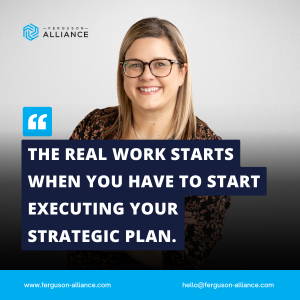
One of the most effective approaches Rob advocates is keeping the plan simple, ideally on a single page.
When you condense your strategy, you’re forced to make real choices.
You have to prioritize.
You can’t pursue everything at once.
This constraint is actually a strength.
A one-page plan is easier to communicate, easier to remember, and more likely to actually guide daily decisions throughout your organization.
Making Your Strategy Visible
A strategic plan only works if people know about it and understand it.
In some organizations, the strategic plan exists but stays locked in the executive suite.
Employees know the mission statement posted on the wall, but they don’t know how their work connects to broader strategic goals.
When team members who can influence strategic outcomes don’t know what those outcomes are, progress becomes difficult.
Consider including strategic direction in your onboarding process.
Make it part of how you orient new team members.
In a family business especially, where teams tend to be close-knit, everyone should understand where you’re heading and how they contribute to getting there.
Bringing Strategy Into Daily Decisions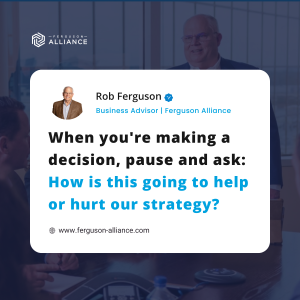
As Brandi reminded us, creating a strategic plan is the easy part.
The real work begins when you start executing.
Think of it as “bringing the future to the present.” The future arrives whether you’re prepared or not.
The question is whether your daily decisions are moving you toward the future you want.
This requires what Rob calls a strategic mindset, a habit of pausing before important decisions to ask:
“How is this going to help or hurt our strategy?”
When you’re hiring someone, ask: Will this person help us achieve our mission?
When you’re considering a new product line or acquisition: Does this align with our strategic direction?
When you’re handling a performance issue: Are our actions consistent with our stated values?
This kind of thinking doesn’t come naturally to most operational leaders.
It’s a muscle that needs exercise.
But it’s what transforms a document into a living tool that shapes your business.
The Family Dynamic Factor
In family businesses, Brandi emphasized, clarity about decision-making is essential.
When it’s unclear who owns which decisions or who’s accountable for specific outcomes, execution falters.
If everyone assumes someone else will drive success, no one takes ownership.
Beyond organizational clarity, there’s a deeper personal question each family member needs to answer honestly:
Is this what I really want?
This takes time to figure out.
Are you involved in the business out of genuine passion and commitment, or out of obligation and family legacy?
This matters because lack of authentic commitment shows up in the business, no matter how hard you try to mask it.
If you’re not genuinely invested, it will affect your leadership, your decisions, and ultimately the organization’s performance.
Jan pointed out that common family dynamics often complicate this picture.
Sibling rivalry can surface, the youngest feeling overlooked, the oldest feeling entitled to final say.
Birth order and family history create patterns that spill into business decisions.
These family issues need to be addressed directly.
In many cases, the family dynamic is exactly what needs attention before any strategic plan can succeed.
Why Family Business Strategy Feels Different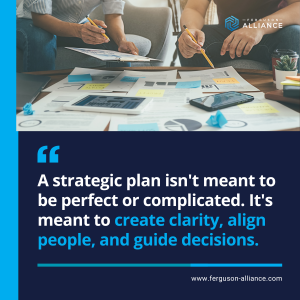
Strategic planning in a family business carries emotional weight that doesn’t exist in other organizations, as Rob highlighted in our discussion.
When siblings, parents, children, or cousins are involved, every business decision becomes personal.
This emotional dimension makes family business strategy uniquely challenging but also uniquely rewarding.
At its core, strategy is about choosing how you’ll win in the marketplace.
For family businesses, that includes defining what “winning” means, not just financially, but in terms of values, legacy, and family wellbeing.
The key is approaching these conversations authentically.
Family members can’t be “in it to win it” just to prove they’re right.
The focus needs to stay on what’s right for the business as a whole.
Family businesses offer distinctive strengths: creativity, innovation, long-term thinking, and measured risk-taking.
But they also require navigating family dynamics carefully.
These conversations must happen.
You can’t ignore them or bury the emotions.
You need to have them in a safe environment where everyone remembers you’re working toward the same goal.
Strategic planning remains essential, perhaps more than ever.
But only if your plan actively guides decisions rather than gathering dust.
The Miller family’s situation reflects what many family businesses experience: capable people with good intentions working hard, yet making limited progress because they lack shared direction.
A strategic plan isn’t meant to be perfect or exhaustive.
It’s meant to create clarity, align your team, guide decisions, and adapt as conditions change.
If your plan is sitting on a shelf, consider this your invitation to dust it off, simplify it, and transform it into a living tool your organization actually uses.
If this sounds familiar and you’re not sure where to start, you don’t have to figure it out alone.
At Ferguson Alliance, we help family businesses create clarity, build alignment, and develop practical strategic plans that drive execution rather than discussion.
Sometimes an outside perspective is exactly what’s needed to cut through complexity and find a clear path forward.
The future is coming whether you plan for it or not.
The question is whether you want to shape it or simply react to it.
Family business is hard.
Clarity makes it easier.
Ready to turn your strategic plan into action? Contact us today for a free consultation with one of our trusted family business advisors.