


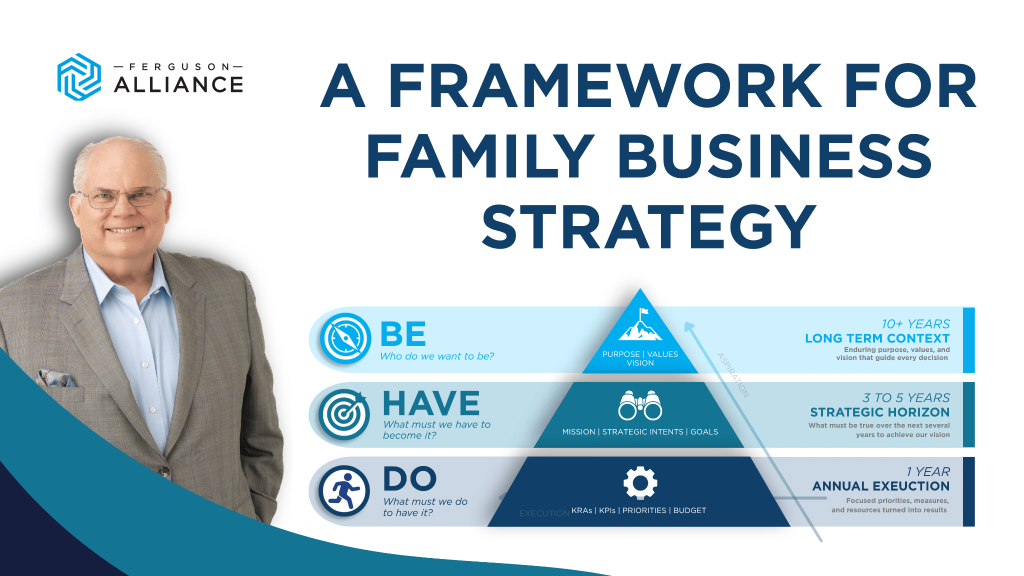
Strategy is a set of choices about where you’re going and how you’re going to get there. Those choices give everyone something to measure decisions against. Your people can make good calls day to day without coming to you first.
When that context isn’t there, an organization wanders.
Priorities shift month to month. Departments work around each other. And leadership meetings turn into debates about who’s right instead of conversations about what to choose.
We use a framework with our family business clients that puts that context in place.
The framework starts with a simple model we call Be-Have-Do.
The “Be” is what sets the context of what the company wants to become. “Have” is what it needs to get there. “Do” are the actions that need to be taken.
Without the “Be” defined, companies get stuck in a “Have-Do” loop. Staying busy having things and doing things to have things, and never getting anywhere.
Activity isn’t strategy. Defining the “Be” is what breaks the loop.
Watch the two-minute version below to see how the framework does that, or scroll down for the transcript.
Strategy is all about context. Where we’re headed.
We’ve taken our Be-Have-Do model and translated it into a strategic framework that we use with our clients.
It helps them convert Be-Have-Do into something that can actually be operationalized.
It provides direction. It gives you a framework that connects the long-term aspiration of the company to today’s task of what needs to be accomplished.
The Framework Moves You from a 10-Year Vision to What You Have to Do This Year
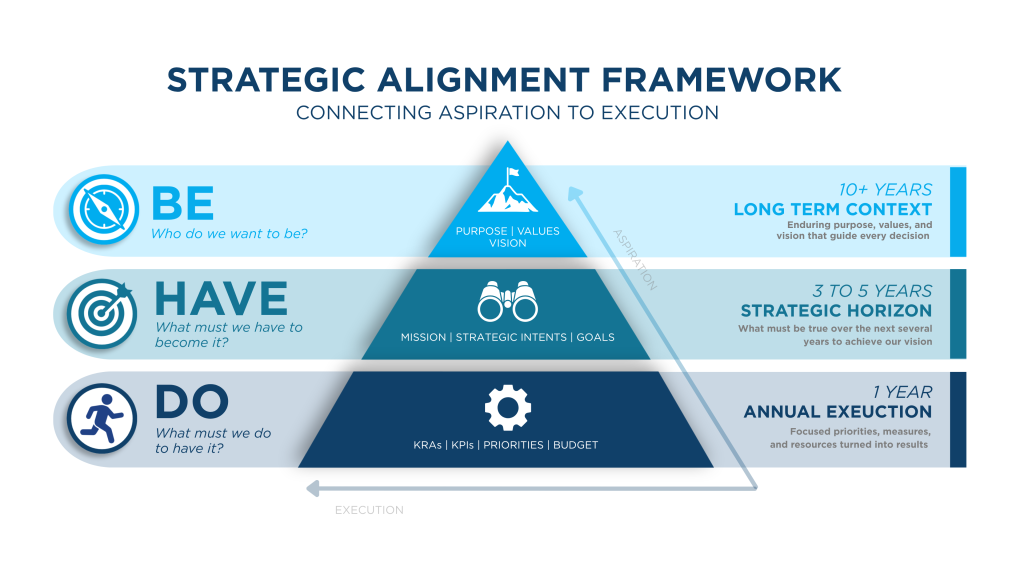
If you look at it, it’s a series of three horizons.
The first horizon is your purpose. It’s your vision of what you aspire to become in the next 10 years or more. It’s as far out as you can see.
The second horizon starts talking to you about what you have to have in order to become that. That’s your mission and your strategic intents. This one usually has a time horizon of three to five years.
The next horizon is the now. What do you have to do this year? That’s where your budget sits, where your priorities are, your key result areas, and how you’re going to measure your performance with your KPIs. Those will change year to year.
The framework moves you from this aspirational idea of where we’re going to be in 10 or 15 years to what we have to do this year.
Family Strategy and Business Strategy Have to Be Developed Together
In a family business, there’s another dimension I don’t think we can ignore. The business has a vision, but so does the family.
The business has needs: capital, leadership, talent, growth. The family has expectations. Expectations around ownership, family careers, distributions, and risk.
So we have to have a parallel system when we’re thinking about strategy in a family business. Family strategy and business strategy can’t be developed independently. They have to come together. Family values, commitment, and vision all have to align with the business side.
The objective isn’t for the family to dictate the strategy at the business. It’s just to create the alignment so that the family can support the business needs for a business to prosper.
Where Does Your Family Business Want to Be in 10 Years?
We work with family businesses to build the strategy across all three horizons, and to build the family strategy that has to run alongside it.
Talk with one of our experienced family business advisors about getting yours in place.
More on Setting Strategy, Defining Your Vision, and Aligning the Family With the Business
Gaining Alignment Through Purpose, Vision, and Mission
What purpose, vision, and mission each mean at the Alliance, and how the three of them together define the impact your business has.
Why Your Family Business Needs a Shared Vision
The signs that a business is missing a shared vision, from competing agendas to silos to employees who have no idea what the company is aiming at. Includes the three-stage process we use to build one, which always starts with the family.
The One-Page Strategic Plan for Family Businesses
The eight elements worth distilling a strategic plan down to, from the SWOT analysis and business purpose through to one-year goals and quarterly targets.
Executing Your Strategic Plan: Where Strategy Comes to Life
A short video on what moves a finished plan into daily work. Covers the process we call leadershipping, and why it starts with bringing the future into the present.
Is Your Strategic Plan Gathering Dust? (Here’s What to Do About It)
Episode 4 of the Prosperity Playbook, built around three siblings who each have a different idea of where the business should go. Covers what happens to a plan nobody revisits, and why ownership and leadership are not the same thing.
The Crucial Question for Family Businesses: Family Needs or Business Priorities?
Rob on the Construction Genius podcast with Eric Anderton, on whether you run a family-first business or a business-first family. That one decision shapes everything from who gets which role to how succession works.