


There’s a question I ask every founder I sit down with:
If you disappeared for 90 days, what would break in your business?
Most of them already know the answer.
And it’s not a comfortable one.
The business owners I work with aren’t failing.
The business is working.
But somewhere along the way, growth started feeling less like freedom and more like a trap.
More decisions land on your desk, not fewer.
More depends on you being in the room, not less.
You took a vacation last year and spent most of it anxious, checking your phone, putting out fires.
Most owners build their business expecting that growth will eventually buy them freedom. What they get instead is complexity.
I see it all the time.
A founder builds something real — wins clients, develops relationships, drives results — and then discovers that the business works because of them, not without them.
They’ve become the top producer, the final decision-maker, the culture carrier, and the safety net all at once.
When that’s you, growth doesn’t reduce your load.
It multiplies it.
I had a client whose team told me,
“The business works because of him.”
They meant it as a compliment.
I heard it as a risk signal.
If you are the system, you are the constraint.
And eventually, you’ll hit a ceiling — either in growth, in value, or in your own quality of life.
Before we talk about solutions, there’s a foundational question every family business owner has to answer honestly
Will you be a business-first family?
This isn’t philosophical.
It’s operational.
Your answer shows up in how decisions get made, who gets promoted, how people are paid, and ultimately — whether your business is sellable or transferable.
Family-first businesses prioritize family harmony above all else.
That’s understandable.
But it often leads to people in roles they’re not suited for, decisions made to avoid conflict rather than create value, and businesses that are far more fragile than they appear.
Business-first families are different.
They prioritize the enterprise, which actually protects the family over the long run.
When the business is healthy and well-structured, it takes care of everyone.
In our experience, business-first families are simply more likely to stand the test of time.
The Prosperity Model: a Replacement for Heroics
At Ferguson Alliance, we work with family businesses through what we call the Prosperity Model.
This is our framework built on one foundational decision:
Will you be a business-first family?
and six core pillars: Governance, People, Strategy, Operations, Finance, and Growth.
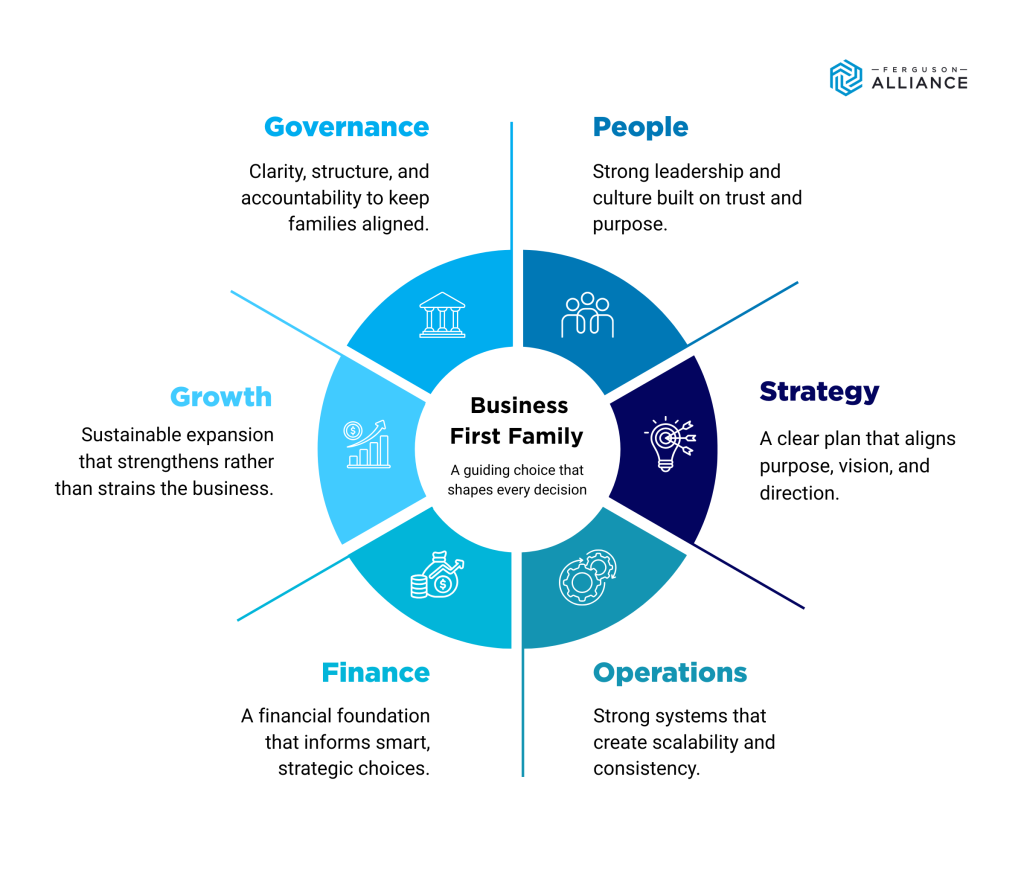
Every one of these pillars supports transferability, not just growth.
This isn’t just about building a bigger business.
It’s about building a better one.
One that could run without you, one that can be passed to the next generation, or one that someone else would actually want to buy.
Let me walk through each one briefly.
Governance is simply how decisions get made and conflicts get resolved when you’re not in the room.
If the answer to every question is “find the owner,” you have a governance problem.
Scalable governance requires clear decision owners, separation between ownership and management, and structures that don’t require consensus on everything.
People is where most of the good intentions go wrong.
Role before relationship.
Capability before title.
Leadership is built, not inherited.
For next-generation family leaders, this means clear entry criteria, relevant outside experience, and performance standards that apply to everyone equally.
The goal isn’t to be hard on the next generation.
It’s to prepare them.
Protection feels loving in the moment.
Preparation is loving over time.
Strategy has to live somewhere other than your head.
I can’t tell you how many businesses I’ve walked into where the strategy exists — but only the owner can articulate it.
If your people can’t explain the strategy, they can’t execute it.
A good strategy tells you where you’re going, how you’ll win, and — just as important — what you’ll say no to.
Operations is where strategy either becomes reality or dies on the vine.
This is the bridge most founders never intentionally design.

There’s a vision on one side, and the demands of execution on the other.
The operating model connects the two.
Documented workflows, clear service models, delegation rhythms — these are how intent survives the founder.
Mission control beats heroics every time.
Finance is not just scorekeeping — it’s a strategic tool.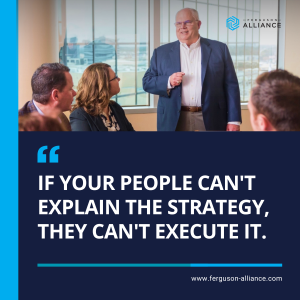
Most family business owners treat finance as an extension of accounting, but accounting tells you what happened while finance tells you what to do next.
When your financial function is working right, the business can make smart decisions without you in the room.
Growth deserves a closer look, because not all growth is created equal.
Healthy growth improves margins, builds leadership capacity, and reduces dependency risk.
Unhealthy growth adds complexity, increases the founder’s load, and masks structural weakness.
Growth that requires you isn’t growth.
It’s disguised risk.
The goal isn’t to remove yourself from a business you love. It’s to design a business that gives you a choice.
Let me ask you the version of this question I ask at the end of every talk:
Can your team run the business without you?
Who makes decisions when you’re gone?
Who owns the client relationships?
Who leads the team?
If the answer is “me” — that’s not a failure.
That’s clarity.
And it’s also where we start.
The goal isn’t to remove yourself from a business you love.
It’s to design a business that gives you a choice.
Whether you want to step back, bring in a successor, hand it to the next generation, or eventually sell — you need optionality. And optionality requires design.
Where to Start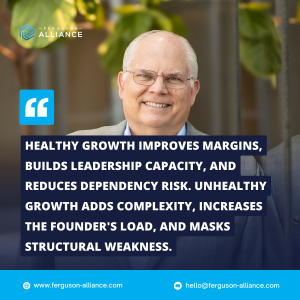
If any of this landed, here are the first moves I’d encourage you to make in the next 90 days:
Clarify who owns which decisions.
Audit your incentives — both sales and admin — to make sure you’re rewarding what you actually want.
Identify leadership gaps, especially in the next generation.
And start removing yourself intentionally, one area at a time.
If you want to know where you stand right now, we also offer a Prosperity Score baseline — an assessment designed to show you exactly where your business is strong and where it’s fragile.
The question isn’t whether you’ll eventually exit this business.
Every owner does.
The question is whether you’ll do it on your terms — or on someone else’s.
Ferguson Alliance helps family businesses grow, strengthen, and plan for what’s next. If you’d like to talk through where your business stands, we’d love to connect.
Reach out today to schedule a consultation with one of our trusted family business advisors.