


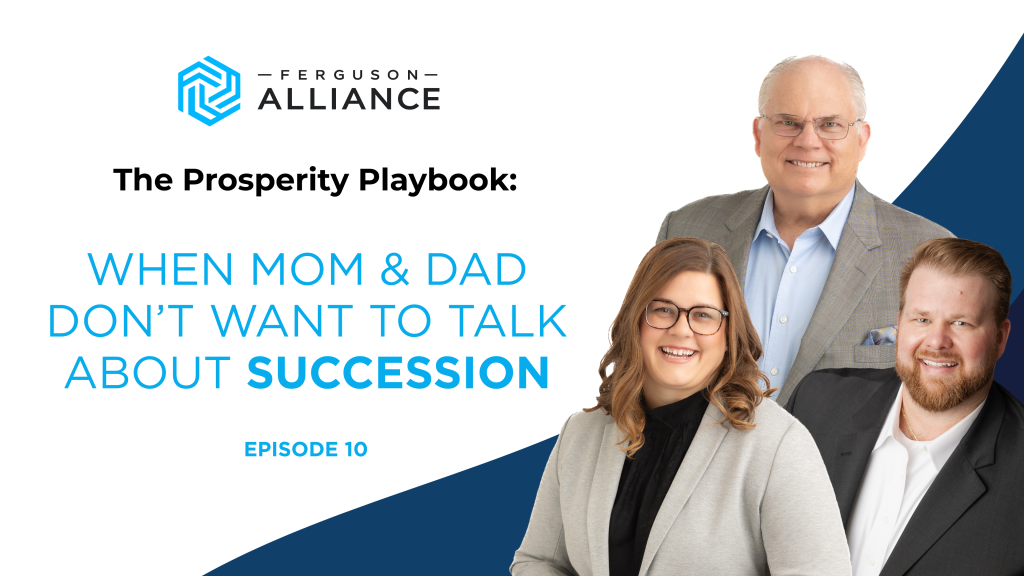
When Mom and Dad Don’t Want to Talk About Succession
For a lot of next-generation family members, the hardest part of succession planning comes before any planning starts. It’s getting the sitting generation to sit down and talk about it.
The founder or current owner goes quiet, changes the subject, or says there’s just not enough time right now.
The family stays stuck in the same unresolved place, sometimes for years.
In this episode of The Prosperity Playbook, Rob Ferguson and Brandi Marek join Price Ferguson to talk about why so many owners avoid succession planning, and what it takes to get the conversation started. They cover:
- The three separate conversations inside succession planning, and why owners so often treat them as one
- Why so many owners feel trapped in their own business, even when they can afford to retire
- Why “we’ll get to it eventually” gets more expensive every year you wait
- Why waiting for a plan can be harder on the next generation than getting a plan they don’t like
- What it usually means when a family member keeps saying succession planning is too expensive or too early
- One question that makes it hard for a resistant parent to keep saying no
- Whether it’s ever the right move to push your parents harder to start a succession plan
- How to decide what each group (family, employees, advisors, customers) hears about your succession plan
- What gets lost when you ask AI to write your succession plan
You can watch the full episode below, or scroll down to read the conversation.
Why do so many families avoid starting, finishing, or even talking about a succession plan?
Brandi: Most of the time, you don’t know what you don’t know. It can seem a little scary, especially from the side of the person who wants succession planning to happen and wants the family to talk about it. It makes you really nervous.
Think about any difficult conversation, or any conversation where you’re not exactly sure what the outcome’s going to be. As humans, we tend to put that off. That’s usually what’s happening in the beginning.
Rob: I agree, Brandi. I think the issue is that the founder, or the patriarch who’s leading the business, has this mindset that talking about these sensitive issues is going to cause friction in the family.
So they put up a wall of excuses. “I don’t have the time.” “We’re too busy right now.” “It’s too early.” “I don’t want my kids to know our financial situation.” I had one client who said, “I don’t want my wife to know our financial situation.”
All these excuses bubble up to avoid the conversation. But events happen. Without a succession plan, or an emergency contingency plan, you’re truly doing a disservice. Not talking about succession planning is going to create far more than any friction you were worried about.
What life events does a succession plan help a family navigate?
Rob: The common ones are death, disability, and divorce. Those are unexpected events, and people don’t naturally want to think about them.
I’ve been working with a client for two years now on his succession planning. I know that sounds like a long time. But he’s been very thoughtful and diligent about setting everything up, from his wills and estates to his leadership succession. Now we’re working on a long-term, 10-year plan for ownership succession.
If a life event happened to him, the business would continue on. He set up an advisory board, so his wife would have the right advisory team to help her through whatever decisions need to be made.
He’s done all the right things. It takes some time, effort, and maybe a little bit of money to set it up. But his family is going to be very, very appreciative of all that he’s done.
Brandi: We have a ton of owners where a large percentage of their net worth is the business. Then some sort of life event happens, and maybe they need to access that money. But they’ve never had a conversation about what it would be like to sell the business.
So just the simple act of starting these conversations can help. You don’t want to have that conversation in the thick of a high-pressure situation in the family. That just makes it even worse.
Rob: That’s a really good point. Life events can be emotional, and that’s the last place you want to make big decisions. You want to make all of them before the event happens, so you can base them on fact and truth rather than an emotional reaction.
Does a succession plan mean it’s time to retire?
 Rob: It’s accurate in the sense that many business owners (not all, but many) have their identity wrapped up in the business. They founded it. They’ve been working there for 30 years. They’ve built it into something they should be very proud of.
As soon as you start talking about succession planning, they think, “Now what am I going to do? I’m going to lose my identity. I don’t have a life outside of this business.” So they don’t want to do it.
We help them through that. We help them understand that to their family, their community, and their employees, they’re something much bigger than the logo on their business. Eventually they realize they do have a life after the sale.
A lot of times, we have to help them find that purpose, or reorient it. It’s fascinating to talk to these owners three, four, or five years after their succession planning. They’re enjoying their life, and they actually have more freedom to pursue a whole new chapter. They become very purpose-driven.
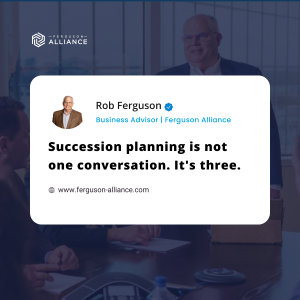
But it’s tough for founders in particular to make that leap, because they don’t want to retire. Owners have this misconception that succession planning means retirement. They haven’t separated what we call the three conversations.
It’s not only succession of ownership. It’s also succession of your wealth, and succession of leadership. Those are three different things, and we try to talk about them separately.
Leadership succession might come first, moving from president or CEO to chairman. The owner shifts into more of an oversight role instead of being immersed in day-to-day operations. The next generation comes in as president, but the owner still retains ownership.
Having these three separate conversations helps move that misconception out of their thinking.
Brandi: That’s where some of the real challenges come in. You’re not only talking about succession. You’re also talking about the boundaries of each one of those roles. That can be especially difficult for owners who have been operators, because their identity is tied up in all of it.
That’s the crux of why this work is so challenging. You’re trying to set the business up for success. At the same time, as the owner, you’re in an identity crisis. You’re facing two very challenging things at once.
And it might not line up with what the next generation wants you to do. So you’re battling a lot of internal things to sort through.
Rob: Because of that, the owner feels trapped, particularly an owner who doesn’t have a family successor or even a non-family successor. They feel like, “I have to do this. I have to work. My retirement plan is the graveyard.” That’s a terrible retirement plan.
They may have plenty of money and the ability to retire happily. But in their mind, they don’t see a way out. That’s where we come in. We show them all the different options available to them and help them find freedom from being trapped in their own business.
It’s their own way of thinking that’s trapped them, not reality.
Who’s usually part of those conversations: just the owner, or the spouse and other generations too?
Rob: It depends. We have to meet the client where they are.
If we have an owner like the one I just described, whose succession plan is the graveyard, we have a lot of work to do. We have to help them broaden their thinking and raise their perspective, so they see there’s optionality here, and that they have a greater purpose than just their business.
In that case, we work them through some assessments to help them get to breakthrough thinking. We have them talk to their spouse, and then maybe to other family members. As they go through that, we start laying out a plan for what their purpose can be after the business. In other words, let’s think about this as the next chapter in your life. What does that look like?
That takes time. There’s no formula or recipe, because every person is an individual.
But eventually they get to the place where they realize, “I see that there’s more to my life than this business. I can reduce my time at the business and spend more time in the areas that bring me energy and passion.”
Once that begins to happen, we start bringing in other stakeholders (potentially the spouse, potentially the next generation, depending on the situation) to start building the roadmap for succession.
Owners often say they’ll get to succession planning eventually. What’s the actual cost of waiting?
 Brandi: It can be a lot. If you don’t have a good tax plan for how ownership or wealth is going to transfer, you could end up being very inefficient with your estate taxes. If you don’t have a leader who can step in, now you have a leaderless business, and that could represent millions of dollars of lost earnings potential.
Then there’s the emotional side. Without a plan in place, the people left behind experience an emotional drain trying to figure out what to do. A lot of times, spouses, children, or siblings aren’t involved in the business. Now they’re left with it, looking at each other and asking what to do.
I remember one family where the founder died unexpectedly. His wife and children had no idea what the business was or what he was doing, and they were very distraught over what to do.
So you have the emotional toll, the financial toll, and the inefficient estate planning. All of it becomes a big problem if you don’t deal with it proactively.
Rob: I have a client right now whose succession plan is to sell his business to his number two, a longtime employee who’s been there 10 or 15 years and is a great guy.
But because the owner put this off, his options have narrowed at his age. His only option is to figure out how to transition the business to this non-family leader. It has cost him. He’s not getting full value, and he has to seller-finance the deal at his age, which is not great. It means he continues to hold the risk while removing himself from the business.
The longer you wait, the higher the risk, and the fewer options you’ll have for a successful transition.
What owners don’t understand is that every owner is eventually not going to be in the business. That’s just how it happens. You might as well figure out how to exit gracefully and financially, in a way that brings harmony to the family and keeps the business on a prosperous trajectory.
The alternative is being selfish and saying, “I’m just going to retire at the graveyard.” I think that’s a selfish act. You put a lot of strain on your survivors, and you aren’t setting the business up to keep prospering.
What does it feel like for the next generation while they’re waiting for their parents to engage?
Brandi: It takes many forms, depending on the dynamics of the relationship. The next generation may just be waiting patiently for it to come down, without recognizing the disconnect of not having a plan.
Or, as we see more often than not, you have the second, third, or fourth generation in the business, and they see the need for a plan. We’re seeing this more and more today. They want a plan in place so they understand what happens and what’s next when things come up.
Recently, those generations have been reaching out to us. “We feel like we need some help in this area. How can you help us talk to our parents? How do we start this conversation as a family? Where do we go from here?”
It can be very challenging, especially if that generation is working in the business. I call this “employee purgatory.” You’re expected to act like an owner, but you’re still an employee. You know that one day this will be different, but you don’t know when, or what that looks like. So you feel stuck.
Whenever we’re short on information, we start to make assumptions, and that can send us down a spiraling path.
Even if the plan isn’t what the next generation wants to see, I promise that once it’s created and everyone understands it, that’s better than no plan at all. When we don’t have a plan, we have no idea what’s going to happen, and it feels really mysterious.
Rob: When we see resistance to planning, I think about one family in particular. They’re third-generation, with five siblings, all working in the business. Two of the five have decided they need to get serious about succession planning. They’re in their 50s, and the next generation is working in the business.
The other three don’t want to do it. They’re resistant. “It’s too expensive to hire an advisor to walk us through this process.” “We don’t need to do it right now. We’re all healthy.”
That’s a signal there’s an underlying issue. There’s an elephant in the room the family isn’t talking about. Somebody feels like they’re not being treated fairly from an ownership perspective.
We have to get in there and discover the underlying issue that’s stopping the process. We ask, “What do you have to lose by doing this?” There’s nothing to lose. Unless, as we keep peeling the onion, we find out, “I wanted to keep our family happy, and I don’t want to talk about the fact that Mom and Dad gave me fewer shares than they gave you in their estate plan.”
That’s stopping the whole process. So we have to talk about it in a facilitated way, identify the issue, and work toward a solution.
That’s usually what we find. There’s an elephant or two in the room that nobody wants to talk about. It stops the succession plan altogether and puts the whole family enterprise at risk.
Brandi: Something else we see is that when generations are raised in the business, it’s constantly, “You’re going to go to college for this, and one day you’re going to run this business.” That gets so ingrained in everyone’s mind.
Then, when it starts to come to fruition, it’s either, “You’re actually not going to be very good at that for the organization,” or “I don’t want to do that. I know I spent my whole life saying I did, but I don’t.”
That’s lurking under the surface too, and it can be one of the big elephants in the room. “We’ve been saying this for 20-plus years, but that’s not how we want it to go. How do we talk about it now?”
When a next-gen family member gets stuck, what gets a resistant parent to engage?
 Rob: Ask this question: “What is it going to hurt?”
I had a case where two brothers were pushing their father to do a succession plan. He was pretty resistant, with the typical excuses. “We’re very busy.” “That’s on our list, but it’s not a priority.”
Eventually they said, “What’s the downside of doing it? What’s the downside of a meeting with Rob?” That was the opening for an introductory lunch meeting.
The more we talked, the more he understood what succession planning was. We approached it from a leadership, ownership, and wealth point of view, because he was focused on wealth. That opened things up, and we started working on his family’s plan.
Quite honestly, he became a strong advocate for the process. He actually led the meetings instead of his two sons. We ended up with a terrific family constitution, and they now have annual shareholder meetings.
Once you ask what harm it can do to have a succession plan, it’s hard to come up with any reason not to do it.
Brandi: It’s like those pop-ups on a website that ask, “Do you want this coupon?” You can either hit “Yes” or “No, I don’t like saving money.”
Replacing judgment with curiosity can go a long way. I know this is something we say to clients often, and it’s much easier said than done.
When you practice asking questions instead of jumping to defensiveness, accusations, or blanket statements, you’re leading with curiosity. You’re trying to understand why the resistance exists and get it out in the open.
It takes a lot of self-awareness. You’re not going to be in the business forever, because you’re not going to live forever. It’s better to have a plan than no plan at all.
For the next generation, recognizing how challenging making that plan can be helps them figure out how to sit with it, encourage the process, and keep their patience and self-awareness.
Rob: If there’s resistance to the succession plan, that’s the signal. The plan itself isn’t the issue. Succession planning isn’t negative or harmful. It’s talking about and planning for the future.
If you get resistance from any generation, there are deeper issues that need attention, either on your own or with a third party to facilitate. In every case, the resistance isn’t about the succession plan itself. It’s about something else.
Is it ever the right move for the next generation to push harder to get their parents to the finish line?
Rob: I personally don’t think so, because the Golden Rule is in place: he who has the gold makes the rules.
The next generation can gently ask the right questions. More importantly, they can bring in a third party to understand what the real issue is. They could ask the sitting generation, “What is the risk or cost of doing a succession plan for when you and Mom leave the business 10 years down the road? How is that going to hurt us?”
There isn’t an answer where it hurts them. It’s going to be something else. You have to find out what the real issue is and confront it in that moment. Once the issues are resolved, moving on to succession planning isn’t a problem.
Once the family is moving in the same direction, how much of the process needs to include people who aren’t family?
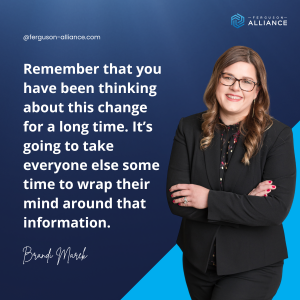 Brandi: You definitely want to take your time with this. You’ve been sitting with it for a long time, whether intentionally or not. Make sure everyone has time to catch up and reflect, and make sure you’re talking to the right people and considering their feedback.
We can’t think of every scenario. Someone else in the organization might think of something you didn’t.
Think about who you’re getting involved, why it matters, and what your messaging is going to be. Then lay out your plan.
Also think through different paths or scenarios based on situations or timing. This might be a 15-year plan, but if a trigger event puts it into motion in three years, the plan might look different.
Rob: Communicating a succession plan to all stakeholders is extremely important, but you have to have a plan for it. It has to be thoughtful, in writing, and designed around your different stakeholder groups: close family, extended family, employees, advisors, and customers. It’s not the same message for each group.
We build a communication matrix, with stakeholders across the top and topics down the side. Then we use three measures. On this topic, with this group, are we going to be fully transparent, measured in what we share, or not share it at all? Not all information needs to go to every stakeholder.
Once your messaging is down, you can execute the communication plan. Sequencing, prioritizing, and messaging appropriately are critical.
How does Ferguson Alliance’s work fit alongside estate planning attorneys, tax professionals, and wealth advisors?
Rob: Each professional advisor attacks the problem from their own perspective. A tax advisor thinks about how to transition wealth in the most tax-efficient way. An attorney thinks about legal compliance and maximizing value in a transaction.
Our role at Ferguson Alliance is to quarterback or facilitate the team. We aren’t wealth advisors, tax planners, or attorneys. We guide families on how to best develop and implement their plans, working alongside their existing advisors, or referring professionals from our network when needed.
Brandi: The biggest differentiator is that we understand how nuanced these situations are, particularly the relationship and family components. We help navigate those choppy waters, so the wealth advisors and tax attorneys know exactly what their target is.
Until they know the target, it can cost a ton of money trying to make headway without clear direction.
For a family that works through all of this and gets a plan in place, what changes?
Rob: The big change is clarity and alignment. Clarity of purpose, and alignment of direction.
Think about the father I mentioned earlier, the one who was initially resistant. He became highly engaged. He spent weeks writing an introductory letter for the family constitution, outlining his purpose of bringing the business to future generations and passing down their legacy and values. When he read that letter at a family meeting, his children were emotionally connected to it.
On the other side of this, everyone gets clarity on their role and alignment on the direction. Ultimately, there’s more harmony in the family.
Brandi: You also learn facilitation and communication skills in the process. And you learn that some things can’t be DIY’d. Even AI can’t solve these issues, because you don’t know what you don’t know. Having an outside perspective and experienced resources reassures you through the process.
Rob: AI stands for artificial intelligence, not artificial emotion. It has a brain, not a heart. This work is emotional, and it requires human contact to facilitate difficult conversations.
Brandi: Exactly. More important than the plan itself is the process of going through it. Anyone can ask AI to write a succession plan. But you miss out on uncovering hidden emotional issues, discovering blind spots, and building stronger relationships. You have to have those strategic conversations to make the plan effective.
What’s one thing you’d tell a next-gen family member who’s stuck waiting, or a parent who’s been avoiding succession planning?
 Rob: Don’t wait. If you’ve been delaying, you’re already late. Excuses are just pushback covering deeper issues that need attention.
Also remember that succession planning isn’t a one-and-done deal. It should be reviewed and updated every couple of years.
Brandi: Avoidance doesn’t fix the problem. Things aren’t going to change just because you defer them. One honest conversation is much easier than sitting in ambiguity for years. Avoid avoidance as much as you can.
Price: The succession planning process isn’t something you can avoid or delay. It involves challenging conversations, but it protects your business, your employees, and your customers from unexpected life events. It’s important to surround yourself with advisors who can help you navigate the taxes, wealth, law, and human emotions involved.
If you’re a family business owner who’s been putting this off, or a next-gen family member who isn’t sure how to start, reach out to us, or check out our Family Business Succession Guide.
Family business is hard. We can help.
How we can help
- Align your family and business around a clear strategy
- Set up governance and a board so decisions get made
- Plan a smooth succession and transition to the next generation
- Build a leadership team that can run the business without owner-dependence
- Improve operations and financial performance
Whether you're looking to scale, strengthen leadership, or plan your transition, we'll help you build a business that lasts for generations.
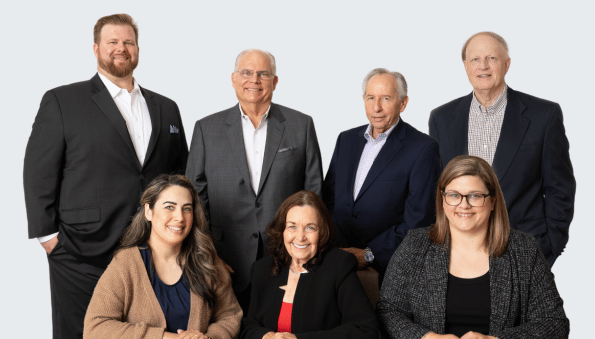
When your family and your business are aligned, everyone wins.
More insights on starting the succession conversation, the three conversations inside it, and bringing your family and team along
Family Business Succession Guide and Checklist
A free guide and checklist you can work through as a family, covering everything from choosing a successor to planning for the unexpected.
What Is a Succession Plan? What Goes into a Succession Plan?
Breaks down the three separate conversations inside succession planning (leadership, ownership, and wealth) and why separating them makes the whole subject feel less overwhelming.
The Prosperity Playbook: A Conversation on Succession Planning
An earlier episode of The Prosperity Playbook, where Rob, Brandi, and Jan Southern work through the case of a founder whose son decides he doesn’t want to take over.
The Emotional Work of Family Business Succession Planning
Rob shares the midnight call from a client who had just sold his business, and why succession planning has to deal with identity and fear, not just the transaction.
Leaving a Legacy, Not a Mess
Rob’s talk on why every owner exits someday, and how planning early lets you leave on your own terms instead of letting circumstances decide.
What Happens to Your Business If You Can’t Show Up Tomorrow?
Why so much of an owner’s net worth is tied up in the business, and how to get it ready to keep running (or sell for what it’s worth) if you have to step away.
When Your Child Doesn’t Want to Take Over the Family Business
Brandi on the moment a son or daughter who was always expected to take over says they want something else, including her own experience of saying it.
Engaging Your Team in the Family Business Succession Process
Brandi’s four tips for bringing your team along once a succession plan starts moving, from giving people time to absorb it to building a bench for the long game.
What Is a Family Constitution?
Rob explains how a family constitution spells out how succession will be handled, including the founder’s letter that often opens it.
Surviving Succession: Navigating the Transition of Family Businesses
Why the answer to “when should we start succession planning?” is always now, and the three-phase process that follows.
Free Family Business Succession Guide and Checklist
Many owners are surprised that a succession plan touches almost every part of the business and the family.
In this e-book, we outline everything you need to create a succession plan that sets your family up for generations.
- A breakdown of the 3 separate transitions you need to plan for:
- Succession of wealth
- Succession of ownership
- Succession of leadership
- A full checklist of everything you need to do and prepare
- Explanations of the process and definitions of common succession planning terms
- Answers to frequently asked questions about succession planning
If you're struggling to create a succession plan or wondering where to start, we created this guide for you.
Enter your email address below and we'll send you a copy.
~ Rob