


Family business is hard. And we hear these kinds of things all the time from business owners:
- “We’re not profitable enough.”
- “We’re constantly putting out fires.”
- “There’s no time to actually work on the business. We’re so busy in the business.”
- “We’ve grown, but our systems and processes haven’t kept up.”
- “We can’t find good people.”
In our opinion, these symptoms have very little to do with how well the business is being operated. As a business grows, it introduces complexity.
Growth can open up a wound or expose weaknesses in a business. What used to work stops working when you’re growing.
Most family businesses fail from a lack of structure, not from a lack of hard work and effort.
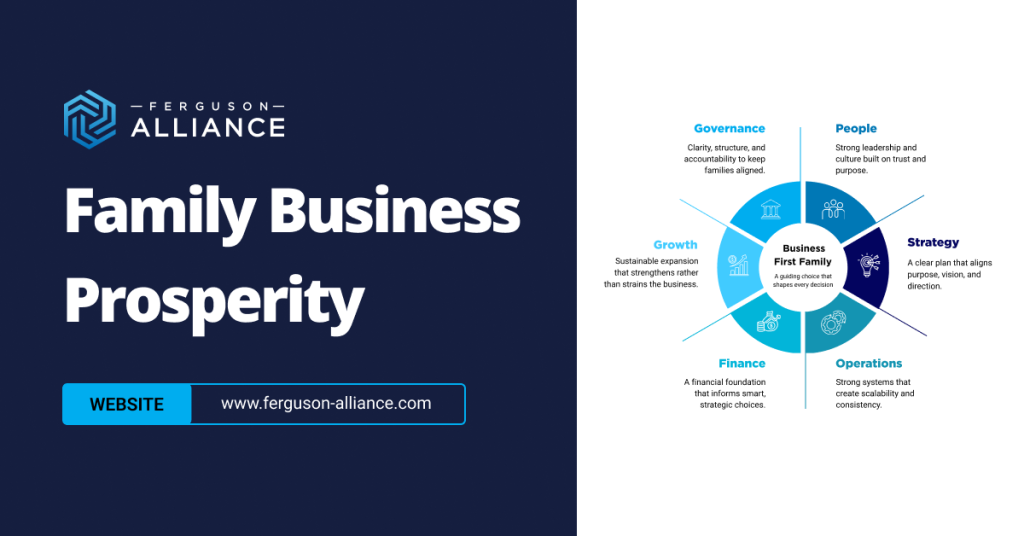
The solution is something we call the Family Business Prosperity Model. It’s designed to give your family business the structure it needs to thrive.
You can watch the video below, or scroll down to read the full edited transcript.
Most Family Businesses Fail From a Lack of Structure
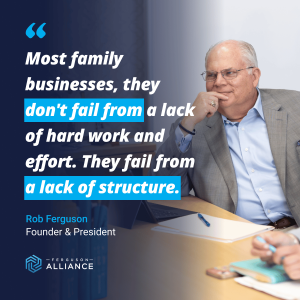 Most family businesses fail from a lack of structure, not from a lack of hard work and effort.
That’s what I want to talk about today. I want to introduce the idea of our prosperity model, the model that gives your family business structure.
This model answers a very practical question: what does it take for my family business to survive across many generations?
Business is hard. And we hear these kinds of things all the time from business owners:
- “We’re not profitable enough.”
- “We’re constantly putting out fires.”
- “There’s no time to actually work on the business. We’re so busy in the business.”
- “We’ve grown, but our systems and processes haven’t kept up.”
- “We can’t find good people.”
We hear this daily.
Growth Exposes Weaknesses a Smaller Business Could Absorb
In our opinion, these symptoms have very little to do with how well the business is being operated. As a business grows, it introduces complexity.
Growth can open up a wound or expose weaknesses in a business. What used to work stops working when you’re growing.
You start concentrating your risk on customers. Eventually the founder realizes they’re stuck in the center of the hub of decision making, and that the business depends more on them than it should.
What that business owner thought was going to give him freedom, because of growth, actually put him deeper into the hub of the decision wheel.
Then You Add the Dynamics of Family
I think that’s true for all businesses. But then you throw the dynamics of family into it and it becomes harder.
You start getting business disagreements. You’ve got different personalities coming in. You’ve got your relationship from back when you were 10 years old with your cousin. All of that starts influencing your business decisions.
Some of the common symptoms we see:
- Family members in a job they’re not qualified for
- No lines of authority
- Everybody wanting to make every decision consensually
- Non-family talent leaving
- Endless, circular conversations about strategy that never produce anything
This is where we think family businesses actually stall out.
Fewer Than 3% of Family Businesses Make It Through a Fourth Generation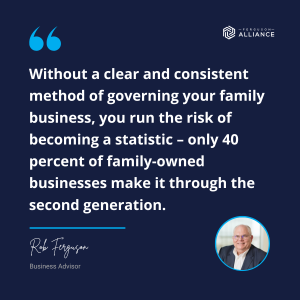
Most business owners we talk with want their business to last for many generations. They have that huge aspiration.
The research and the statistics tell us something quite different.
Only 40% of businesses actually make it through the second generation. Only about 12% get all the way through the third.
So by the time you get to the fourth generation, it’s less than 3%.
And a fifth generation business, in business over a hundred years? Those are very unique and hard to find. That’s a fraction of a percent.
Every Business Moves Through a Known, Predictable Life Cycle
Businesses go through a life cycle. It’s known and predictable, and it occurs over time and over the growth of the business.
We can map that out. We can map it from the very beginning when a business is a startup, and watch over time and over growth where it plots out on this curve.
Most businesses start off family first. It’s usually a husband and wife, or two brothers, or an uncle and a nephew starting an idea. It’s a startup. It’s a little seedling. That business is there to basically provide an income for those family members.
Then the business starts becoming a little more mature. It gains some traction in the market. It’s selling more products, hiring people.
And all of a sudden growth becomes very important.
When growth starts coming into that business at that particular point in the life cycle, it can overshadow structural issues. The business has to be very flexible. You’re taking orders you don’t really want to take, but you need them to help manage your cash flow.
The same thing starts happening with your business philosophy. All of a sudden you have employees now, no longer just family members. You’re constantly balancing what the family wants against what the business needs.
The Inflection Point: The Needs of the Business or the Wants of the Family?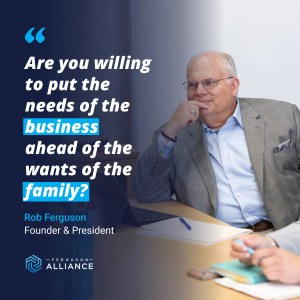
As the business continues on its growth cycle, it runs into what I’ll call an inflection point. That’s where we’re trying to decide what to put first as a priority: the needs of the business, or the wants of the family.
Many times that decision gets kicked down the road, gets ignored, or never gets declared.
When that happens, that’s what we call premature death of the business. It falls off the life cycle, because the business is outgrowing the capabilities of the owners. It isn’t allowing additional structure to come into the business to help keep it inside the guard rails.
Reaching the Prosperity Zone
If you want a business to survive long term, I believe you have to start putting the needs of the business ahead of the wants of the family.
You also have to begin putting more structure in balance with the entrepreneurial, flexible spirit of the business.
Once you have flexibility and structure in equilibrium, and you’ve made a conscious choice to have a business-first discipline, you’ve reached what we call the prosperity zone. And you commit to it.
That is how we see family businesses moving through their life cycle, one generation after the next.
One Decision and Six Fundamentals
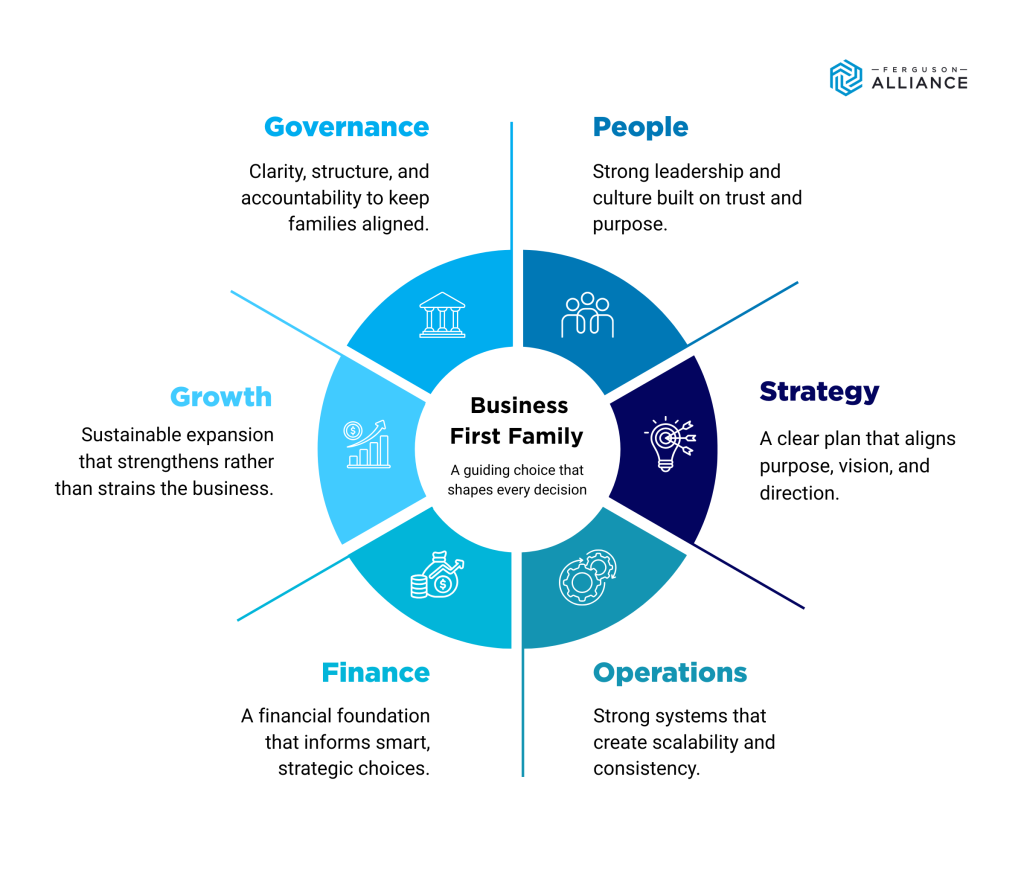
The good news is that family businesses can live past many generations. If you adopt that model and those best practices, I think that can be true for you as well.
We’ve spent quite a bit of time with family businesses and we’ve studied them. We’ve realized there’s a pattern, a pretty clear pattern for us, and that’s how we came up with our prosperity model.
There’s one foundational decision that has to be made, and it’s that question: are we a business-first family, or a family-first business?
Once that decision is made, everything else is anchored right into it. Then you start designing and developing your best practices in what we call the six fundamentals: governance, people, strategy, operations, finance, and growth.
These six areas form the operating system of a prosperous family business.
When they’re aligned and working, the business becomes strong and long-lasting and durable. When they’re weak, the business becomes dependent on the founder. You can only scale as much as that founder can scale.
Most businesses focus on only a couple of these areas. They’ll probably excel in some of them, but that isn’t good enough. You have to strengthen all six to have generational succession in place.
Business-First Shows Up in How Decisions Actually Get Made
The decision around being a business-first family is something you shouldn’t take lightly.
It’s how decisions are made. It’s who gets promoted, who gets hired, how compensation works, and who makes decisions, whether they’re family members or not.
A philosophy statement on the wall of the meeting room is a different thing entirely. So is a value statement.
If you find that the family’s needs are constantly overriding your business needs, then you probably have a family-first business. That might last you for quite a while, but it won’t last you for multiple generations.
Governance: How Decisions Get Made When the Owner Isn’t in the Room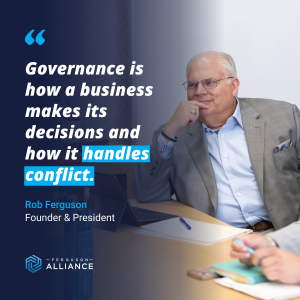
Let’s take a look at these six fundamentals a little deeper. I like to start with governance.
Governance always sounds corporate or formal or bureaucratic when I first introduce it with our clients. It’s simpler than that.
Governance is about how decisions get made and how conflicts get resolved, particularly when the boss isn’t in the room and the owner isn’t present.
Healthy governance makes it very clear who owns what decisions, what the levels of authority are, and what the philosophy is around making decisions. It separates decision making between ownership, management, and family roles.
Without governance, families default to consensual decision making. I see it all the time, and it isn’t good for businesses. You can never agree on everything.
Or they go democratic and political. They want to vote on everything, and that doesn’t work either. It just slows everything down.
Decision making is critical, and how you handle conflict is critical. That’s governance.
People: Put the Role Before the Relationship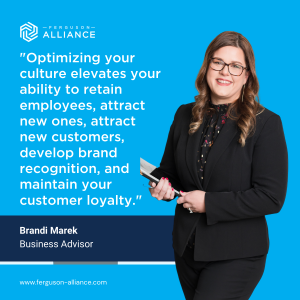
One of the strengths of a family business is the family values and the culture. That’s what helps these businesses live longer than a non-family business.
However, family members tend to ignore some key principles between family members and non-family members.
You’ve got to put the role before the relationship with your family member. You want to make sure the capability and competency are there for that particular job. That has to come before the title is given to them.
Leadership isn’t inherited. It’s trained. It’s acquired. It’s learned.
If you get these principles right, the next generation doesn’t need to be protected from the difficulty of progressing up the ladder in a business. They can start on the warehouse floor and work their way up to an executive role over a 10-year period.
They need that experience. They need preparation, not protection.
When standards are equal for family and non-family members, the level of trust increases across the organization and accountability gets stronger than ever before.
Strategy: Where Are We Going, How Do We Win, and What Do We Say No To?
Strategy answers three simple questions.
Where are we going? How are we going to win? And what do we say no to?
That last one is sometimes the hardest thing.
Strategy only works when everybody knows what it is and can explain it in their own words, not read it off a piece of paper on the wall.
Strategy also has to live somewhere other than the owner’s head.
If it’s only in the owner’s head, what you’ve got is a hope and an aspiration. It’s a dream the owner has that’s never going to come to reality.
Operations: The Bridge Between Strategy and Results
All right, here’s the secret sauce.
Operations is the bridge between strategy and results. We see a lot of businesses forget that. They skip it.
Why? Because that’s the operating system.
Most businesses have a vision. They have their values and their mission. They have their aspirational goals and their strategic intents laid out. And now they want to jump immediately to getting it done. “Let’s make it happen.”
But you need a sound operating model in place first. One that articulates in writing:
- What your workflows are
- What your standards of excellence are
- What your decision philosophy and decision-making cadence are going to be
- What meeting rhythms you have
- What clear accountabilities you have to operate in
Without those, you’re going to struggle mightily to keep execution aligned with strategy.
So that’s the secret sauce. Operating systems are how strategic intent survives the founder.
Finance: Accounting Tells You What Happened. Finance Tells You What to Do.
Finance gets confused with accounting way too many times.
Accounting tells you what happened. Finance tells you what you’re going to do.
When finance is working properly, the business can make better decisions without the owner present, because you’re making fact-based decisions and you have good forecasts in place built on thoughtful risk analysis.
This is a critical step, in my opinion, to have sustainable growth.
No matter what’s going on in the economy or in your industry, you just choose not to participate in those external events. You have an operating model, you have a strategy, and you have finance systems in place that allow you to get through those difficult times.
Growth: If It Requires the Owner to Execute It, It Isn’t Healthy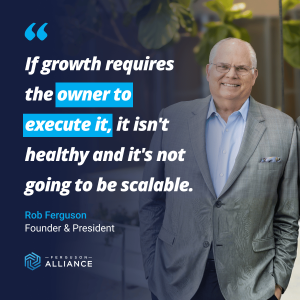
The last one is a result of everything else, which is growth. I know everybody likes to grow.
There are two types of growth. There’s healthy growth and there’s unhealthy growth.
Healthy growth improves your margins. It builds competency and capacity in your leadership team. It reduces the business’s dependency on the founder.
Unhealthy growth is the opposite. It makes things more complex. It increases the workload on the founder. And it overshadows or hides your system failures and the structural problems you have.
So a good rule of thumb around growth: if growth requires the owner to execute it, it isn’t healthy and it isn’t going to be scalable.
One Question, One Philosophy, Six Fundamentals
So that’s it. One question, one philosophy, six fundamentals.
Prosperity is simple. It isn’t mysterious. But it certainly isn’t easy.
The decision sets the direction. The fundamentals build the structure.
When both of those are in place, the family business can thrive across multiple generations.
Where Does Your Family Business Stand Right Now?
If some of the symptoms at the top of this piece sounded familiar, the useful next step is finding out which of the six fundamentals is actually holding you back.
Take the Prosperity Score Assessment
It’s a quick self-assessment that shows how your family business is performing across the one decision and six fundamentals, and where the biggest opportunity for your next move might be.
More on the One Decision, the Six Fundamentals, and Where Your Business Sits on the Curve
Will You Be a Business-First Family?
A short video on the one foundational question, built around two fifth-generation businesses of the same age and size that ended up on completely opposite trajectories.
The Family Business Lifecycle: Where Is Your Business? Where Is It Headed?
The full curve, from seed and sapling through Prime, Middle-Age, Senior, and Twilight, and what a business looks and feels like at each stage.
What is Family Business Governance? Busting Common Myths
What governance actually means, once you get past the assumption that installing it will depersonalize your business or cost you control.
Managing Talent in a Family Business: 7 Challenges and 4 Solutions
The seven talent problems that show up when family and non-family employees work side by side, including the glass ceiling non-family staff hit as the business grows.
Why Strategic Planning is Crucial for Your Family Business
The difference between a strategic plan and a documented habit of opportunistic growth, which is what most owners actually have when they say they have a plan.
System for Managing: The 5 Phases of Effective Business Management in Family Enterprises
The five-phase system that turns strategic intent into an operating rhythm, and how it differs from the management systems you already have in place.
What’s the Difference Between Accounting and Finance?
A closer look at where accounting ends and finance begins, and the blind spots that open up when one person is doing both jobs.
Key Insights for Growing Your Family Business
Eight keys to growing a family business, including the growth trap, the constraints that cap how fast you can move, and how to tell strategic growth from opportunistic growth.
From Solo Pilot to Mission Control: Building a Business That Runs Without You
What it takes to build a business that keeps running when you’re not in it, starting with the question of what would break if you disappeared for 90 days.